Close Menu
TechCentralTechCentral

    Subscribe to the newsletter

    Get the best South African technology news and analysis delivered to your e-mail inbox every morning.

    Facebook X (Twitter) YouTube LinkedIn
    WhatsApp Facebook X (Twitter) LinkedIn YouTube
    TechCentralTechCentral
    • News
      Anthropic eyes $200-billion in revenue by 2028

      Anthropic eyes $200-billion in revenue by 2028

      15 August 2026
      Workday

      Silver Lake said to be in talks to buy Workday

      15 August 2026
      Icasa retracts collusion claim against mobile operators

      Icasa retracts collusion claim against mobile operators

      14 August 2026
      South Africa's next broadband war may be won by a bank - Capitec

      South Africa’s next broadband war may be won by a bank

      14 August 2026
      Bank robberies, ATM bombings collapse as criminals go digital

      Bank robberies, ATM bombings collapse as criminals go digital

      14 August 2026
    • World
      Russia building its own Starlink - and faster than expected - Vadym Skibitskyi

      Russia building its own Starlink – and faster than expected

      11 August 2026
      Meta AI will now tell parents if their teen is in crisis

      Meta AI will now tell parents if their teen is in crisis

      17 July 2026
      IBM shares crash 25% as AI upends software spending - Arvind Krishna

      IBM shares crash 25% as AI upends software spending

      15 July 2026
      Jony Ive's first OpenAI device: an AI smart speaker - Jony Ive and Sam Altman

      Jony Ive’s first OpenAI device: an AI smart speaker

      15 July 2026
      Stripe, Advent in talks to buy PayPal for $53-billion

      Stripe, Advent in talks to buy PayPal for $53-billion

      15 July 2026
    • In-depth
      Google DeepMind CEO Demis Hassabis. Image: John Sears

      The plan to stop AI from breaking the world

      16 July 2026
      The internet has a Strait of Hormuz problem

      The internet has a Strait of Hormuz problem

      15 July 2026
      AI boom sparks rally, frenzy and fear

      AI boom sparks rally, frenzy and fear

      11 June 2026
      Every plug-in hybrid on sale in South Africa, ranked by price - Lamborghini Temerario

      Every plug-in hybrid on sale in South Africa, ranked by price

      7 June 2026
      What Wi-Fi 8 will mean for wireless networks

      What Wi-Fi 8 will mean for wireless networks

      1 June 2026
    • TCS
      Meet the CIO | Discovery's Derek Wilcocks on AI, guardrails and growth

      Meet the CIO | Derek Wilcocks on how AI personalised Vitality

      13 August 2026
      TCS | Money just became native to the internet - Steven Boykey Sidley

      TCS | Money just became native to the internet – Steven Boykey Sidley

      12 August 2026
      TCS+ | Specops' Darren James on continuous trust in an AI world

      TCS+ | Specops’ Darren James on continuous trust in an AI world

      7 August 2026
      TCS+ | How AI is turning hardware into a subscription service - Shane van der Merwe Merchant West

      TCS+ | How AI is turning hardware into a subscription service

      6 August 2026
      TCS+ | Why South African workers must become supervisors of digital labour - Accelera Digital Group Cliff de Wit

      TCS+ | Why South African workers must become supervisors of digital labour

      31 July 2026
    • Opinion
      The author, Jannie van Zyl

      Selling vapour is corporate suicide in slow motion

      16 July 2026
      Brazil's online gambling crackdown is a lesson for South Africa

      How Amazon outmanoeuvred Starlink in South Africa

      15 July 2026
      The Popia problem with agentic AI - Herman Haasbroek

      The Popia problem with agentic AI

      14 July 2026
      The author, Fanie van Rooyen

      South Africa can still catch the AI wave – here’s how

      7 July 2026
      The author, Fanie van Rooyen

      The AI utopia South Africa can’t afford

      1 July 2026
    • Company Hubs
      • 1Stream
      • Africa Data Centres
      • AfriGIS
      • Altron Digital Business
      • Altron Document Solutions
      • Altron Group
      • Arctic Wolf
      • Ascent Technology
      • AvertITD
      • BBD
      • Braintree
      • CallMiner
      • CambriLearn
      • CM Telecom
      • Contactable
      • CYBER1 Solutions
      • Digicloud Africa
      • Digimune
      • Domains.co.za
      • ESET
      • Euphoria Telecom
      • HOSTAFRICA
      • Incredible Business
      • iONLINE
      • IQbusiness
      • Iris Network Systems
      • Kaspersky
      • LSD Open
      • Mitel
      • NEC XON
      • Netstar
      • Network Platforms
      • Next DLP
      • Ovations
      • Paracon
      • Paratus
      • Q-KON
      • SevenC
      • SkyWire
      • Solid8 Technologies
      • Telit Cinterion
      • Telviva
      • Tenable
      • Vertiv
      • Videri Digital
      • Vodacom Business
      • Vox
      • Wipro
      • Workday
      • XLink
    • Sections
      • AI and machine learning
      • Banking
      • Broadcasting and Media
      • Cloud services
      • Contact centres and CX
      • Cryptocurrencies
      • Education and skills
      • Electronics and hardware
      • Energy and sustainability
      • Enterprise software
      • Financial services
      • HealthTech
      • Information security
      • Internet and connectivity
      • Internet of Things
      • Investment
      • IT services
      • Lifestyle
      • Policy and regulation
      • Public sector
      • Retail and e-commerce
      • Satellite communications
      • Science
      • SMEs and start-ups
      • Social media
      • Talent and leadership
      • Telecoms
      • Watts & Wheels
    • Events
    • Advertise
    TechCentralTechCentral
    Home » In-depth » The iCEO has left the building

    The iCEO has left the building

    By Editor25 August 2011
    Twitter LinkedIn Facebook WhatsApp Email Telegram Copy Link
    News Alerts
    WhatsApp

    There are plenty of reasons why Steve Jobs is one of the most recognised personalities in business. But chief among them is the fact that he’s credited with having saved Apple and then turning it into the most valuable technology company in the world. The journey to the top hasn’t always been smooth, however.

    Jobs dropped out of Portland’s Reed College before graduating, going on to found Apple with Steve Wozniak and the older Ronald Wayne in the late 1970s. The company’s first real success came with the Apple II series, the first mass-produced range of personal computers.

    Many credit Jobs with pushing Apple to create a graphical user interface (GUI) — others say the company stole it from Xerox — and incorporating it in the Macintosh computer in 1984. The Mac made personal computing far more accessible to ordinary consumers — it was less threatening and so far more appealing.

    A year later, Jobs lost a power struggle with CEO John Sculley — who he’d hired from Pepsi — and was fired (the official line was he resigned). It would prove to be the biggest mistake the company ever made.

    Jobs moved on and started Next — later known as NeXT — that designed and manufactured computer systems for education and business applications, but became better known for its programming platform, OpenStep. The software, along with another of NeXT’s products, WebObjects, became so well known that Apple bought the company in December 1996 for US$429m plus equity.

    OpenStep would go on to form the basis of Apple’s Mac OS X operating system, with Jobs returning first as temporary CEO, replacing Gil Amelio who had engineered the NeXt acquisition. In 1997, he returned to the company’s helm. At the time Apple was in desperate financial trouble. Its operating system was ageing and its computers weren’t keeping pace with the growing popularity of PCs running Microsoft Windows.

    Then came the iMac, Jobs’s first attempt at reinvigorating the Mac and making it cool and desirable again among consumers. Its radical design — colourful, bubble-shaped machines — caught the world’s imagination. PCs were seen as grey and dull. The iMac changed the popular view that computers were boring and more than a little intimidating.

    The iMac introduced the “i” in Apple product nomenclature. It was meant to refer to both “Internet” and “individual”, the latter eventually a target for ridicule from Apple detractors who often claimed that Apple’s design tends to be so minimalist you can’t tell its products apart.

    Despite the good reception, the iMac remained a niche product, particularly because of the dominance of Microsoft in the 1990s in both the home and business markets.
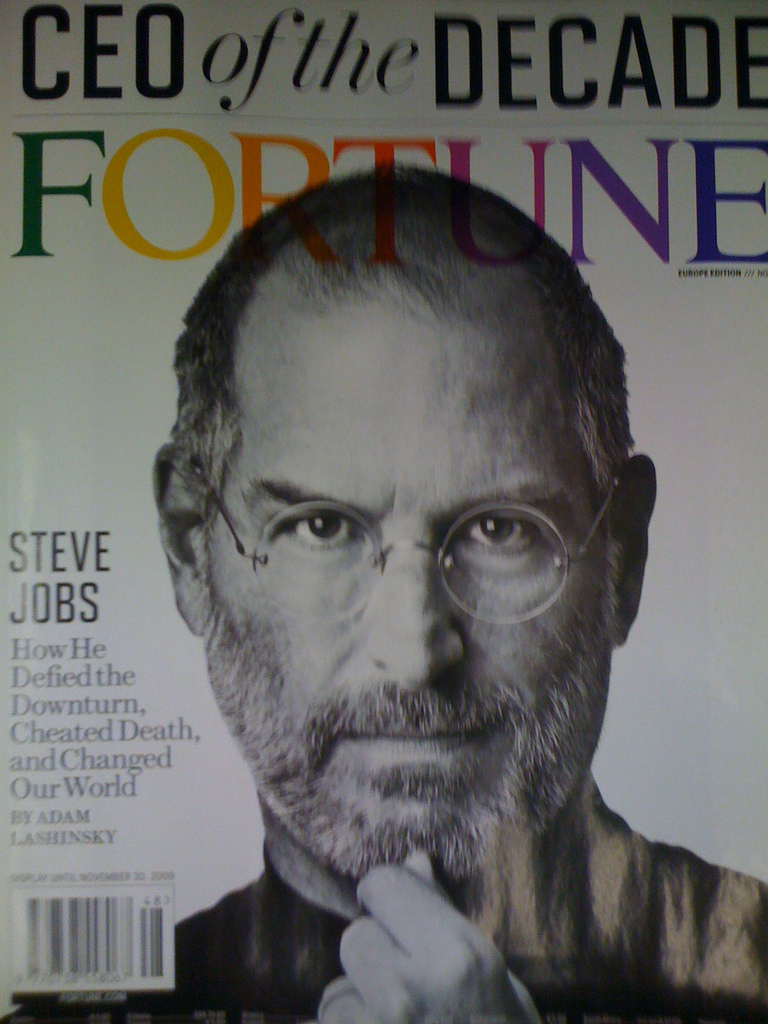
    Fortune magazine named Steve Jobs CEO of the decade in 2009

    It wasn’t until the iPod was introduced in 2001 that Apple’s fortunes really began to take off again. The portable music player would turn Apple into a consumer electronics giant and cement Jobs’ place in the annals of technology history. He’s known for his hyperbole, when he said shortly after the iPod’s launch that it would “go down in history as a turning point for the music industry” he wasn’t wrong. “This is landmark stuff. I can’t overestimate it,” he said at the time.

    In the process, Apple took the portable music player market from Sony, which had dominated in an earlier era with the Walkman.

    Since its launch, Apple has sold more than 200m iPods and the company has gone on to become the world’s biggest retailer of music through the iTunes store.

    Jobs has been such a success not only because of the manner in which he has shifted Apple’s focus over the years, and his role in encouraging the company to move into consumer electronics and music distribution — and then into mobile devices and applications — but because he bridged the gap between engineers and developers on one hand, and marketers and designers on the other.

    Earlier this week, news emerged that Korea’s Samsung Electronics, a fast-growing Apple rival, was disputing a patent infringement lawsuit against it on the grounds that the US company had stolen the idea for the iPad from imaginary devices featured in Stanley Kubrick’s 2001: A Space Odyssey.

    Though it’s a bizarre argument, and one unlikely to succeed in court on account of the precedent it would set and the floodgates it would open, it underscores an important point: Apple’s industrial design is extraordinary. Or as some might argue, so good that it’s difficult to better.

    Further support for this argument comes from the relative lack of product diversity in the Apple product line-up. On the back of just a few products — the iPhone, Mac computers, the iPad and the iPod — Apple has become the most valuable technology company in the world.

    Just as Apple has its critics, so too does Jobs. The company’s opponents cite the company’s closed ecosystem, draconian control of content and applications in its online stores and insistence on proprietary connectors and accessories for the bulk of its products as reasons to loathe both the company and the man.

    An early file photo of Steve Jobs

    It may have detractors, but in purely financial terms it’s hard to fault the company. For the most part, consumers love its products and appreciate its online services.

    From the iPod to the iPad 2, ease of use combined with clever industrial design has seen Apple products enjoying favour with people in an expandinge range of sectors and across the age groups. Its products are considered expensive, but then no one has yet said of a piece of Apple kit that it’s poorly made. Still, Apple is an aspirational brand but that is an important lesson the company has taught its competitors: if it’s great enough, people will pay. And they’ll do so in their millions.

    Neither Jobs nor Apple are beyond reproach. The company has been accused of worker exploitation, taken to task for poor battery life and reliability in early generations of the iPod, chastised for its lack of willingness to license third parties to make accessories, criticised because of its lack of electronic waste management programmes and the high prices of its products.

    Jobs, meanwhile has been accused of everything from being a megalomaniac and dictator to being a slave driver and a callous capitalist uninterested in corporate social responsibility, charity or philanthropy in general. Bloomberg also once reported he was dead when it accidentally ran a prepared obituary. He denied the allegation, which understandably settled the matter.

    Despite the criticism, there’s no denying that he’s became a titan of the technology industry. More than that, he’s one of its few genuine rock star personalities in business and the catalyst for many students who choose to study computer science or business.

    Like Microsoft co-founder Bill Gates and Facebook co-founder Mark Zuckerberg, Jobs has shown that those who want to change the world and make a fortune doing it should go into technology. He hasn’t just built an instantly recognisable brand, he’s built a business empire.

    It’s an empire that’s going to have to work hard to maintain its current dominance and the announcement that Jobs will continue to chair Apple’s board of directors should help reassure investors that the changing of the guard — long-serving chief operating officer Tim Cook is taking over as CEO — doesn’t represent the peak of Apple’s fortunes. The company’s share price outperformed the general market the day after the news of Jobs’s resignation broke, suggesting investors are confident in Cook’s ability to continue the growth story.

    Jobs is also a stark reminder of our own mortality. Despite calls to respect his privacy, his health has been a source of constant debate and speculation in recent years. It may finally have got the better of him. In stepping down, Jobs has displayed another attribute found in great leaders: they know when to call it a day.

    Steve Jobs’ 2005 Stanford Commencement Address (via YouTube):

    Jobs has been an uncompromising leader, a vocal advocate for matching form to function, a pioneer in the field of consumer electronics, an astute businessman, a trend predictor and at times the target of vitriol and derision.

    Under his leadership, Apple has generated hundreds of billions of dollars in shareholder value in a cutthroat industry.

    He once quipped he was the “iCEO”. It’s a fitting moniker for a man who has been responsible, however indirectly, for changing the face of the music industry, computers and the consumer electronics market.  — Craig Wilson, TechCentral

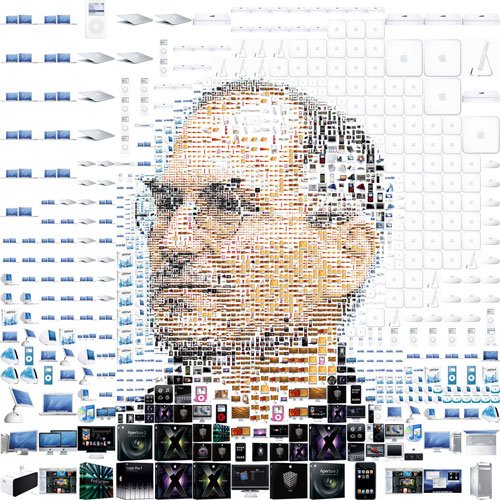
    • Top image mosaic: Tsevis (Creative Commons BY-NC-ND 2.0)
    • Subscribe to our free daily newsletter
    • Follow us on Twitter or on Facebook
    Follow TechCentral on Google News Add TechCentral as your preferred source on Google


    Apple Bill Gates Facebook Gil Amelio John Sculley Mark Zuckerberg Microsoft NeXT Pepsi Sony Stanley Kubrick Steve Jobs Tim Cook Xerox
    WhatsApp YouTube
    Share. Facebook Twitter LinkedIn WhatsApp Telegram Email Copy Link
    Previous ArticleVOD:TV: new details emerge
    Next Article Vodacom chases a slice of the app pie

    Related Posts

    Only a quarter of SA firms are running AI for real

    Only a quarter of SA firms are running AI for real

    12 August 2026
    Solly Malatsi stakes South Africa's AI future on staying neutral

    Solly Malatsi stakes South Africa’s AI future on staying neutral

    5 August 2026
    Microsoft just had the biggest day in stock market history

    Microsoft just had the biggest day in stock market history

    31 July 2026
    Company News
    Kaspersky on how to secure a supply chain you do not control

    Kaspersky on how to secure a supply chain you do not control

    13 August 2026
    Build or buy software? AI is rewriting the answer - BBD Software

    Build or buy software? AI is rewriting the answer

    12 August 2026
    Max zoom meets max speed with the new 5G Huawei Pura 90s series

    Max Zoom meets Max Speed with the 5G Huawei Pura 90s series

    11 August 2026
    Opinion
    The author, Jannie van Zyl

    Selling vapour is corporate suicide in slow motion

    16 July 2026
    Brazil's online gambling crackdown is a lesson for South Africa

    How Amazon outmanoeuvred Starlink in South Africa

    15 July 2026
    The Popia problem with agentic AI - Herman Haasbroek

    The Popia problem with agentic AI

    14 July 2026

    Subscribe to Updates

    Get the best South African technology news and analysis delivered to your e-mail inbox every morning.

    Latest Posts
    Anthropic eyes $200-billion in revenue by 2028

    Anthropic eyes $200-billion in revenue by 2028

    15 August 2026
    Workday

    Silver Lake said to be in talks to buy Workday

    15 August 2026
    Icasa retracts collusion claim against mobile operators

    Icasa retracts collusion claim against mobile operators

    14 August 2026
    South Africa's next broadband war may be won by a bank - Capitec

    South Africa’s next broadband war may be won by a bank

    14 August 2026
    © 2009 - 2026 NewsCentral Media
    Built and maintained by Chronon
    • Cookie policy (ZA)
    • TechCentral – privacy and Popia

    Type above and press Enter to search. Press Esc to cancel.

    Manage consent

    TechCentral uses cookies to enhance its offerings. Consenting to these technologies allows us to serve you better. Not consenting or withdrawing consent may adversely affect certain features and functions of the website.

    Functional Always active
    The technical storage or access is strictly necessary for the legitimate purpose of enabling the use of a specific service explicitly requested by the subscriber or user, or for the sole purpose of carrying out the transmission of a communication over an electronic communications network.
    Preferences
    The technical storage or access is necessary for the legitimate purpose of storing preferences that are not requested by the subscriber or user.
    Statistics
    The technical storage or access that is used exclusively for statistical purposes. The technical storage or access that is used exclusively for anonymous statistical purposes. Without a subpoena, voluntary compliance on the part of your Internet Service Provider, or additional records from a third party, information stored or retrieved for this purpose alone cannot usually be used to identify you.
    Marketing
    The technical storage or access is required to create user profiles to send advertising, or to track the user on a website or across several websites for similar marketing purposes.
    • Manage options
    • Manage services
    • Manage {vendor_count} vendors
    • Read more about these purposes
    View preferences
    • {title}
    • {title}
    • {title}