Close Menu
TechCentralTechCentral

    Subscribe to the newsletter

    Get the best South African technology news and analysis delivered to your e-mail inbox every morning.

    Facebook X (Twitter) YouTube LinkedIn
    WhatsApp Facebook X (Twitter) LinkedIn YouTube
    TechCentralTechCentral
    • News
      Digital authoritarianism grows as African states normalise internet blackouts

      Digital authoritarianism grows as African states normalise internet blackouts

      19 December 2025
      Starlink satellite anomaly creates debris in rare orbital mishap

      Starlink satellite anomaly creates debris in rare orbital mishap

      19 December 2025
      TechCentral's South African Newsmakers of 2025

      TechCentral’s South African Newsmakers of 2025

      18 December 2025
      Malatsi buries Post Office's long-dead monopoly

      Malatsi buries Post Office monopoly the market ignored

      18 December 2025
      China races to crack EUV as chip war with the West intensifies

      China races to crack EUV lithography as chip war with the West intensifies

      18 December 2025
    • World
      Trump space order puts the moon back at centre of US, China rivalry - US President Donald Trump

      Trump space order puts the moon back at centre of US, China rivalry

      19 December 2025
      Warner Bros slams the door on Paramount

      Warner Bros slams the door on Paramount

      17 December 2025
      X moves to block bid to revive Twitter brand

      X moves to block bid to revive Twitter brand

      17 December 2025
      Oracle’s AI ambitions face scrutiny on earnings miss

      Oracle’s AI ambitions face scrutiny on earnings miss

      11 December 2025
      China will get Nvidia H200 chips - but not without paying Washington first

      China will get Nvidia H200 chips – but not without paying Washington first

      9 December 2025
    • In-depth
      Black Friday goes digital in South Africa as online spending surges to record high

      Black Friday goes digital in South Africa as online spending surges to record high

      4 December 2025
      Canal+ plays hardball - and DStv viewers feel the pain

      Canal+ plays hardball – and DStv viewers feel the pain

      3 December 2025
      Jensen Huang Nvidia

      So, will China really win the AI race?

      14 November 2025
      Valve's Linux console takes aim at Microsoft's gaming empire

      Valve’s Linux console takes aim at Microsoft’s gaming empire

      13 November 2025
      iOCO's extraordinary comeback plan - Rhys Summerton

      iOCO’s extraordinary comeback plan

      28 October 2025
    • TCS
      TCS+ | Africa's digital transformation - unlocking AI through cloud and culture - Cliff de Wit Accelera Digital Group

      TCS+ | Cloud without culture won’t deliver AI: Accelera’s Cliff de Wit

      12 December 2025
      TCS+ | How Cloud on Demand helps partners thrive in the AWS ecosystem - Odwa Ndyaluvane and Xenia Rhode

      TCS+ | How Cloud On Demand helps partners thrive in the AWS ecosystem

      4 December 2025
      TCS | MTN Group CEO Ralph Mupita on competition, AI and the future of mobile

      TCS | Ralph Mupita on competition, AI and the future of mobile

      28 November 2025
      TCS | Dominic Cull on fixing South Africa's ICT policy bottlenecks

      TCS | Dominic Cull on fixing South Africa’s ICT policy bottlenecks

      21 November 2025
      TCS | BMW CEO Peter van Binsbergen on the future of South Africa's automotive industry

      TCS | BMW CEO Peter van Binsbergen on the future of South Africa’s automotive industry

      6 November 2025
    • Opinion
      Netflix, Warner Bros deal raises fresh headaches for MultiChoice - Duncan McLeod

      Netflix, Warner Bros deal raises fresh headaches for MultiChoice

      5 December 2025
      BIN scans, DDoS and the next cybercrime wave hitting South Africa's banks - Entersekt Gerhard Oosthuizen

      BIN scans, DDoS and the next cybercrime wave hitting South Africa’s banks

      3 December 2025
      Your data, your hardware: the DIY AI revolution is coming - Duncan McLeod

      Your data, your hardware: the DIY AI revolution is coming

      20 November 2025
      Zero Carbon Charge founder Joubert Roux

      The energy revolution South Africa can’t afford to miss

      20 November 2025
      It's time for a new approach to government IT spend in South Africa - Richard Firth

      It’s time for a new approach to government IT spend in South Africa

      19 November 2025
    • Company Hubs
      • Africa Data Centres
      • AfriGIS
      • Altron Digital Business
      • Altron Document Solutions
      • Altron Group
      • Arctic Wolf
      • AvertITD
      • Braintree
      • CallMiner
      • CambriLearn
      • CYBER1 Solutions
      • Digicloud Africa
      • Digimune
      • Domains.co.za
      • ESET
      • Euphoria Telecom
      • Incredible Business
      • iONLINE
      • IQbusiness
      • Iris Network Systems
      • LSD Open
      • NEC XON
      • Netstar
      • Network Platforms
      • Next DLP
      • Ovations
      • Paracon
      • Paratus
      • Q-KON
      • SevenC
      • SkyWire
      • Solid8 Technologies
      • Telit Cinterion
      • Tenable
      • Vertiv
      • Videri Digital
      • Vodacom Business
      • Wipro
      • Workday
      • XLink
    • Sections
      • AI and machine learning
      • Banking
      • Broadcasting and Media
      • Cloud services
      • Contact centres and CX
      • Cryptocurrencies
      • Education and skills
      • Electronics and hardware
      • Energy and sustainability
      • Enterprise software
      • Financial services
      • Information security
      • Internet and connectivity
      • Internet of Things
      • Investment
      • IT services
      • Lifestyle
      • Motoring
      • Public sector
      • Retail and e-commerce
      • Satellite communications
      • Science
      • SMEs and start-ups
      • Social media
      • Talent and leadership
      • Telecoms
    • Events
    • Advertise
    TechCentralTechCentral
    Home » In-depth » End of the line for Moore’s Law?

    End of the line for Moore’s Law?

    By The Conversation20 July 2015
    Twitter LinkedIn Facebook WhatsApp Email Telegram Copy Link
    News Alerts
    WhatsApp
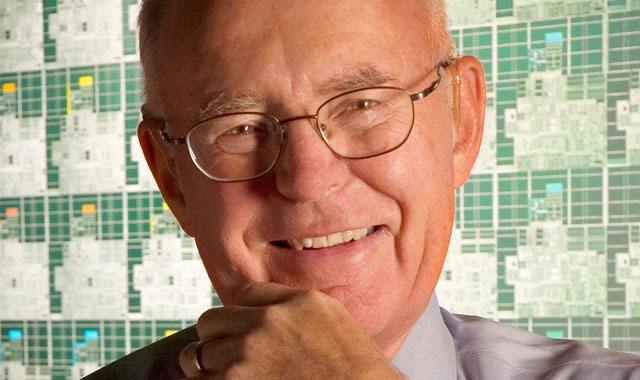
    Gordon Moore
    Gordon Moore

    It’s been 50 years since Gordon Moore, one of the founders of the microprocessor company Intel, gave us Moore’s Law. This says that the complexity of computer chips ought to double roughly every two years.

    Now the current CEO of Intel, Brian Krzanich, is saying the days of Moore’s Law may be coming to an end as the time between new innovation appears to be widening:

    The last two technology transitions have signalled that our cadence today is closer to two-and-a-half years than two.

    Moore’s Law has its roots in an article by Moore written in 1965, in which he observed the complexity of component development was doubling each year. This was later modified to become:

    The number of transistors incorporated in a chip will approximately double every 24 months.

    This rate was again modified to a doubling over roughly 18 months.

    In its 24-month guise, Moore’s Law has continued unabated for 50 years, with an overall advance of a factor of roughly 231, or two billion. That means memory chips today story around two billion times as much data as in 1965. Or, in more general terms, computer hardware today is around two billion times as powerful for the same cost.

    It is hard to comprehend Moore’s Law. Imagine airline technology advancing from 1965 to 2015 to travel nearly at the speed of light (almost 1,1bn kilometres per hour), yet capacious enough to contain the entire world’s population. Or imagine the cost of a jet airliner dropping from US$100m to $1. Yet even these analogies fall far short of a factor of two billion.

    Moore was originally embarrassed by his eponymous “law”. This is in part because it is not at all a law in the sense a law of physics, but instead merely an observation. But on the 40th anniversary, Intel was happy to celebrate it and Moore was pleased to note that it still seemed to be accurate.

    The end is nigh?
    A few months ago though, Moore observed:

    The original prediction was to look at 10 years, which I thought was a stretch […] The fact that something similar is going on for 50 years is truly amazing. […] But someday it has to stop. No exponential like this goes on forever.

    There have been numerous other predictions that Moore’s Law was soon to end.

    In 1999, physicist and bestselling author Michio Kaku declared that the “Point One barrier” (meaning chip features 0,1 micron or 100 nanometres in size) would soon halt progress.
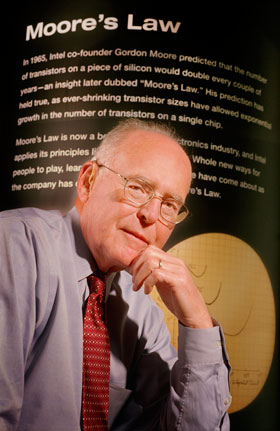
    Gordon Moore
    Gordon Moore

    Yet the semiconductor industry sailed through the 0,1 micron level like a jetliner passing through a wispy cloud. Devices currently in production have feature sizes as small as 10nm or 14nm, and IBM has just announced chip with 7nm features.

    By comparison, a helical strand of DNA is 2,5nm in diameter, thus commercial semiconductor technology is now entering the molecular and atomic realm.

    Not all is roses, though. By one measure — a processor’s clock speed — Moore’s Law has already stalled.

    Today’s state-of-the-art production microprocessors typically have 3GHz clock rates, compared with 2GHz rates five or 10 years ago — not a big improvement.

    But the industry has simply increased the number of processor “cores” and on-chip cache memory, so that aggregate performance continues to track or exceed Moore’s Law projections. There are many, many software challenges to make sure this remains relevant.

    Hewlett-Packard Laboratories is hard at work developing new approaches for microelectronics. Its nanotechnology research group has developed a “crossbar architecture”, a design where a set of parallel “wires” a few nanometres in width are crossed by a second set of “wires” at right angles. Where the “wires” intersect forms an electronic switch, which can be configured for either logic or memory storage use.

    It is also investigating nanoscale photonics (light-based devices), which can be deployed either for conventional electronic devices or for emerging quantum computing devices.

    Moore’s Law has been a great blessing to science and mathematics research. Modern laboratories are loaded with high-tech measurement and analysis devices, which become more powerful and cheaper ever year.

    In addition, a broad range of modern science, mathematics and engineering has benefited from Moore’s Law in the form of scientific supercomputers, which are used for applications as diverse as supernova simulation and protein folding to product design and the processing of microwave background radiation from the cosmos.

    Software running these computers has advanced abreast with Moore’s Law.

    For example, the fast Fourier transform algorithm, which is used extensively in scientific computation and magnetic resonance imaging, both involve substantial computation that would not be possible without Moore’s Law advances.

    It is not entirely coincidental that both of these algorithmic advances arose roughly 50 years ago, the same time Moore’s Law was first observed.

    Intel’s CEO, Brian Krzanich, said the company would “strive to get back to two years” for innovation to keep Moore’s Law on track.

    If Moore’s Law does continue for just two or three more decades, typical handheld devices may well exceed the human brain in intelligence. Some, such as author James Barrat, declare that artificially intelligent computers will be the “final invention” of mankind, after which humans may become irrelevant.

    We do not subscribe to such pessimism. Rather we see a promising future with scientific knowledge, among other things, increasing at an exponential rate.

    Time will tell. As physicist Richard Feynman wrote in 1959, referring to the potential for ever finer control of nature at the microscopic level, there still appears to be plenty of room at the bottom.The Conversation

    • Jonathan Borwein is laureate professor of mathematics at the University of Newcastle; David H Bailey is PhD, Lawrence Berkeley Laboratory (retired) and research fellow at the University of California, Davis
    • This article was originally published on The Conversation


    Brian Krzanich David H Bailey Gordon Moore Intel Jonathan Borwein Moore's Law
    Subscribe to TechCentral Subscribe to TechCentral
    Share. Facebook Twitter LinkedIn WhatsApp Telegram Email Copy Link
    Previous ArticleTalkCentral: Ep 130 – ‘Open-access fibre’
    Next Article Uncapped data, tablets for Gauteng schools

    Related Posts

    Signs of life at Intel

    Signs of life at Intel

    24 October 2025
    Intel fights back in the AI chip wars

    Intel fights back in the AI chip wars

    15 October 2025
    Panther Lake: the chip that Intel can't let fail

    Panther Lake: the chip that Intel can’t let fail

    8 October 2025
    Company News
    Why TechCentral is the most powerful platform for reaching IT decision makers

    Why TechCentral is the most powerful platform for reaching IT decision makers

    17 December 2025
    Business trends to watch in 2026 - Domains.co.za

    Business trends to watch in 2026

    17 December 2025
    MTN Zambia launches world's first 4G cloud smartphone solution - Huawei

    MTN Zambia launches world’s first 4G cloud smartphone solution

    17 December 2025
    Opinion
    Netflix, Warner Bros deal raises fresh headaches for MultiChoice - Duncan McLeod

    Netflix, Warner Bros deal raises fresh headaches for MultiChoice

    5 December 2025
    BIN scans, DDoS and the next cybercrime wave hitting South Africa's banks - Entersekt Gerhard Oosthuizen

    BIN scans, DDoS and the next cybercrime wave hitting South Africa’s banks

    3 December 2025
    Your data, your hardware: the DIY AI revolution is coming - Duncan McLeod

    Your data, your hardware: the DIY AI revolution is coming

    20 November 2025

    Subscribe to Updates

    Get the best South African technology news and analysis delivered to your e-mail inbox every morning.

    Latest Posts
    Digital authoritarianism grows as African states normalise internet blackouts

    Digital authoritarianism grows as African states normalise internet blackouts

    19 December 2025
    Starlink satellite anomaly creates debris in rare orbital mishap

    Starlink satellite anomaly creates debris in rare orbital mishap

    19 December 2025
    Trump space order puts the moon back at centre of US, China rivalry - US President Donald Trump

    Trump space order puts the moon back at centre of US, China rivalry

    19 December 2025
    TechCentral's South African Newsmakers of 2025

    TechCentral’s South African Newsmakers of 2025

    18 December 2025
    © 2009 - 2025 NewsCentral Media
    • Cookie policy (ZA)
    • TechCentral – privacy and Popia

    Type above and press Enter to search. Press Esc to cancel.

    Manage consent

    TechCentral uses cookies to enhance its offerings. Consenting to these technologies allows us to serve you better. Not consenting or withdrawing consent may adversely affect certain features and functions of the website.

    Functional Always active
    The technical storage or access is strictly necessary for the legitimate purpose of enabling the use of a specific service explicitly requested by the subscriber or user, or for the sole purpose of carrying out the transmission of a communication over an electronic communications network.
    Preferences
    The technical storage or access is necessary for the legitimate purpose of storing preferences that are not requested by the subscriber or user.
    Statistics
    The technical storage or access that is used exclusively for statistical purposes. The technical storage or access that is used exclusively for anonymous statistical purposes. Without a subpoena, voluntary compliance on the part of your Internet Service Provider, or additional records from a third party, information stored or retrieved for this purpose alone cannot usually be used to identify you.
    Marketing
    The technical storage or access is required to create user profiles to send advertising, or to track the user on a website or across several websites for similar marketing purposes.
    • Manage options
    • Manage services
    • Manage {vendor_count} vendors
    • Read more about these purposes
    View preferences
    • {title}
    • {title}
    • {title}