Close Menu
TechCentralTechCentral

    Subscribe to the newsletter

    Get the best South African technology news and analysis delivered to your e-mail inbox every morning.

    Facebook X (Twitter) YouTube LinkedIn
    WhatsApp Facebook X (Twitter) LinkedIn YouTube
    TechCentralTechCentral
    • News
      South Africa's ATM network faces its biggest overhaul in decades

      South Africa’s ATM network faces its biggest overhaul in decades

      16 October 2026
      The R77 000 iPhone has arrived in South Africa

      The R77 000 iPhone has arrived in South Africa

      16 October 2026
      Africa's mobile operators pay more for less spectrum, GSMA says

      Africa’s mobile operators pay more for less spectrum, GSMA says

      16 October 2026
      Netflix is losing the battle for your screen time

      Netflix is losing the battle for your screen time

      16 October 2026
      Safaricom control to stay with Vodacom until appeal

      Safaricom control to stay with Vodacom until appeal

      16 October 2026
    • World
      AI is now holding up the world economy, says IMF

      AI is now propping up the world economy, says IMF

      12 October 2026
      SpaceX takes aim at US wireless carriers with spectrum acquisition

      Starlink is coming for your mobile operator

      9 October 2026
      The AI PC is finally here. It's just very expensive - Jensen Huang, Satya Nadella

      The AI PC is finally here. It’s just very expensive

      8 October 2026
      The memory crunch is making Samsung fabulously rich

      The memory crunch is making Samsung fabulously rich

      8 October 2026
      SpaceX to borrow $40-billion to buy Nvidia chips

      SpaceX to borrow $40-billion to buy Nvidia chips

      7 October 2026
    • In-depth

      10 days that changed the course of AI

      21 September 2026
      Meta to the AI industry: slow down without us - Mark Zuckerberg

      Meta to the AI industry: slow down without us

      16 September 2026
      Google DeepMind CEO Demis Hassabis. Image: John Sears

      The plan to stop AI from breaking the world

      16 July 2026
      The internet has a Strait of Hormuz problem

      The internet has a Strait of Hormuz problem

      15 July 2026
      AI boom sparks rally, frenzy and fear

      AI boom sparks rally, frenzy and fear

      11 June 2026
    • TCS
      W&W | LDV's Gerhard Moolman on electric bakkies, fleet orders and 'school fees'

      W&W | LDV’s Gerhard Moolman on electric bakkies and fleets

      9 October 2026
      TCS | Frogfoot sees bigger fibre deals coming - TechCentral Show guests Abraham van der Merwe and Shane Chorley

      TCS | Frogfoot sees bigger fibre deals coming

      8 October 2026
      Meet the CIO | Vodacom's Mohamed Sami on the agentic future

      Meet the CIO | Vodacom’s Mohamed Sami on the agentic future

      5 October 2026
      Lexi Novitske, general partner at Norrsken22, on the TechCentral Show

      TCS | Norrsken22’s Lexi Novitske on how China is winning African tech

      1 October 2026
      TCS | Dominic White and Adam Ely on AI agents going rogue

      TCS | Dominic White and Adam Ely on AI agents going rogue

      29 September 2026
    • Opinion
      When a machine can choose, who does it become? Fanie van Rooyen

      When a machine can choose, who does it become?

      9 October 2026
      Let South Africans jailbreak their way to digital sovereignty - Dirk de Vos

      Let South Africans jailbreak their way to digital sovereignty

      5 October 2026
      South Africa's next energy crisis is in the accounts department - Craig Holmes

      South Africa’s next energy crisis is in the accounts department

      29 September 2026
      The steam engine lesson AI doomsayers keep missing - Sam Clarke

      The steam engine lesson AI doomsayers keep missing

      28 September 2026
      Let South Africans jailbreak their way to digital sovereignty - Dirk de Vos

      Regulating AI: apply the laws we have first

      21 September 2026
    • Company News
      • 1Stream
      • Africa Data Centres
      • AfriGIS
      • Altron Digital Business
      • Altron Document Solutions
      • Altron Group
      • Arctic Wolf
      • Ascent Technology
      • AvertITD
      • BBD
      • Braintree
      • CallMiner
      • CambriLearn
      • CM.com
      • Contactable
      • CYBER1 Solutions
      • Digicloud Africa
      • Digimune
      • Domains.co.za
      • ESET
      • Euphoria Telecom
      • HOSTAFRICA
      • Incredible Business
      • iONLINE
      • IQbusiness
      • Iris Network Systems
      • Kaspersky
      • LSD Open
      • Mitel
      • NEC XON
      • Netstar
      • Network Platforms
      • Next DLP
      • Ovations
      • Paracon
      • Paratus
      • Publishared
      • Q-KON
      • SevenC
      • SkyWire
      • Solid8 Technologies
      • Telit Cinterion
      • Telviva
      • Tenable
      • Vertiv
      • Videri Digital
      • Vodacom Business
      • Vox
      • Wipro
      • Workday
      • XLink
    • Sections
      • AI and machine learning
      • Banking
      • Broadcasting and Media
      • Cloud services
      • Contact centres and CX
      • Cryptocurrencies
      • Education and skills
      • Electronics and hardware
      • Energy and sustainability
      • Enterprise software
      • Financial services
      • HealthTech
      • Information security
      • Internet and connectivity
      • Internet of Things
      • Investment
      • IT services
      • Lifestyle
      • Policy and regulation
      • Public sector
      • Retail and e-commerce
      • Satellite communications
      • Science
      • SMEs and start-ups
      • Social media
      • Talent and leadership
      • Telecoms
      • Watts & Wheels
    • Events
    • Advertise
    TechCentralTechCentral
    Home » Editor's pick » Elon Musk and his mission to Mars

    Elon Musk and his mission to Mars

    By Editor7 May 2012
    Twitter LinkedIn Facebook WhatsApp Email Telegram Copy Link
    Get breaking news on WhatsApp

    Elon Musk with Falcon 9 at Cape Canaveral (image: SpaceX)

    It was bad SA television that gave Elon Musk part of his mysterious edge. As a 10-year-old he read whole volumes of the Encyclopaedia Britannica after emptying the family bookshelves — anything to avoid another episode of CHiPs or Die Man van Intersek.

    Avoiding sports and bullies just as keenly, he sat alone in his boy cave at home in Pretoria, reading Jules Verne and playing Space Invaders.

    Now, 29 years later, Musk is still playing video games alone into the late hours of the night.

    These days it is in a basement man cave in a leased mansion in Bel Air, California, where Musk, who sold his online payment system PayPal for R11bn in 2002, is plotting the future of the human race.

    Sixteen months ago, the SA expat accomplished something only ever achieved by the governments of the US, Russia and China. He sent a spacecraft into orbit and then recovered it.

    Changing space flight
    This Monday, he plans to change space flight forever, becoming the first entrepreneur to dock his own orbiter, Dragon, with the International Space Station.

    And it literally is his spacecraft. Beyond founding his private SpaceX company in 2002, Musk likes to remind people that he is also the self-taught “chief designer” of the Falcon launch rockets and their Dragon capsules.

    Shortly after the symbolic end of the space-shuttle era and the transport of the shuttle Enterprise to its new home at a New York museum, Americans are struggling to digest how an African-born 39-year-old with no background in rocketry represents their future access to space — a guy so apparently whacky he once travelled to Russia to haggle with God knows who for an intercontinental ballistic missile, which he hoped to use to land a greenhouse on Mars.

    “It is tough for a lot of people to swallow,” said Rand Simberg, a leading space-industry analyst. “But he is a visionary guy and I take him at his word. Barring disasters, he will be ferrying astronauts to space and he is quite serious when he said he wants to retire on Mars.”

    From the terse and stoic reassurances of Nasa administrators, Americans are now having to deal with this kind of rhetoric from their new doorman to the heavens: “An asteroid or a super-volcano could certainly destroy us and we face risks the dinosaurs never saw: an engineered virus, inadvertent creation of a micro black hole, catastrophic global warming or some as-yet-unknown technology could spell the end of us,” he wrote in an essay for Esquire in 2008. And that is when he is making sense.

    In a revealing at-home cover story for Forbes Life last month, the billionaire casually described the BioShock video game thus: “It talks about Hegelian dialectics being the things that determine the course of history — you can look at modern history where it is not so much genetics going into battle as a battle of meme structures.”

    No financial background
    Musk admits that, beyond a brief internship as a cashier at a bank, he had no background in financial services before co-founding PayPal. He also did not have a background in the automotive industry before founding Tesla, the electric-car company valued at more than R20bn. Similarly, he knew nothing at all about the movie business when he co-produced the brilliant satire Thank You for Smoking and later acted in a cameo role in Iron Man II — a superhero whose alter ego was modelled on Musk himself.

    For many people, his design of a rocket and spacecraft, which are now slated to replace much of the shuttle’s role, is no less jarring than if he had performed the world’s first brain transplant.

    Just four years ago, both Musk’s career and his personal life were taking a beating. In 2008 his eight-year marriage with author Justine Musk was publicly imploding. His wife blogged: “We married young, took it as far as we could and now it is over.” The divorce was nasty and potentially financially crippling to the billionaire, but Justine later said she had been outmanoeuvred with a post-nuptial contract. In divorce papers, he claimed to be “out of cash”.
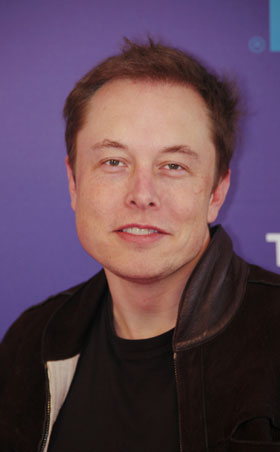
    Elon Musk (image: David Shankbone)

    According to Reuters, Tesla was “down to its last $9m” and struggling to sell its Roadster sports cars. Musk’s first three rocket launches had also failed spectacularly.

    When I interviewed him ahead of his first failed rocket launch in March 2006, he was vague about the role his SA roots had played in his success. He mentioned that, as a teenager, he had to build model rockets from scratch because there was nothing available off the shelf. He also revealed that he almost died of cerebral malaria on a holiday to an SA game reserve in about 2000 and that the “near-miss” had given him renewed focus and energy.

    “Man, that experience was no fun at all, but it does tend to sharpen your goal-setting,” he said.

    Musk gave ironic credit to the SA Defence Force for broadening his horizons. He went to Canada, rather than undergoing military service, which, aside from being morally repugnant, he considered “the most amazing waste of time I could think of”.

    He likened his Falcon to a “space bakkie” in that it would replace the shuttle as a cheap, low-maintenance, safe and reusable workhorse with no need for Nasa-style bells and whistles.

    I was set to speak with Musk in the hours after the Falcon 1 launch, but the interview was cancelled after the rocket blew up. To my shame, I did not call him after the second malfunctioned in March 2007. His third disaster seemed almost comical to non-engineers: the first stage of his rocket rear-ended its own upper stage. Worse, the flight was carrying the ashes of 200 people to space, including those of Star Trek actor James Doohan — Musk had actually blown up Scotty.

    Learning from mistakes
    But, according to Simberg, Musk not only has a gift for learning from mistakes, but also for not seeing them as mistakes at all. “Unlike North Korea, whose rockets actually get worse each flight, the five Falcon 1 flights got successively better. He knows how to learn and he has remarkable ‘stick-to-it-iveness’.”

    Musk has admitted that a failed fourth launch would have doomed SpaceX. Two weeks after the start of the 2008 recession Musk gambled everything on that launch and won — the Falcon finally flew into orbit.

    He then somehow raised about R2bn by taking Tesla public and bagged twice as much in guaranteed government loans to turn the niche electric-car manufacturer into a mass-production brand.

    In addition to the 300km/h Roadster, Musk is now rolling out a luxury sedan version and has teamed up with Toyota to launch the RAV4 EV next week.

    Although Musk knows how to learn from failure, he is also a master at capitalising on success.

    Two months after finally getting his smallest rocket into orbit, he won an R11bn contract from Nasa for 12 supply missions to the space station.

    In March, Forbes reported that his net worth had surged to $2bn from just $800m last year.

    Last month, Musk tweeted that he was one of 12 billionaires who answered Warren Buffett’s call to pledge at least half their wealth to charity. “Just signed giving pledge with 11 others. I hope this announcement convinces others to do the same,” he wrote.

    Musk did not respond to questions this week on how he turned things around, but what is more significant is that analysts such as Simberg are taking him seriously. Musk plans to be the Christopher Columbus who turns mankind into “a multiplanetary species”. Cost remains the biggest barrier to Mars and Musk has already made good on his vow to slash the costs of space flight, partly by making 80% of the rocket parts in-house and reusing his rockets as aeroplanes.

    He claims he can eventually reduce them to 1% of shuttle-era costs, which would open up the red planet as a lifeboat for any global disaster on Earth and, ultimately, “a permanent settlement”.

    Still, Musk has yet to establish his own permanent settlement on Earth. In January, his second marriage — a one-year quickie to British actress Talulah Riley — collapsed; a fact he tweeted thus: “I will love you forever. You will make someone very happy one day.”

    He has joint custody of five children with his first wife, but Forbes notes that, in the backyard of his Los Angeles mansion, “the pool is covered, the manicured backyard devoid of toys, lawn chairs, or a grill”.

    Musk does not even have a formal office at SpaceX, just an open-plan corner in a cavernous converted aeroplane hangar in Hawthorne, Los Angeles. There is no ping-pong table, but the 1 400 staff get cool drinks and snacks for free.

    Generally wearing jeans and golf shirts — he is pictured on his website in an Africa t-shirt while inspecting his Dragon capsule — he commutes to SpaceX in one of three sports cars and to Telsa, near San Francisco, in a business jet.

    His first wife, whom he met as a fellow student at Queens University, Canada, told Marie Claire: “The life you lead with him is his life.” Meanwhile, Musk was coldly matter of fact about his romantic failure with his second wife: “It just became emotionally difficult.” On a 60 Minutes interview weeks later, he teared up spontaneously when it was pointed out that Apollo II astronaut Neil Armstrong disapproved of Musk’s plans. “I was very sad,” he said.

    Musk lives in, and for, a world of dreamer heroes such as Armstrong. He named his car company after Nikola Tesla, the Serbian engineer who developed alternating-current electricity. The lobby of the Tesla office is dominated by a portrait of Nazi rocket genius Wernher von Braun and a statue of superhero Tony Stark, and his conference rooms have names such as “Goddard”, for Robert Goddard, who invented the liquid-fuelled rocket. He keeps a full-size sword in his open cubicle.

    He also has a group of Nasa astronauts who now call him boss. On a SpaceX video, astronaut Garrett Reisman compares Musk to Howard Hughes, the larger-than-life billionaire who helped found commercial air travel with his TWA airline.

    Already, among a dozen other innovations, Musk is leading the development of a revolutionary emergency escape system for astronauts, who had no such option aboard the shuttle.

    But Musk’s ambitions go far beyond pioneering private space exploration, even bridging the gap from superhero to God. In a recent press conference, he described his goal of colonising Mars as an evolutionary step “on the same scale” as the advent of single-cell life and the later appearance of mammals.

    It seems for a moment that it’s not so much that Musk needs to get to Mars as to simply return there.  — (c) 2012 Mail & Guardian

    • Visit the Mail & Guardian Online, the smart news source

    Add TechCentral as a preferred source on GoogleFollow TechCentral on Google NewsGet breaking news on WhatsApp


    Elon Musk PayPal SpaceX
    WhatsApp YouTube
    Share. Facebook Twitter LinkedIn WhatsApp Telegram Email Copy Link
    Previous ArticlePadayachie ‘died with his boots on’
    Next Article Knott-Craig makes his first move at Cell C

    Related Posts

    SpaceX takes aim at US wireless carriers with spectrum acquisition

    Starlink is coming for your mobile operator

    9 October 2026
    SpaceX to borrow $40-billion to buy Nvidia chips

    SpaceX to borrow $40-billion to buy Nvidia chips

    7 October 2026
    Anthropic bets AI will outstrip electricity and the internet

    Anthropic bets AI will outstrip electricity and the internet

    29 September 2026
    Company News
    Paratus Zambia delivers Starlink to thousands of children in Family Legacy schools

    Paratus Zambia delivers Starlink to thousands of children in Family Legacy schools

    15 October 2026
    Data sovereignty in South Africa is not an address - Ascent Technology, Johan Lamberts

    Data sovereignty in South Africa is not an address

    15 October 2026
    AI is only as good as your asset data

    AI is only as good as your asset data

    14 October 2026
    Opinion
    When a machine can choose, who does it become? Fanie van Rooyen

    When a machine can choose, who does it become?

    9 October 2026
    Let South Africans jailbreak their way to digital sovereignty - Dirk de Vos

    Let South Africans jailbreak their way to digital sovereignty

    5 October 2026
    South Africa's next energy crisis is in the accounts department - Craig Holmes

    South Africa’s next energy crisis is in the accounts department

    29 September 2026

    Subscribe to Updates

    Get the best South African technology news and analysis delivered to your e-mail inbox every morning.

    Latest Posts
    South Africa's ATM network faces its biggest overhaul in decades

    South Africa’s ATM network faces its biggest overhaul in decades

    16 October 2026
    The R77 000 iPhone has arrived in South Africa

    The R77 000 iPhone has arrived in South Africa

    16 October 2026
    Africa's mobile operators pay more for less spectrum, GSMA says

    Africa’s mobile operators pay more for less spectrum, GSMA says

    16 October 2026
    Netflix is losing the battle for your screen time

    Netflix is losing the battle for your screen time

    16 October 2026
    © 2009 - 2026 NewsCentral Media
    Built and maintained by Chronon
    • Cookie policy (ZA)
    • TechCentral – privacy and Popia

    Type above and press Enter to search. Press Esc to cancel.

    Manage consent

    TechCentral uses cookies to enhance its offerings. Consenting to these technologies allows us to serve you better. Not consenting or withdrawing consent may adversely affect certain features and functions of the website.

    Functional Always active
    The technical storage or access is strictly necessary for the legitimate purpose of enabling the use of a specific service explicitly requested by the subscriber or user, or for the sole purpose of carrying out the transmission of a communication over an electronic communications network.
    Preferences
    The technical storage or access is necessary for the legitimate purpose of storing preferences that are not requested by the subscriber or user.
    Statistics
    The technical storage or access that is used exclusively for statistical purposes. The technical storage or access that is used exclusively for anonymous statistical purposes. Without a subpoena, voluntary compliance on the part of your Internet Service Provider, or additional records from a third party, information stored or retrieved for this purpose alone cannot usually be used to identify you.
    Marketing
    The technical storage or access is required to create user profiles to send advertising, or to track the user on a website or across several websites for similar marketing purposes.
    • Manage options
    • Manage services
    • Manage {vendor_count} vendors
    • Read more about these purposes
    View preferences
    • {title}
    • {title}
    • {title}
    🇿🇦 Sign up to the TechCentral newsletter