
Close Menu
TechCentralTechCentral

    Subscribe to the newsletter

    Get the best South African technology news and analysis delivered to your e-mail inbox every morning.

    Facebook X (Twitter) YouTube LinkedIn
    WhatsApp Facebook X (Twitter) LinkedIn YouTube
    TechCentralTechCentral
    • News
      R12.1-billion wasted as government IT projects collapse - Sita

      R12.1-billion wasted as government IT projects collapse

      1 April 2026
      DStv 4K streaming launch is not imminent

      R99 DStv deal to keep Showmax subscribers from bolting

      1 April 2026
      The biggest untapped EV market on Earth is hiding in plain sight

      The biggest untapped EV market on Earth is hiding in plain sight

      1 April 2026
      US-listed data centre operator Equinix doubles down on South Africa - Sandile Dube

      US-listed data centre operator Equinix doubles down on South Africa

      1 April 2026
      TCS | MTN's Divysh Joshi on the strategy behind Pi - Divyesh Joshi

      TCS | MTN’s Divyesh Joshi on the strategy behind Pi

      1 April 2026
    • World

      Apple plans to open Siri to rival AI services

      27 March 2026
      It's official: ads are coming to ChatGPT

      It’s official: ads are coming to ChatGPT

      23 March 2026
      Mystery Chinese AI model revealed to be Xiaomi's

      Mystery Chinese AI model revealed to be Xiaomi’s

      19 March 2026
      A mystery AI model has developers buzzing

      A mystery AI model has developers buzzing

      18 March 2026
      Samsung's trifold gamble ends in retreat

      Samsung’s trifold gamble ends in retreat

      17 March 2026
    • In-depth
      The R18-billion tech giant hiding in plain sight - Jens Montanana

      The R16-billion tech giant hiding in plain sight

      26 March 2026
      The last generation of coders

      The last generation of coders

      18 February 2026
      Sentech is in dire straits

      Sentech is in dire straits

      10 February 2026
      How liberalisation is rewiring South Africa's power sector

      How liberalisation is rewiring South Africa’s power sector

      21 January 2026
      The top-performing South African tech shares of 2025

      The top-performing South African tech shares of 2025

      12 January 2026
    • TCS
      Anoosh Rooplal

      TCS | Anoosh Rooplal on the Post Office’s last stand

      27 March 2026
      Meet the CIO | HealthBridge CTO Anton Fatti on the future of digital health

      Meet the CIO | Healthbridge CTO Anton Fatti on the future of digital health

      23 March 2026
      TCS+ | Arctic Wolf unpacks the evolving threat landscape for SA businesses - Clare Loveridge and Jason Oehley

      TCS+ | Arctic Wolf unpacks the evolving threat landscape for SA businesses

      19 March 2026
      TCS+ | Vox Kiwi: a wireless solution promising a fibre-like experience - Theo van Zyl

      TCS+ | Vox Kiwi: a wireless solution promising a fibre-like experience

      13 March 2026
      TCS+ | Flipping the narrative on AI in the Global South - Josefin Rosén

      TCS+ | Flipping the narrative on AI in the Global South

      13 March 2026
    • Opinion
      The conflict of interest at the heart of PayShap's slow adoption - Cheslyn Jacobs

      The conflict of interest at the heart of PayShap’s slow adoption

      26 March 2026
      South Africa's energy future hinges on getting wheeling right - Aishah Gire

      South Africa’s energy future hinges on getting wheeling right

      10 March 2026
      Hold the doom: the case for a South African comeback - Duncan McLeod

      Apple just dropped a bomb on the Windows world

      5 March 2026
      VC's centre of gravity is shifting - and South Africa is in the frame - Alison Collier

      VC’s centre of gravity is shifting – and South Africa is in the frame

      3 March 2026
      Hold the doom: the case for a South African comeback - Duncan McLeod

      Hold the doom: the case for a South African comeback

      26 February 2026
    • Company Hubs
      • 1Stream
      • Africa Data Centres
      • AfriGIS
      • Altron Digital Business
      • Altron Document Solutions
      • Altron Group
      • Arctic Wolf
      • Ascent Technology
      • AvertITD
      • BBD
      • Braintree
      • CallMiner
      • CambriLearn
      • CYBER1 Solutions
      • Digicloud Africa
      • Digimune
      • Domains.co.za
      • ESET
      • Euphoria Telecom
      • HOSTAFRICA
      • Incredible Business
      • iONLINE
      • IQbusiness
      • Iris Network Systems
      • LSD Open
      • Mitel
      • NEC XON
      • Netstar
      • Network Platforms
      • Next DLP
      • Ovations
      • Paracon
      • Paratus
      • Q-KON
      • SevenC
      • SkyWire
      • Solid8 Technologies
      • Telit Cinterion
      • Telviva
      • Tenable
      • Vertiv
      • Videri Digital
      • Vodacom Business
      • Wipro
      • Workday
      • XLink
    • Sections
      • AI and machine learning
      • Banking
      • Broadcasting and Media
      • Cloud services
      • Contact centres and CX
      • Cryptocurrencies
      • Education and skills
      • Electronics and hardware
      • Energy and sustainability
      • Enterprise software
      • Financial services
      • HealthTech
      • Information security
      • Internet and connectivity
      • Internet of Things
      • Investment
      • IT services
      • Lifestyle
      • Motoring
      • Policy and regulation
      • Public sector
      • Retail and e-commerce
      • Satellite communications
      • Science
      • SMEs and start-ups
      • Social media
      • Talent and leadership
      • Telecoms
    • Events
    • Advertise
    TechCentralTechCentral
    Home » Science » Earth’s magnetic poles could soon swap places

    Earth’s magnetic poles could soon swap places

    By The Conversation30 January 2017
    Twitter LinkedIn Facebook WhatsApp Email Telegram Copy Link
    News Alerts
    WhatsApp

    Earth’s magnetic field surrounds it like an invisible force field — protecting life from harmful solar radiation by deflecting charged particles away. Far from being constant, this field is continuously changing. Indeed, our planet’s history includes at least several hundred global magnetic reversals, where north and south magnetic poles swap places. So, when’s the next one happening and how will it affect life on Earth?

    During a reversal, the magnetic field won’t be zero but will assume a weaker and more complex form. It may fall to 10% of the present-day strength and have magnetic poles at the equator or even the simultaneous existence of multiple “north” and “south” magnetic poles.

    Geomagnetic reversals occur a few times every million years on average. However, the interval between reversals is very irregular and can range up to tens of millions of years.

    There can also be temporary and incomplete reversals, known as events and excursions, in which the magnetic poles move away from the geographic poles — perhaps even crossing the equator — before returning back to their original locations. The last full reversal, the Brunhes-Matuyama, occurred around 780 000 years ago. A temporary reversal, the Laschamp event, occurred around 41 000 years ago. It lasted less than a thousand years with the actual change of polarity lasting around 250 years.

    Power cut or mass extinction?

    The alteration in the magnetic field during a reversal will weaken its shielding effect, allowing heightened levels of radiation on and above the Earth’s surface. Were this to happen today, the increase in charged particles reaching Earth would result in increased risks for satellites, aviation and ground-based electrical infrastructure. Geomagnetic storms, driven by the interaction of anomalously large eruptions of solar energy with our magnetic field, give us a foretaste of what we can expect with a weakened magnetic shield.

    In 2003, the so-called Halloween storm caused local electricity-grid blackouts in Sweden, required the rerouting of flights to avoid communication blackout and radiation risk, and disrupted satellites and communication systems. But this storm was minor in comparison with other storms of the recent past, such as the 1859 Carrington event, which caused aurorae as far south as the Caribbean.

    Aurora borealis

    The impact of a major storm on today’s electronic infrastructure is not fully known. Of course, any time spent without electricity, heating, air conditioning, GPS or Internet would have a major impact; widespread blackouts could result in economic disruption measuring in tens of billions of dollars a day.

    In terms of life on Earth and the direct impact of a reversal on our species, we cannot definitively predict what will happen as modern humans did not exist at the time of the last full reversal. Several studies have tried to link past reversals with mass extinctions — suggesting some reversals and episodes of extended volcanism could be driven by a common cause.

    However, there is no evidence of any impending cataclysmic volcanism and so we would only likely have to contend with the electromagnetic impact if the field does reverse relatively soon.

    We do know that many animal species have some form of magnetoreception that enables them to sense the Earth’s magnetic field. They may use this to assist in long-distance navigation during migration. But it is unclear what impact a reversal might have on such species. What is clear is that early humans did manage to live through the Laschamp event and life itself has survived the hundreds of full reversals evidenced in the geologic record.

    Predicting geomagnetic reversals

    The simple fact that we are “overdue” for a full reversal and the fact that the Earth’s field is currently decreasing at a rate of 5% per century, has led to suggestions that the field may reverse within the next 2 000 years. But pinning down an exact date — at least for now — will be difficult.
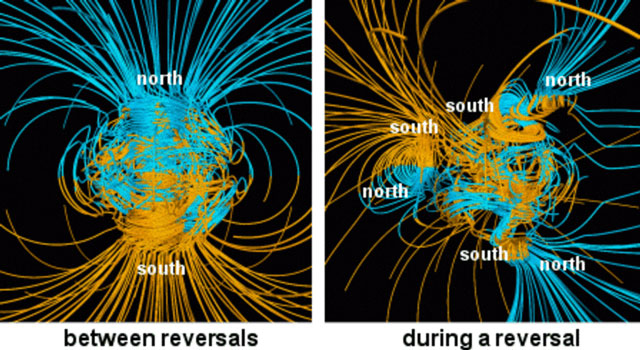
    Magnetic reversal. Nasa

    Earth’s magnetic field is generated within the liquid core of our planet, by the slow churning of molten iron. Like the atmosphere and oceans, the way in which it moves is governed by the laws of physics. We should therefore be able to predict the “weather of the core” by tracking this movement, just like we can predict real weather by looking at the atmosphere and ocean. A reversal can then be likened to a particular type of storm in the core, where the dynamics — and magnetic field — go haywire (at least for a short while), before settling down again.

    The difficulties of predicting the weather beyond a few days are widely known, despite us living within and directly observing the atmosphere. Yet predicting the Earth’s core is a far more difficult prospect, principally because it is buried beneath 3 000km of rock such that our observations are scant and indirect. However, we are not completely blind: we know the major composition of the material inside the core and that it is liquid. A global network of ground-based observatories and orbiting satellites also measure how the magnetic field is changing, which gives us insight into how the liquid core is moving.

    The recent discovery of a jet stream within the core highlights our evolving ingenuity and increasing ability to measure and infer the dynamics of the core. Coupled with numerical simulations and laboratory experiments to study the fluid dynamics of the planet’s interior, our understanding is developing at a rapid rate. The prospect of being able to forecast Earth’s core is perhaps not too far out of reach.The Conversation

    • Phil Livermore and Jon Mound are associate professors of geophysics, University of Leeds
    • This article was originally published on The Conversation
    Follow TechCentral on Google News Add TechCentral as your preferred source on Google


    WhatsApp YouTube
    Share. Facebook Twitter LinkedIn WhatsApp Telegram Email Copy Link
    Previous ArticleTime SA’s ICT sector embraced ‘openness’
    Next Article Trump on collision course with Silicon Valley

    Related Posts

    R12.1-billion wasted as government IT projects collapse - Sita

    R12.1-billion wasted as government IT projects collapse

    1 April 2026
    DStv 4K streaming launch is not imminent

    R99 DStv deal to keep Showmax subscribers from bolting

    1 April 2026
    The biggest untapped EV market on Earth is hiding in plain sight

    The biggest untapped EV market on Earth is hiding in plain sight

    1 April 2026
    Company News
    Mining's problem isn't output, it's execution - Workday

    Mining’s problem isn’t output, it’s execution – Workday

    1 April 2026
    Paratus launches Starlink-powered connectivity for Africa's essential services - Paratus Essential Access

    Paratus launches Starlink-powered connectivity for Africa’s essential services

    1 April 2026
    How consumers can identify a true QLED TV

    How consumers can identify a true QLED TV

    30 March 2026
    Opinion
    The conflict of interest at the heart of PayShap's slow adoption - Cheslyn Jacobs

    The conflict of interest at the heart of PayShap’s slow adoption

    26 March 2026
    South Africa's energy future hinges on getting wheeling right - Aishah Gire

    South Africa’s energy future hinges on getting wheeling right

    10 March 2026
    Hold the doom: the case for a South African comeback - Duncan McLeod

    Apple just dropped a bomb on the Windows world

    5 March 2026

    Subscribe to Updates

    Get the best South African technology news and analysis delivered to your e-mail inbox every morning.

    Latest Posts
    R12.1-billion wasted as government IT projects collapse - Sita

    R12.1-billion wasted as government IT projects collapse

    1 April 2026
    DStv 4K streaming launch is not imminent

    R99 DStv deal to keep Showmax subscribers from bolting

    1 April 2026
    The biggest untapped EV market on Earth is hiding in plain sight

    The biggest untapped EV market on Earth is hiding in plain sight

    1 April 2026
    Mining's problem isn't output, it's execution - Workday

    Mining’s problem isn’t output, it’s execution – Workday

    1 April 2026
    © 2009 - 2026 NewsCentral Media
    • Cookie policy (ZA)
    • TechCentral – privacy and Popia

    Type above and press Enter to search. Press Esc to cancel.

    Manage consent

    TechCentral uses cookies to enhance its offerings. Consenting to these technologies allows us to serve you better. Not consenting or withdrawing consent may adversely affect certain features and functions of the website.

    Functional Always active
    The technical storage or access is strictly necessary for the legitimate purpose of enabling the use of a specific service explicitly requested by the subscriber or user, or for the sole purpose of carrying out the transmission of a communication over an electronic communications network.
    Preferences
    The technical storage or access is necessary for the legitimate purpose of storing preferences that are not requested by the subscriber or user.
    Statistics
    The technical storage or access that is used exclusively for statistical purposes. The technical storage or access that is used exclusively for anonymous statistical purposes. Without a subpoena, voluntary compliance on the part of your Internet Service Provider, or additional records from a third party, information stored or retrieved for this purpose alone cannot usually be used to identify you.
    Marketing
    The technical storage or access is required to create user profiles to send advertising, or to track the user on a website or across several websites for similar marketing purposes.
    • Manage options
    • Manage services
    • Manage {vendor_count} vendors
    • Read more about these purposes
    View preferences
    • {title}
    • {title}
    • {title}