 For some time now, the ongoing debate between over-the-top providers on one side and network operators on the other returns like a comet in an elliptical orbit. Each time it returns, the stakes appear to be higher as this “comet” gets closer and threatens to crash into planet ICT.
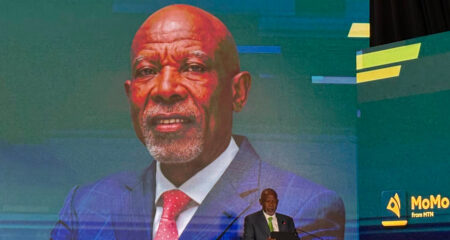
MTN South Africa CEO Ahmad Farroukh said that at a recent forum in Dubai, the arguments between the two sides become so heated that “it almost turned in a fistfight”. The problem seems, at first, impossible to resolve. When mobile operators were making fabulous amounts of money off voice, their greatest source of revenue, the emergence of OTT providers did not make much of a difference.
Providing broadband connectivity priced on a per-megabyte basis with no termination fee arrangements is far less profitable than voice — large investments in infrastructure are needed to enable acceptably fast broadband connectivity, which renders a far smaller margin.
The problem for operators becomes a bigger one when less profitable broadband services become a bigger part of the total revenue mix. Still, for good operators who can control costs and increase their infrastructure efficiencies, this is a sound, if not spectacular business.
The fact that Wireless Business Solutions, the owner of iBurst, can attract investor interest is an indication that there is an appetite for broadband connectivity services.
When, however, OTT providers – companies such as Google and WhatsApp – move in on the core, legacy voice business with low-bandwidth voice calls, in the process rendering voice merely a feature and not a standalone service, then the problem for the mobile operators becomes an existential one.
For some time now, the operators have responded in different ways to avoid becoming “dumb pipe” utilities. We have seen how they have set up business services, acquired IT capabilities, and built or acquired their own content or media type services. They have also started to grow into other sectors such as banking and other financial and transactional services. Few of these have been successful.
It is not clear what mobile operators offer in financial services that is not already covered by the financial sector already. Moreover, the strategy for venturing into other sectors is often not clear. For example, is mobile money merely a means to increase stickiness in the prepaid market or is it an effort to actually make mobile money a profitable line of business on its own merits? Is it both? The same can be said for value-add services to the corporate or small and medium business sectors.
Poor record
The record of mobile operators competing with OTT providers and capturing value at the edge is not particularly a good one. There are a number of given reasons for this. One of the main points that is repeatedly made is that telco DNA, founded on selling voice services, is fundamentally unsuited to the current dynamics of OTT services. This explains why every OTT innovation one can think of did not come from within the telecoms sector. Some take the view that telecoms operators could be far more adventurous in product development. Certainly, many operators have a well-funded “skunkworx” — a department focused on innovation — and the people involved are often extremely talented and smart. But innovation is more than well-funded R&D. If the overall organisation is not driven by innovation, and when some parts may even be openly hostile to it, innovation struggles. Convincing the CEO of the need to change the business model or to do things differently is one thing; convincing the thousands of employees to do the same is a much harder task.

This then drives us back to the original debate, nicely framed by Thabiso Moerane, a mobile commerce consultant, who points to efforts by operators to get relief by regulation or via termination rates — the argument being that as they invest heavily in network infrastructure, they should be compensated for this investment.
But there is another conceptual problem with charging OTT providers. The American poet and novelist Eleanore Marie Sarton once observed that “a garden is always a series of losses set against a few triumphs, like life itself”. This is just as applicable to the OTT ecosystem. A lot of risk capital has gone into and been lost in chasing the “next killer app”. Indeed, the returns from investments in telecoms operators have certainly exceeded the returns from apps or OTT development, even if not adjusting for risk. The big ones that we know today — Google, Facebook, etc — emerged from a series of now-forgotten losses. Is it fair, then, to share in revenues when you didn’t share in the risks?
Internet of Things
This is not the end of the story, though. Operators have a role to play and will be among the beneficiaries of OTT services if they play to their strengths.
One sector presents a rich opportunity: the Internet of Things (IoT), that will enable the “smart” devices, embedded systems, industrial control, in-car systems and smart household appliances that process and interact with each other without human intervention.
Forecasts show that as many as 4bn people and more than 31bn devices will be using IoT-enabled services by 2020 from just 500m now. The recent acquisition by Google of Nest Labs for US$3,2bn appears to be a high price for what is a simple thermostat system, but the value is in the underlying skill set and response/support ecosystem that supports any device on a large scale.
It is an attractive proposition for operators because simple services – say, an electricity meter — can be provided for a monthly subscription of R50/month, yet the data overhead is so small that a positive yielding cash flow can be generated with minimal additional network-related costs.
Why, then, would mobile operators have an advantage in IoT over other OTT providers?

Well, according to Martin Weiss, a thought leader in telemetry and IoT, who has spent a lot of time assisting the two largest South African mobile operators with their IoT strategies, a few things come to mind. Unlike other OTT services, there is an advantage to being able to manage things at the Sim card level, within the operator’s own infrastructure. This includes being able to monitor when a Sim-connected device is offline because the device itself is faulty or the network is down. Mobile network operators can also detect if the Sim card is being used in another device, if it has been moved from one account to another or if it has been added to an account. Only operators can permit devices to be sold with an embedded Sim, which is only activated when the device is installed rather than having to insert an active Sim post installation and then turn off and then turn on a Sim remotely and bill on this basis.
In short, the operators can provide end-to-end service levels because they have end-to-end end control of the connectivity layers on their networks.
The advantage does not end there. Operators have strong brands, a large customer base in enterprises, small and medium business and even the consumer sector. But most importantly, they have ample experience with billing large amounts of customers using different charging rates with endless special deals.
Countless applications
Consider this: one of Eskom’s and municipalities’ critical problems is that, despite their best efforts, they are unable to provide time-based billing on a large scale. As the price for electricity goes up, consumers use less and revenues generated from electricity sales decline. This results in further upward pressure on tariffs, which, in turn, causes further declines in consumption. Actually, what Eskom and the municipalities ought to be doing is implementing time-based billing on a large scale with high per-kilowatt-hour unit charges in the peak times and below-tariff charges during the troughs.
Eskom has to build and maintain the generating capacity to meet peak demand, yet at other times of the day — or in the middle of the night — it is unable to sell all its capacity. Smoothing peak demand, or at least charging a premium for it, and elevating daily demand troughs is an obvious solution. It’s called inventory management — in real time. Neither Eskom nor the local municipalities have a view, in real time, how much electricity customers are using. Instead, they rely on forecasting to anticipate demand. Eskom and municipal electricity meters can’t provide remote real time information and, even if they could, their billing systems were not set up for dynamic billing.
A mass roll-out of IoT-enabled electricity meters using the network operators’ billing systems, on an outsourced basis, could be done – and done today.
There are countless other applications that could leverage the mobile infrastructure to provide managed services and other IoT applications. Unlike in the case of many OTT providers, the big issues in IoT-enabled services are mundane and practical (such as the response protocols to reports activated by remote devices and quick identification of the nature of a problem and its precise location) rather than innovative, bleeding-edge products or services.
This does not mean IoT services should be done in-house. Mobile operators should continue to focus on the things they know how to do relatively well, namely building and managing network infrastructure and billing. The correct approach would be to focus on enabling an array of IoT services with specialists on a partnership basis. Big data and analytics are one aspect, but so is security that deals with how access is authenticated, logged and how possible failures are insured against.
Specific IoT solutions (verticals) can be quite complex, costly and generally require experienced and high skill sets in a range of disciplines beyond just the technical aspects. These include getting the business case right and ensuring the logistics surrounding the solution is in place.
The OTTs versus mobile operator debate will continue in the background for some time, and we are no closer to a resolution. It is not going to be solved by the operators opening up more app stores or new business services that can’t compete with the main OTT providers.
As pointed out, by the time those OTT providers become a threat, they have already been through an extreme Darwinian process and have succeeded against the odds by being highly flexible, innovative and able to bring new products and services to market in a flash.
Instead, mobile operators should look to services where their own infrastructure gives them advantages. They have a place on the edge of their networks. And the Internet of Things fits the bill.
- Dirk de Vos runs corporate finance and advisory firm QED Solutions, specialising in the ICT and energy sectors. Find him on Twitter
- Read more pieces by De Vos