
Close Menu
TechCentralTechCentral

    Subscribe to the newsletter

    Get the best South African technology news and analysis delivered to your e-mail inbox every morning.

    Facebook X (Twitter) YouTube LinkedIn
    WhatsApp Facebook X (Twitter) LinkedIn YouTube
    TechCentralTechCentral
    • News
      WhatsApp is eating South African operators' revenue

      WhatsApp is eating South African operators’ revenue

      4 April 2026
      DeepSeek V4 to run on Huawei silicon as China builds its own AI stack

      DeepSeek V4 to run on Huawei silicon as China builds its own AI stack

      4 April 2026
      Gaping holes in South African government cyber defences

      Gaping holes in South African government cyber defences

      2 April 2026
      EV charging start-up Charge bypasses JSE for token-based raise - Joubert Roux

      EV charging start-up Charge bypasses JSE for token-based raise

      2 April 2026
      Ring, reject, repeat: South Africa's spam call crisis

      Ring, reject, repeat: South Africa’s spam call crisis

      2 April 2026
    • World
      Amazon in talks to buy satellite operator Globalstar

      Amazon in talks to buy satellite operator Globalstar

      2 April 2026

      Apple plans to open Siri to rival AI services

      27 March 2026
      It's official: ads are coming to ChatGPT

      It’s official: ads are coming to ChatGPT

      23 March 2026
      Mystery Chinese AI model revealed to be Xiaomi's

      Mystery Chinese AI model revealed to be Xiaomi’s

      19 March 2026
      A mystery AI model has developers buzzing

      A mystery AI model has developers buzzing

      18 March 2026
    • In-depth
      The biggest untapped EV market on Earth is hiding in plain sight

      The biggest untapped EV market on Earth is hiding in plain sight

      1 April 2026
      The R18-billion tech giant hiding in plain sight - Jens Montanana

      The R16-billion tech giant hiding in plain sight

      26 March 2026
      The last generation of coders

      The last generation of coders

      18 February 2026
      Sentech is in dire straits

      Sentech is in dire straits

      10 February 2026
      How liberalisation is rewiring South Africa's power sector

      How liberalisation is rewiring South Africa’s power sector

      21 January 2026
    • TCS
      TCS | MTN's Divysh Joshi on the strategy behind Pi - Divyesh Joshi

      TCS | MTN’s Divyesh Joshi on the strategy behind Pi

      1 April 2026
      Anoosh Rooplal

      TCS | Anoosh Rooplal on the Post Office’s last stand

      27 March 2026
      Meet the CIO | HealthBridge CTO Anton Fatti on the future of digital health

      Meet the CIO | Healthbridge CTO Anton Fatti on the future of digital health

      23 March 2026
      TCS+ | Arctic Wolf unpacks the evolving threat landscape for SA businesses - Clare Loveridge and Jason Oehley

      TCS+ | Arctic Wolf unpacks the evolving threat landscape for SA businesses

      19 March 2026
      TCS+ | Vox Kiwi: a wireless solution promising a fibre-like experience - Theo van Zyl

      TCS+ | Vox Kiwi: a wireless solution promising a fibre-like experience

      13 March 2026
    • Opinion
      The conflict of interest at the heart of PayShap's slow adoption - Cheslyn Jacobs

      The conflict of interest at the heart of PayShap’s slow adoption

      26 March 2026
      South Africa's energy future hinges on getting wheeling right - Aishah Gire

      South Africa’s energy future hinges on getting wheeling right

      10 March 2026
      Hold the doom: the case for a South African comeback - Duncan McLeod

      Apple just dropped a bomb on the Windows world

      5 March 2026
      VC's centre of gravity is shifting - and South Africa is in the frame - Alison Collier

      VC’s centre of gravity is shifting – and South Africa is in the frame

      3 March 2026
      Hold the doom: the case for a South African comeback - Duncan McLeod

      Hold the doom: the case for a South African comeback

      26 February 2026
    • Company Hubs
      • 1Stream
      • Africa Data Centres
      • AfriGIS
      • Altron Digital Business
      • Altron Document Solutions
      • Altron Group
      • Arctic Wolf
      • Ascent Technology
      • AvertITD
      • BBD
      • Braintree
      • CallMiner
      • CambriLearn
      • CYBER1 Solutions
      • Digicloud Africa
      • Digimune
      • Domains.co.za
      • ESET
      • Euphoria Telecom
      • HOSTAFRICA
      • Incredible Business
      • iONLINE
      • IQbusiness
      • Iris Network Systems
      • Kaspersky
      • LSD Open
      • Mitel
      • NEC XON
      • Netstar
      • Network Platforms
      • Next DLP
      • Ovations
      • Paracon
      • Paratus
      • Q-KON
      • SevenC
      • SkyWire
      • Solid8 Technologies
      • Telit Cinterion
      • Telviva
      • Tenable
      • Vertiv
      • Videri Digital
      • Vodacom Business
      • Wipro
      • Workday
      • XLink
    • Sections
      • AI and machine learning
      • Banking
      • Broadcasting and Media
      • Cloud services
      • Contact centres and CX
      • Cryptocurrencies
      • Education and skills
      • Electronics and hardware
      • Energy and sustainability
      • Enterprise software
      • Financial services
      • HealthTech
      • Information security
      • Internet and connectivity
      • Internet of Things
      • Investment
      • IT services
      • Lifestyle
      • Motoring
      • Policy and regulation
      • Public sector
      • Retail and e-commerce
      • Satellite communications
      • Science
      • SMEs and start-ups
      • Social media
      • Talent and leadership
      • Telecoms
    • Events
    • Advertise
    TechCentralTechCentral
    Home » Opinion » Nathan Jeffery » Vodacom, MTN want to break the Internet

    Vodacom, MTN want to break the Internet

    By Nathan Jeffery27 January 2016
    Twitter LinkedIn Facebook WhatsApp Email Telegram Copy Link
    News Alerts
    WhatsApp

    nathan-jeffery-180As you might have seen, the networks are at it again, on a drive to get the government to regulate Web services, which these network operators like to call “over-the-top” (OTT) providers.

    Regulating Internet services will have a huge ripple effect throughout the economy. I don’t even want to start thinking about how badly this could be implemented.

    How on Earth would such regulation even be managed? Can you imagine Facebook opening offices in every city or appointing officials in small towns to do Rica just so South Africans can talk to each other online?

    I can’t see this happening, though. It is counterintuitive and anti-Internet to add such labour-intensive processes. If Vodacom and MTN have their way and companies such as Facebook and Google are somehow forced to add complex and unnecessary red tape to the sign up and account-creation process, all that will happen is they will pull out of the country.

    Fighting for regulation instead of innovation

    While organisations like Digital Village, Project Isizwe and the Western Cape government are making an effort to get more people online and bring communication costs down, companies like Vodacom and MTN are publicly making an effort here to screw the South African consumer.

    These big companies are pleading poverty while the CEO of Vodacom was paid R10,9m in 2015 and the CEO of MTN R28,1m in 2014. Who are they trying to fool?

    They sell bandwidth to consumers and then, if you don’t use it within a certain amount of time, you lose it. Imagine buying a hamburger, but because you don’t eat it fast enough, the restaurant throws it away. There is no way we would accept that from anyone in retail, so why on Earth is it acceptable from a cellular service provider?

    Meanwhile, forward-thinking network operator Cell C is embracing OTT players and says regulation could hurt the industry. That’s stating the obvious.

    I’ve been a Vodacom customer for going on 18 years now and I’ve generally been happy with the service, even if I haven’t been happy with the pricing. I have, however, reached the point where I feel we need to start threatening to cancel our contracts and moving to operators like Cell C that have embraced the future.

    Networks like MTN and Vodacom need to realise that they are nothing more than utilities. The only value they have to offer us in the long term is faster connectivity and wider network coverage. There is, however, nothing stopping them from investing in Internet start-ups or creating their own OTT services.

    Why not rather be productive and contribute to society by incentivising innovation or establishing and running accelerators or incubators? They could even create investment vehicles to push our economy forward, in new directions, leveraging their core network and embracing new technologies instead of spending time, effort and money on slowing down progress with legal or regulatory proceedings and attacking companies offering services that benefit the community and economy.

    Let’s debunk some myths

    Service providers make some blanket claims that indicate they don’t understand how the Internet or hosting business works. Worse, it seems that the CEOs of these companies that make the claims don’t understand how the billing systems work at their own companies.

    Part of what is so infuriating about this whole situation and some of the accusations being thrown around is that both Vodacom and MTN are also commercial Internet service providers, operating data centres, home to what they themselves refer to as OTTs. As a result of hosting and bandwidth utilisation being a source of revenue for network operators, they should know that anyone operating a cloud service (an OTT service) pays for hosting and bandwidth utilisation.

    Myth 1: OTT operators are ‘free riders’

    Every cat picture and meme you look at on Facebook costs both you and Facebook money to transmit over the Internet. The same goes for watching videos on YouTube and Netflix.

    Every website and Web service pays to stay online. Companies such as Facebook, Twitter, Google, Microsoft and Apple pay enormous amounts of money to run servers in countries around the world.

    They either rent data centre space or set up their own data centres. They need to pay to connect to Internet service providers and either pay for bandwidth used or for dedicated bandwidth/pipe.

    Think of it this way. At home, you can either have capped or uncapped ADSL. If you have capped ADSL, you pay for data used; if you have uncapped ADSL, you pay for the size/speed of your data pipe/connection. In other words, the amount of data you can transmit per second.

    Uncapped connections usually come with a fair-usage policy, which sets an upper limit on how much bandwidth you may transmit either via upload or download during a 30-day period before being throttled. These same concepts apply to the tech giants, but on a massively different scale. Instead of needing to worry about megabytes, they’re working with terabytes and petabytes. All of this costs real money.

    Myth 2: OTT services are being used for free

    The cheek and audacity of network operators to complain that accessing OTT services is free is unbelievable.

    Users — also known as paying customers — access the Internet either through purchasing data bundles from Internet service providers or mobile networks or paying for network access in the form of a monthly subscription. Once on the network, users can access hosted websites and services, all of which use bandwidth for which they have paid.

    Below I outline some differences between the traditional and modern (Internet) engagement and billing models.
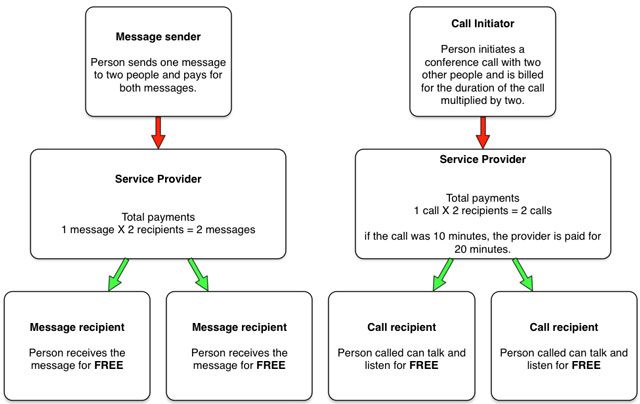
    Traditional model ... initiator pays
    Traditional model … initiator pays

    In the old model, the person initiating the phone call or sending the message is the only one who pays for the communication¹.

    Take the “please call me” service.

    A “please call me” allows someone without airtime to send a free message to someone else (presumably with airtime) to call them back. The reason this works and is viable is because the person who initiates the call pays for it so the person being called, in this case the person who sent the “please call me”, does not need to have any airtime as their participation in the conversation is free. They could both listen and speak without incurring any cost.
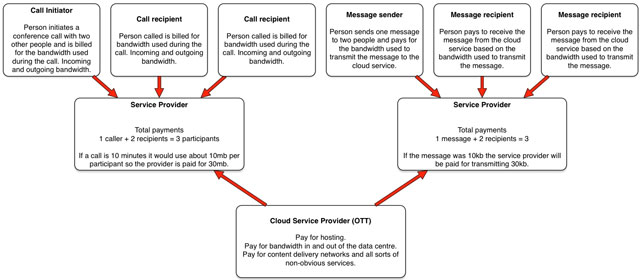
    Internet-based voice and messages ... everyone pays
    Internet-based voice and messages … everyone pays

    There is a big difference in how Internet-based services work compared to the traditional model².

    In the modern Internet world, the networks being operated by the telecommunications companies, whether they be cellular or fixed line, provide a data conduit through which devices can communicate with each other. All devices on the big interconnected network, also referred to as the Internet, pay to participate and pay for data traffic in both directions.

    With this in mind, any OTT operator doing their job properly will be using compression and efficient encoding to reduce the bandwidth being used by their service as it costs them money to operate. This leads to less strain on the network and smaller data packages being sent between devices. As a result of this, modern, Internet-based communication is more efficient and generally uses the least possible amount of data required to get the job done. This is good for everyone, even the traditional Internet service providers, as it reduces the load on the networks. It might not result in a surge in data usage (and revenue) upfront, but in the long term it results in faster Internet adoption and more users spending money to get online and do business online.

    Due to both directions of traffic being billable, all parties pay to be part of a conversation. Whether it is a voice-over-Internet protocol call or a group chat via instant messaging, users pay to both send (upload) and receive (download) data. This means the more people participating in a conversation, the more bandwidth is being invoiced, even if only one person is sending the messages or speaking.

    Regulation will affect everyone

    Tell your friends and your family. Help them understand the far-reaching impact should Vodacom and MTN get their way. This is an issue that will affect us all. The definition of OTT is vague and could eventually be twisted and applied to this very website you’re reading.

    1. Calls made to networks, other than the user’s home network, are handled through interconnection, which is a complex issue on its own.
    2. This only covers the high-level concepts; the billing structure is actually more complex. I’m just trying to illustrate that it’s a multi-payer situation now and that same packet of data is being paid for multiple times by different parties. There are other more complex issues such as peering which this Ars Technica article covers quite nicely.
    • Nathan Jeffery is a technology strategist who invests in and consults for technology start-ups on product development and infrastructure. He is founder and CEO of software development company MyEcommerce, co-founder and director of the Garden Route ICT Incubator, and chief product officer for construction project management software-as-a-service company Hlalani IQ

    Follow TechCentral on Google News Add TechCentral as your preferred source on Google


    Apple Cell C Facebook Google Microsoft MTN Nathan Jeffery Twitter Vodacom
    WhatsApp YouTube
    Share. Facebook Twitter LinkedIn WhatsApp Telegram Email Copy Link
    Previous ArticleNgcaba warns against OTT regulation
    Next Article Google’s Go triumph a milestone for AI research

    Related Posts

    Ring, reject, repeat: South Africa's spam call crisis

    Ring, reject, repeat: South Africa’s spam call crisis

    2 April 2026
    Amazon in talks to buy satellite operator Globalstar

    Amazon in talks to buy satellite operator Globalstar

    2 April 2026
    TCS | MTN's Divysh Joshi on the strategy behind Pi - Divyesh Joshi

    TCS | MTN’s Divyesh Joshi on the strategy behind Pi

    1 April 2026
    Company News
    Synthesis helps financial enterprises transform with new Gemini Enterprise - Digicloud Africa

    Synthesis helps financial enterprises transform with new Gemini Enterprise

    2 April 2026
    The next churn wave is already in your contact centre conversations - CallMiner

    The next churn wave is already in your contact centre conversations

    2 April 2026
    Mining's problem isn't output, it's execution - Workday

    Mining’s problem isn’t output, it’s execution – Workday

    1 April 2026
    Opinion
    The conflict of interest at the heart of PayShap's slow adoption - Cheslyn Jacobs

    The conflict of interest at the heart of PayShap’s slow adoption

    26 March 2026
    South Africa's energy future hinges on getting wheeling right - Aishah Gire

    South Africa’s energy future hinges on getting wheeling right

    10 March 2026
    Hold the doom: the case for a South African comeback - Duncan McLeod

    Apple just dropped a bomb on the Windows world

    5 March 2026

    Subscribe to Updates

    Get the best South African technology news and analysis delivered to your e-mail inbox every morning.

    Latest Posts
    WhatsApp is eating South African operators' revenue

    WhatsApp is eating South African operators’ revenue

    4 April 2026
    DeepSeek V4 to run on Huawei silicon as China builds its own AI stack

    DeepSeek V4 to run on Huawei silicon as China builds its own AI stack

    4 April 2026
    Gaping holes in South African government cyber defences

    Gaping holes in South African government cyber defences

    2 April 2026
    EV charging start-up Charge bypasses JSE for token-based raise - Joubert Roux

    EV charging start-up Charge bypasses JSE for token-based raise

    2 April 2026
    © 2009 - 2026 NewsCentral Media
    • Cookie policy (ZA)
    • TechCentral – privacy and Popia

    Type above and press Enter to search. Press Esc to cancel.

    Manage consent

    TechCentral uses cookies to enhance its offerings. Consenting to these technologies allows us to serve you better. Not consenting or withdrawing consent may adversely affect certain features and functions of the website.

    Functional Always active
    The technical storage or access is strictly necessary for the legitimate purpose of enabling the use of a specific service explicitly requested by the subscriber or user, or for the sole purpose of carrying out the transmission of a communication over an electronic communications network.
    Preferences
    The technical storage or access is necessary for the legitimate purpose of storing preferences that are not requested by the subscriber or user.
    Statistics
    The technical storage or access that is used exclusively for statistical purposes. The technical storage or access that is used exclusively for anonymous statistical purposes. Without a subpoena, voluntary compliance on the part of your Internet Service Provider, or additional records from a third party, information stored or retrieved for this purpose alone cannot usually be used to identify you.
    Marketing
    The technical storage or access is required to create user profiles to send advertising, or to track the user on a website or across several websites for similar marketing purposes.
    • Manage options
    • Manage services
    • Manage {vendor_count} vendors
    • Read more about these purposes
    View preferences
    • {title}
    • {title}
    • {title}