

Vet before you bet

A Cape Town-based start-up wants to help individuals and businesses check the credibility of people they intend to deal with so they can weed out hucksters. By Craig Wilson.

John Laatz

Fraudcheck, a new start-up based in the Cape Town suburb of Bellville, has been established to offer individuals and businesses peace of mind when dealing with people or companies they don’t know. The site is meant to help protect them from falling victim to fraudsters by offering vetting services that can check whether contact details, ID numbers and addresses supplied are genuine.

The company, which opened its doors last month, offers two services. The first is an identity check that confirms phone numbers and e-mail and physical addresses, cross-references these with the deeds office. An identity check costs R40.

The second option, which costs R120, provides an identity check as well as an in-depth review of an individual’s credit history and judgments or notices against them. It also allows users to examine a person’s debt review status, cross-check their last address and address history, and cross-check their personal details and mobile phone number.

In order to comply with privacy laws, Fraudcheck requires that those being vetted opt-in and the company doesn’t disclose sensitive information to either party but rather seeks to confirm that the details supplied to an individual or small business are, in fact, correct.

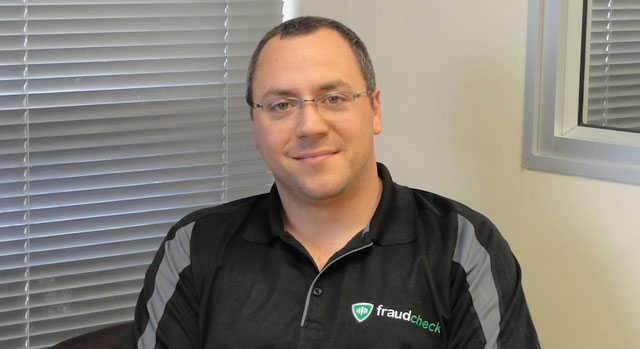
Fraudcheck MD John Laatz, 36, says the bulk of his team consists of risk management specialists. Laatz previously worked for an online UK risk management and payment services company called DataCash. He later started what is now Fraudcheck’s holding company, Progressive Dynamics.

Laatz says he opted for a “soft launch” for Fraudcheck and there have between about 250 sign-ups in the first month of operation. He says the company is targeting consumers and small businesses, from brokerages to insurance companies and small or medium-sized business.

“We’ve also attracted some interest from the investment space so, after our first round of funding, we will look to add services aimed at large companies,” Laatz says.

Until now, Fraudcheck has been wholly privately funded. Progressive Dynamics provides consulting services for UK companies but has seen its business declining because of the harsh economic conditions in that country. “We’ve been looking to get out of that market and launch own product in SA.”
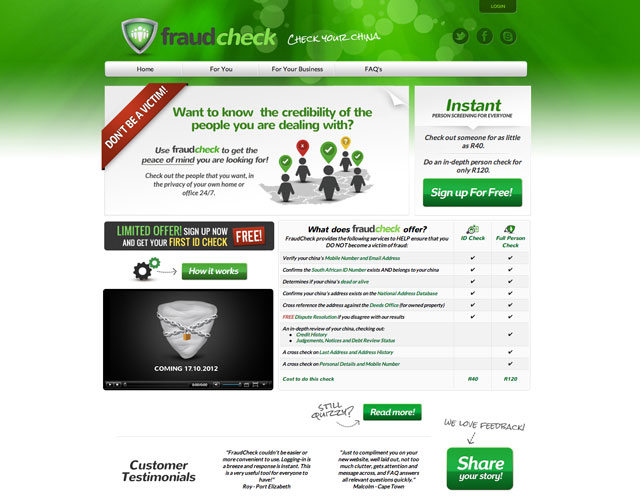
The Fraudcheck homepage

The service was built and coded by a small, in-house development team.

Laatz created the start-up after noticing a lack of similar offerings in SA, and because of personal experiences. “We’ve all had instances where we’ve bought from Gumtree or other online classifieds and been nervous of the seller. We’re hoping Fraudcheck can bridge that gap and help separate the legitimate [sellers] from the chancers.”

Of the R40 or R120 users are charged for an inquiry, Laatz says Fraudcheck keeps about 20%. “We have three component costs,” he says. “The first is the cost of data suppliers, which is quite high. On smaller checks that can be up to 40% of the price, and on larger checks up to 60% of the fee can go on a full [credit bureau] report. Then there’s the cost of hardware, marketing, hosting and so on which accounts for another 10%.”

Although there is the option to pay for each check done, any user can register with Fraudcheck as a business and can get a volume discount of up to 25%. For now, those signing up also get one free check.

Laatz says Fraudcheck has spent an “enormous amount of time” on data privacy. The service uses an SMS opt-in process for vetting. “If you register and want to check someone, they’ll get an SMS asking for their ID number, which you’ll never see. Also, the person being checked gets offered the data we find. You won’t get their data, only the information they’re willing to give you and whether or not it’s valid.”

Much of Fraudcheck’s value lies in its rules management system, which isolates points of interest on the various reports it examines. “[Credit bureau] reports are long, laborious and detailed. We delve into every aspect and run about 120 rules against it. At the end of the findings are all weighted and packaged. You’ll get a red – proceed with caution, amber or green status, along with reasons.”

There’s also a dispute resolution process for those who don’t agree with the findings. Although the company can’t reverse judgments or alter credit history information, it can make people aware of these things so that they can follow up with retailers or banks about problems they might have.

When someone tries to register with an invalid ID or phone number, that information is stored so that future instances of the same numbers will show up immediately.  — (c) 2012 NewsCentral Media

Share this article

  • mike862

    A quick perusal of the Fraudcheck website and I would advise concerned here to consider reviewing the pending Protection of Personal Information (PPI) Bill, that is law before year-end. I somehow think that clients vetting “subjects” (chinas?) from the “comfort-of their own homes” will require more than a simple “opt-in” SMS confirmation from subjects. With the fines up to R 10 Million for serious breach of confidentiality a diligent process should be followed, and directing subjects by SMS to disclaimers posted on a website is would certainly not stand scrutiny. The “opt-in” via SMS without consent would be regarded as an “unsolicited communication” and as such be in violation, and therefore a signed agreement from the identified subject, where the subject permits to the disclosure of his/her personal information is a prerequisite.

  • John Laatz

    Mike, thanks for your comment and I certainly take your point.

    Our legal counsel is fully engaged in our processes watching current and future legislation and we will evolve along with any changes that may come our way and something I wish to impress upon our users is that we will share changes and how they impact our users as and when they occur.
    The Opt-In process via SMS should happen in the full knowledge of both our User and their “china” being aware of an imminent transaction as part of the ongoing purchaser/seller dialog.
    For example, should I wish to purchase something off an online classified, I would inform the seller of my intention to check them and therefore the seller would be aware of the communication (or buyer in the converse scenario).
    As another example where I wanted to hire a gardener, I too would inform them of my intention/pre-requisites, of which one would be FraudCheck, and upon their agreement execute a check.
    In the B2B scenario, users won’t need to opt in as they have signed consent for background checks with the businesses they are engaged with and that delegated authority is then contracted to us.
    While I do appreciate the concerns we all have around unsolicited communication, for those people trading online or who are engaged with a business where consent has been given, I would think that getting that far in the process could at least verify who they are dealing with and allow them to conclude their sale with peace of mind.
    I guess where people wish to abuse this tool and its intent there is little we can do to stop them, however at the same time we really wish to improve the buyer/seller confidence in the South African online market places and would be really pleased if we could make a dent in the incidents around fraud and mistaken identities in the process.

  • Dean

    Hi John,

    I trust you are well.

  • dean

    Apologies for that.

    Not sure if you remember me, i used to work with you at DataCash, now working with DigiCash, wanted to run a few things past you if you are interested. You can contact me on 021 552 2005.

    Thanks,
    Dean

  • John Laatz

    cool, will do.

  • http://twitter.com/Wayne_DSA WMD

    Great concept and the website is awesome.

  • http://twitter.com/scrookson Sean Crookson

    How would you check whether an ID number “belongs” to someone unless you have a contact in a government department? You can check if the number is valid though. Maybe they are overselling capabilities.

Why TechCentral?

We know that as a prospective advertiser, you are spoilt for choice. Our job is to demonstrate why TechCentral delivers the best return for your advertising spend.

TechCentral is South Africa’s online technology news leader. We don’t say that lightly. We believe we produce the country’s best and most insightful online tech news aimed at industry professionals and those interested in the fast-changing world of technology.

We provide news, reviews and comment, without fear or favour, that is of direct relevance to our fast-expanding audience. Proportionately, we provide the largest local audience of all technology-focused online publishers.

We do not constantly regurgitate press releases to draw in search engine traffic — we believe websites that do so are doing their readers and advertisers a disservice. Nor do we sell “editorial features”, offer advertising “press offices” or rely on online bulletin-board forums of questionable value to advertisers to bolster our traffic.

TechCentral, which is edited and written by award-winning South African journalists, cares about delivering top-quality content to draw in the business and consumer readers that are of most interest to technology advertisers.

We’d like the opportunity to demonstrate the value of directing a portion of your advertising budget to TechCentral, whether your company is in the technology field or not. Numerous opportunities exist for companies interested in reaching our audience of key decision-makers in South Africa’s dynamic information and communications technology sector. We offer packages that will deliver among the best returns on investment available in the online technology news space.

For more information about advertising opportunities, and how your organisation can benefit by publicising itself on TechCentral, please call us on 011-792-0449 during office hours. Or send us an e-mail and ask for our latest rate card and brochure.