Although the new products in Apple’s line-up will largely please those looking to upgrade or purchase their first MacBook Air or Pro laptops, there were some notable omissions at Monday night’s Worldwide Developers’ Conference keynote in San Francisco — and a couple of pricing surprises.
The most glaring of the omissions — at least from the presentation — was the lack of a mention of a new Mac Pro, Apple’s premium desktop solution aimed at creative professionals that demand almost server-speed processing. The Mac Pro range was last updated in the middle of 2010. It turns out the Mac Pro has, in fact, been updated but didn’t make it into the presentation.
The Mac Pro didn’t get Thunderbolt or USB 3. The standard selection of USB 2.0 and FireWire 800 ports are unchanged, an odd decision given it’s precisely users of these high-end machines that will want the latest forms of cable connectivity. Instead, they’ll have to fork out for PCI Express expansion cards.
There was also no mention on Monday night of the long-anticipated high-definition television from Apple or an accompanying software development kit for the existing Apple TV set-top box, something many pundits expected.
Just as the iTunes Store’s biggest challenge was getting content providers on board, this seems to be the largest obstacle in Apple’s path in television. The company doesn’t want to simply make a TV; it wants to tie it to an ecosystem as it did with the iPod. Though there is money to be made in hardware, there’s far more to be made in the long run from content.
Two of the biggest highlights — unsurprising in light of it being an event aimed at developers — were the announcements concerning updates to Apple’s two operating systems, OS X Mountain Lion for laptops and desktops, and iOS 6, which powers iPhones and iPads.
Early adopters of the iPad will be disappointed to learn that there will be no support for iOS 6 for the first generation iPad, even though it’s newer than the iPhone 3GS, which is supported. There’s also no mention of an overhaul of iTunes even though the App Store is to be updated in iOS 6.
Portable powerhouses
To the delight of digital nomads with large wallets, Apple has refreshed its MacBook Air and MacBook Pro ranges of laptops. The Air receives minor updates as expected, but it’s the top-end of the MacBook Pro that has received the most obvious makeover.
As anticipated, the MacBook Air range sees its processors and graphics cards overhauled and the size of its solid-state drives (SSDs) increased. The range also now offers USB 3 ports and the built-in camera has been upgraded to 720p. Pricing starts at US$999 and goes up to $1 499 for the top of the range 13-inch model. This is in keeping with the prices on the last generation of MacBook Airs.
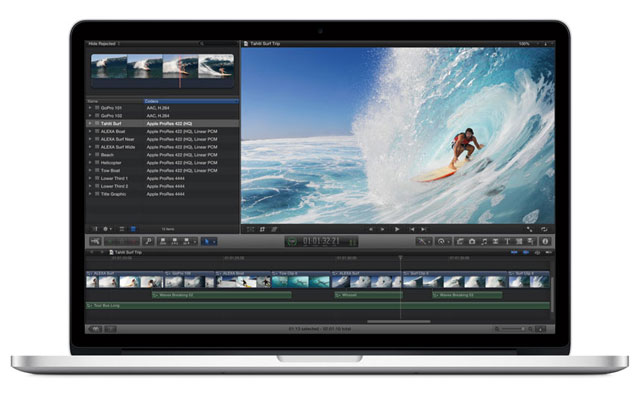
The star of Apple’s presentation, however, was the new 15-inch MacBook Pro with Retina display — 2 880×1 800 pixels — and SSD, dual Thunderbolt and USB 3 ports and HDMI rather than mini-DisplayPort.
The new star in Apple’s portable universe also does away with an optical drive, though this is still included on entry-level MacBook Pro models across the range.
Though punters can still get a 15-inch MacBook Pro for $1 799, provided they’re willing to forsake the new, high-resolution display. The Retina-enabled models start at $2 199. With a little boosting of RAM and flash storage this can easily get closer to $3 000.
For the sake of comparison, in June 2009 a 15-inch MacBook Pro started at $1 699, with the top-end model priced at $2 299 — meaning it’s become more expensive to become a MacBook owner, but less expensive to become a power user. The 13-inch MacBook Pro pricing remains unchanged from 2009, starting at $1 199 and going up to $1 499.
Aside from the new, top-end 15-inch model, and the fact that the entire range of MacBook Pro’s is now thinner and lighter, the rest of the upgrades were largely incremental.
Storage has been increased, with both the 13-inch and 15-inch MacBook Pro now available with hard drives up to 1TB in size, or SSDs up to 512GB.
No mention was made of updates to the iMac or Mac Mini ranges, but this isn’t surprising as both are only a year old.
Maps for mobile
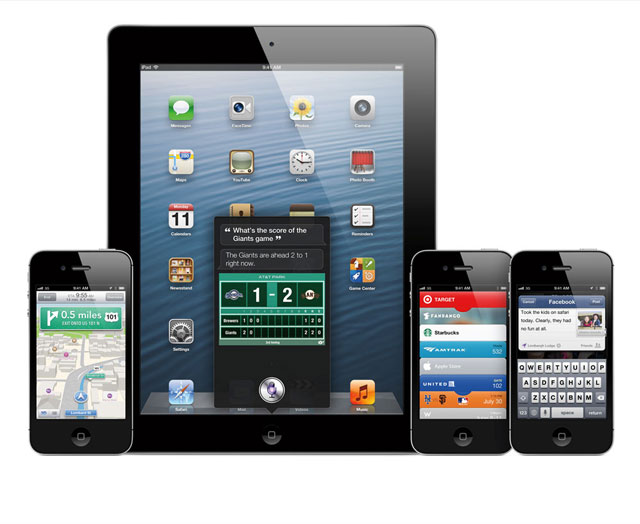
What is noteworthy from Apple’s iOS 6 announcement is the move to its own mapping service and away from Google Maps. To date, Apple hasn’t offered its own turn-by-turn navigation, with users having to rely on third-party apps.
Much like Nokia’s mapping offering, the new Maps app in iOS 6 will also include real-time traffic information and, thanks to Apple’s recent tie-in with Yelp, will offer local business information in supported regions.
Apple hasn’t yet specified which countries are supported by its new map app, but has intimated that it will be available in a number of countries outside the US. This is in keeping with the expansion of its voice recognition service, Siri, to 15 countries.
In iOS 5, Apple built in closer integration with micro-blogging service Twitter. In iOS 6, it takes the same approach to Facebook. The new OS will make it possible to synchronise Facebook contacts across Apple devices, and post content within Apple’s own apps, including Photos, Safari and newcomer Maps.
Mountain Lion is set to include similarly thorough Facebook integration and will take a page from iOS’s book with the inclusion of a notifications centre.
Although iOS 6 will be free to existing iPad, iPod Touch and iPhone users when it is released later this year, Mountain Lion — set for release in July — will cost $19,99. — (c) 2012 NewsCentral Media