Close Menu
TechCentralTechCentral

    Subscribe to the newsletter

    Get the best South African technology news and analysis delivered to your e-mail inbox every morning.

    Facebook X (Twitter) YouTube LinkedIn
    WhatsApp Facebook X (Twitter) LinkedIn YouTube
    TechCentralTechCentral
    • News
      The biggest IPO ever is also one of the riskiest - SpaceX

      The biggest IPO ever is also one of the riskiest

      4 June 2026
      The MVNO trap deepens as the battle moves to data

      The MVNO trap deepens as the battle moves to data

      4 June 2026
      BMW's Pretoria hub built the AI now running on its factory floors worldwide - Peter van Binsbergen

      BMW’s Pretoria hub built the AI now running on its factory floors worldwide

      4 June 2026
      Nedbank, Jumo bet on AI lending for the underbanked - Mutsa Chironga

      Nedbank, Jumo bet on AI lending for the underbanked

      4 June 2026
      AI demand sparks 'chipflation' warning

      AI demand sparks ‘chipflation’ warning

      4 June 2026
    • World
      Meta takes on OpenAI and Anthropic in enterprise AI

      Meta takes on OpenAI and Anthropic in enterprise AI

      4 June 2026
      Astronomers discover exoplanets with magnetic fields

      Strange winds reveal magnetic fields on distant ‘hot Jupiters’

      2 June 2026
      AI giant Anthropic files for landmark US listing

      AI giant Anthropic files for landmark US listing

      1 June 2026
      Dell guns for MacBook Neo with low-cost laptop

      Dell guns for MacBook Neo with low-cost laptop

      1 June 2026
      Nvidia's first CPUs to debut in Windows laptops this week

      Nvidia CPUs to debut in Windows laptops this week

      31 May 2026
    • In-depth
      What Wi-Fi 8 will mean for wireless networks

      What Wi-Fi 8 will mean for wireless networks

      1 June 2026
      Alfa's electric rebel - Alfa Romeo Junior Elettrica Veloce

      Alfa’s electric rebel

      29 April 2026
      Africa switches on as Europe dims the lights

      Africa switches on as Europe dims the lights

      9 April 2026
      The biggest untapped EV market on Earth is hiding in plain sight

      The biggest untapped EV market on Earth is hiding in plain sight

      1 April 2026
      AI, cybersecurity power standout year for Datatec - Jens Montanana

      The R16-billion tech giant hiding in plain sight

      26 March 2026
    • TCS
      TCS | Charge's R1.8-billion bet on an off-grid EV future - Charge chairman Joubert Roux

      TCS | Charge’s R1.8-billion bet on an off-grid EV future

      18 May 2026
      TCS+ | The Up&Up Group on the hidden cost of AI - Jason Harrison

      TCS+ | The Up&Up Group on the hidden cost of AI

      13 May 2026
      Michael Rossouw

      TCS+ | The retirement decision most South Africans get wrong

      6 May 2026
      TCS | The Cape Town start-up listening for TB with AI - Braden van Breda

      TCS | The Cape Town start-up listening for TB with AI

      4 May 2026

      TCS+ | ‘The ISP for ISPs’: Vox’s shift to wholesale aggregator

      20 April 2026
    • Opinion

      Clashing judgments leave South Africa’s crypto law unsettled

      2 June 2026
      The author, Pambos Soteriades

      The trap inside South Africa’s banking MVNO boom

      1 June 2026
      The hidden cost of social media age bans is everyone's privacy - Petrus Potgieter

      The hidden cost of social media age bans is everyone’s privacy

      29 May 2026
      Treasury's crypto crackdown is a betrayal of Mandela's promise - Duncan McLeod

      Treasury’s crypto crackdown is a betrayal of Mandela’s promise

      22 May 2026
      South Africa is sleepwalking into another AI policy failure - Celeste Labuschagne

      South Africa is sleepwalking into another AI policy failure

      20 May 2026
    • Company Hubs
      • 1Stream
      • Africa Data Centres
      • AfriGIS
      • Altron Digital Business
      • Altron Document Solutions
      • Altron Group
      • Arctic Wolf
      • Ascent Technology
      • AvertITD
      • BBD
      • Braintree
      • CallMiner
      • CambriLearn
      • CM Telecom
      • Contactable
      • CYBER1 Solutions
      • Digicloud Africa
      • Digimune
      • Domains.co.za
      • ESET
      • Euphoria Telecom
      • HOSTAFRICA
      • Incredible Business
      • iONLINE
      • IQbusiness
      • Iris Network Systems
      • Kaspersky
      • LSD Open
      • Mitel
      • NEC XON
      • Netstar
      • Network Platforms
      • Next DLP
      • Ovations
      • Paracon
      • Paratus
      • Q-KON
      • SevenC
      • SkyWire
      • Solid8 Technologies
      • Telit Cinterion
      • Telviva
      • Tenable
      • Vertiv
      • Videri Digital
      • Vodacom Business
      • Wipro
      • Workday
      • XLink
    • Sections
      • AI and machine learning
      • Banking
      • Broadcasting and Media
      • Cloud services
      • Contact centres and CX
      • Cryptocurrencies
      • Education and skills
      • Electronics and hardware
      • Energy and sustainability
      • Enterprise software
      • Financial services
      • HealthTech
      • Information security
      • Internet and connectivity
      • Internet of Things
      • Investment
      • IT services
      • Lifestyle
      • Motoring
      • Policy and regulation
      • Public sector
      • Retail and e-commerce
      • Satellite communications
      • Science
      • SMEs and start-ups
      • Social media
      • Talent and leadership
      • Telecoms
    • Events
    • Advertise
    TechCentralTechCentral
    Home » In-depth » Technology a pathway out of poverty

    Technology a pathway out of poverty

    By Editor23 October 2012
    Twitter LinkedIn Facebook WhatsApp Email Telegram Copy Link
    News Alerts
    WhatsApp
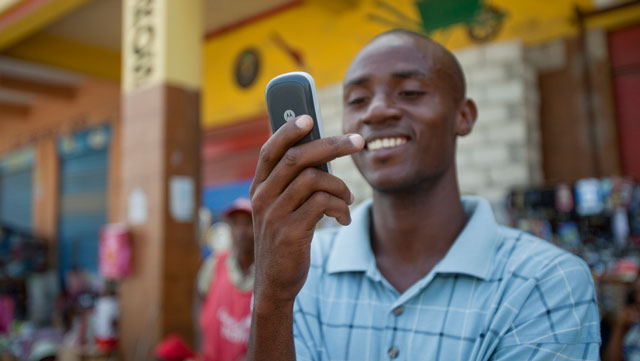
    Jean Louis Thomas of Haiti writes a text message to a friend. Many people living on less than $2/day already have access to a mobile phone. (Image courtesy of the Gates Foundation)

    It will take a century for a poor household to tweet its way out of poverty. That’s a very long time for anyone wondering where their next meal is coming from. But it’s a significant new finding because it proves once and for all that social media and access to information and communication technology (ICT) is a pathway out of poverty.

    This is one of the central findings of economist Prof Julian May, director of the Institute for Social Development at the University of the Western Cape, who released his study at the Towards Carnegie 3 conference in Cape Town recently. Based in the poorest 20 areas in four East African countries, the study found that access to ICT contributed about 0,5% to annual household income and had a measurable transformative role.

    “The finding is significant because it shows that a mobile phone on its own leads to an increase in income,” May told the conference which brought together the country’s top academics, government officials and NGOs to focus on strategies to overcome poverty and inequality. “There aren’t many things that cost so little and yet have this result. In the face of many other huge plans like land reform that lead to little measurable change, this study shows that a mobile phone can change lives — we can say now that here is a resource that shows a difference.”

    He warned against becoming evangelical about ICT, but said “the availability of mobile phones is a potentially valuable tool to improve the livelihood of the very poor over the medium term (six to 10 years) and contribute towards their escape from poverty traps”.

    The starting point for his research was “the staggering uptake of mobile phones in Africa accompanied by persistent levels of poverty”. He showed that by late 2010, Africa had exceeded Western Europe in terms of the number of mobile connections, and Internet usage between 2 000 and 2011 had grown by more than 2 000% — five times more than for the rest of the world.

    “We wanted to find out whether this uptake of mobile phones could be a new tool in poverty reduction and what we found was that there is a small but positive benefit to the very poor,” he said.

    The study took place in 1 600 households in 2008 and 2010 during a period of dramatic food price increases and global economic crisis, and yet the income of the poorest people who had access to mobile phones went up. “Access to ICT buffered people against poverty,” he said. “The gains made as a result of ICT access for the most poor were twice that for the non-poor. As a result there was a steady convergence between the income of the poor and the non-poor. Over a 10-year time horizon the modest additional gains from ICT can be seen to disproportionately benefit the very poor.”

    More than that, “if you put a mobile phone into the hands of someone with an additional year of education, their income increased further and if you add skills and entrepreneurship training this income figure increases even more”.

    The poor used mobile phones to grow their income in a range of innovative ways such as developing better communication networks, hearing about jobs on offer and communicating more directly with those offering work. But a mobile phone also meant a household could deal more effectively with a crisis which would ordinarily have led to large expenses on travel, and a household could find more efficient ways of sending money to relatives. For instance, in East Africa M-Pesa is a hugely successful mobile-phone-based service that enabled an estimated 17m users to deposit, withdraw and transfer money.

    But mobile phones also allowed users to check on things like food prices. “In Uganda, where the main crop of small scale producers is plantain, farmers can find out what prices are being offered at markets and what the demand is and so decide when they harvest and when they take their produce to market,” he said. In both Uganda and Rwanda, there were government services where farmers could send an SMS to a free number and hear instantly what coffee prices were in regional markets.

    May’s study was particularly significant when viewed in the SA context where 70% of the unemployed were between the ages of 15 and 35, said Rumbidzai Goredema of the DG Murray Trust.

    Speaking at the conference, which was funded by the National Planning Commission and UCT, Goredema said the trust and NGO Career Planet had created a mobile tool aimed at putting job seekers in touch with job providers. Based on the Indian mobile tool Babajob — which connects up to 1 000 work seekers every working day and over the last three years 900 000 jobs have been posted by employers — the mobile information hub is a bridge between a social networking and a job site. It allows employers to hire people that someone they know can vouch for.

    “We are not the first to try replicate this model in SA,” she said. Last year, the Praekelt Foundation launched Ummeli, a mobile jobs portal hosted on Vodafone Live. In Ummeli’s first two weeks, it attracted 20 000 members while Athlone-based RLabs launched Uusi, a Mxit-based platform connecting work seekers and placement services attracted 100 000 users.

    But the Career Planet platform was developed specifically for users with non-WAP-enabled phones and basic feature phones that use an unstructured supplementary service data (USSD) platform. And this is where their problem lay: the costs of accessing the hub at 20c for 20 seconds prevented the poorest people from using it.

    “The challenge here is to create platforms that bypass traditional barriers of cost and accessibility and equip youth with the skills and information they need to seek out opportunities,” Goredema said. “The Babajob platform in India is freely accessible to users, contributing to its success. We need to get bodies such as the Independent Communications Authority of SA to ensure such mobi sites can be subsidised or zero-rated so users who have limited airtime can get access,” she said.

    The high mobile and Internet costs in SA were a major barrier to ICT’s ability to change the lives of the poor.

    “Measures need to be taken at a structural level so that the high access to mobile technology is translated into higher levels of access to information and services that could facilitate successful connections to opportunities,” she said.

    For May, these structural changes also pointed to problems in the department of communications — the very reason he did his research in the more forward-looking East African countries in the first place.

    “The department of communications has not done a proper job in terms of providing clear and unambiguous policy, with the result that channels for the delivery of ICT are confusing and function poorly. Internet and mobile phone costs remain high compared to East Africa and as a result we are not doing justice to the many projects that could help alleviate poverty,” he said.  — (c) 2012 Mail & Guardian

    • Visit the Mail & Guardian Online, the smart news source

    Follow TechCentral on Google News Add TechCentral as your preferred source on Google


    DG Murray Trust Icasa Julian May M-Pesa MXit National Planning Commission NGO Career Planet Praekelt Foundation RLabs Rumbidzai Goredema
    WhatsApp YouTube
    Share. Facebook Twitter LinkedIn WhatsApp Telegram Email Copy Link
    Previous ArticleCopper theft tumbles in September
    Next Article Lumia 920 gets SA launch date

    Related Posts

    What Wi-Fi 8 will mean for wireless networks

    What Wi-Fi 8 will mean for wireless networks

    1 June 2026
    Huge win for South Africa's Wi-Fi lobby in spectrum fight

    Mobile operators locked out as Icasa opens 900MHz of spectrum

    27 May 2026
    Malatsi opens door to 'some' partial privatisations of SOEs - communications minister Solly Malatsi

    Malatsi opens door to ‘some’ partial privatisations of SOEs

    13 May 2026
    Company News
    Payments Live returns to Johannesburg for 2nd edition

    Payments Live returns to Johannesburg for 2nd edition

    4 June 2026
    Finding the next Sandton - AfriGIS

    Finding the next Sandton

    3 June 2026
    How telematics keeps fleets safe, efficient and compliant - Tracker

    How telematics keeps fleets safe, efficient and compliant

    3 June 2026
    Opinion

    Clashing judgments leave South Africa’s crypto law unsettled

    2 June 2026
    The author, Pambos Soteriades

    The trap inside South Africa’s banking MVNO boom

    1 June 2026
    The hidden cost of social media age bans is everyone's privacy - Petrus Potgieter

    The hidden cost of social media age bans is everyone’s privacy

    29 May 2026

    Subscribe to Updates

    Get the best South African technology news and analysis delivered to your e-mail inbox every morning.

    Latest Posts
    The biggest IPO ever is also one of the riskiest - SpaceX

    The biggest IPO ever is also one of the riskiest

    4 June 2026
    The MVNO trap deepens as the battle moves to data

    The MVNO trap deepens as the battle moves to data

    4 June 2026
    BMW's Pretoria hub built the AI now running on its factory floors worldwide - Peter van Binsbergen

    BMW’s Pretoria hub built the AI now running on its factory floors worldwide

    4 June 2026
    Nedbank, Jumo bet on AI lending for the underbanked - Mutsa Chironga

    Nedbank, Jumo bet on AI lending for the underbanked

    4 June 2026
    © 2009 - 2026 NewsCentral Media
    • Cookie policy (ZA)
    • TechCentral – privacy and Popia

    Type above and press Enter to search. Press Esc to cancel.

    Manage consent

    TechCentral uses cookies to enhance its offerings. Consenting to these technologies allows us to serve you better. Not consenting or withdrawing consent may adversely affect certain features and functions of the website.

    Functional Always active
    The technical storage or access is strictly necessary for the legitimate purpose of enabling the use of a specific service explicitly requested by the subscriber or user, or for the sole purpose of carrying out the transmission of a communication over an electronic communications network.
    Preferences
    The technical storage or access is necessary for the legitimate purpose of storing preferences that are not requested by the subscriber or user.
    Statistics
    The technical storage or access that is used exclusively for statistical purposes. The technical storage or access that is used exclusively for anonymous statistical purposes. Without a subpoena, voluntary compliance on the part of your Internet Service Provider, or additional records from a third party, information stored or retrieved for this purpose alone cannot usually be used to identify you.
    Marketing
    The technical storage or access is required to create user profiles to send advertising, or to track the user on a website or across several websites for similar marketing purposes.
    • Manage options
    • Manage services
    • Manage {vendor_count} vendors
    • Read more about these purposes
    View preferences
    • {title}
    • {title}
    • {title}