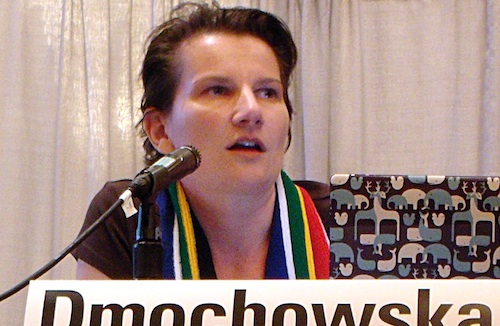
A start-up investment model developed by SA entrepreneur Eve Dmochowska (pictured) and her colleagues to solve key problems in SA start-up financing proved a big hit at the annual South by South West (SxSW) Interactive festival held in Austin, Texas earlier this week. Dan Oshinsky, a reporter for a local news station, described her as one of the best presenters he had seen at SxSW, alongside such luminaries as Clay Shirky and Marc Cuban.
The idea she presented, CrowdFunding, will obtain investment in R1 000 blocks from individuals, and raise R1m for its first fund. It is structured as a trust, which resolves a number of regulatory issues around investments and soliciting funds from the public.
The idea was launched almost by accident. When the news leaked out of a small preview circle, the pledges began streaming in, with 254 investors offering R842 000 in just the first two weeks. This was well ahead of her expectations, which was that R1m might take three or four months to raise.
Dmochowska’s panel was one of two talks involving South Africans on the packed SxSW programme, with panellists Heather Ford, who currently studies at Berkeley, Justin Spratt, the co-founder of start-up incubator ISLabs, Brett Haggard, technology journalist and podcaster, and Gareth Knight, an experienced start-up founder with business interests in SA and the UK.
The goal of CrowdFunding, Dmochowska explained, is to complete the cycle of online funding, which in the US begins with bootstrapping using an entrepreneur’s own money, and proceeds via angel funding or an incubator to the venture capital stage, after which the usual exit is either a sale to a bigger firm, or a stock market listing.
The early phases of this cycle are missing in SA, she says, which leaves venture capitalists with little to invest in.
Yet they need to hedge bets by picking 10 or 15 promising companies to fund, in the hope that two or three make it big and provide the ten-baggers or better that makes the fund profitable.
“SA has lots of clever people, with great coding skills, and good knowledge of how to take products global,” she says. “But because there is a lack of funding, many don’t even try.”
Unlike in other countries, the banking sector is so uncompetitive and risk-averse that there’s little chance of entrepreneurs being able to use loans or credit cards for bootstrapping. Government programmes, if they understand the technology and business model at all, take 12-18 months to reach the approval stage, by which time the world has moved on and the idea is usually stale. Bureaucracy and inexperience is not conducive to grabbing first-mover advantage.
“It’s more than just about the money, she said. “Investors will have the knowledge that they’re part of a network of people who want to help, and make up for lost time. Corporate South Africa is also very supportive, and is happy to provide work space, equipment, and other help. That shows we have a model that people really believe in, and understand. There’s also already a huge interest in second-round funding. A network of mentorship has been built too.”
Her audience was small — as is common with the many simultaneous panels on the programme — but very receptive of an idea that wasn’t about the presenters, but about the start-ups and entrepreneurs around them. Many offered congratulations and asked questions, hoping to learn from Dmochowska’s experience.
It prompted not only glowing local news coverage in the USA, but also interviews with international channels such as the BBC.
“The reason this will be successful,” Dmochowska says, “is that the money is almost incidental. Start-ups will be able to tap into our network, and be able to get to experts at only two or three degrees of separation, and get help, advice, or skills.”
The other reason is illustrated by Spratt, in the form of an example: “We have the Development Bank of Southern Africa, and the Industrial Development Corporation. But when Personera, an SA start-up founded by Sheraan Amod, presented them with a great idea on which it had to move quickly, the IDC took eight months to decide that it didn’t understand the business model.”
As it turned out, several angel-funding entrepreneurs from successful companies such as Yola and Clicks2Customers stepped up with risk capital to provide the funding that the official channels failed to provide. The company is already a great success, with a growing international market and rising public profile.”
The hope is that CrowdFunding can fund 10 or 15 such companies with the first fund, and produce the requisite two, three or more successes that go on to receive second-level or venture capital investment.
“We’re hoping CrowdFunding will succeed,” says Dmochowska, “and wake up the IDC.” — Ivo Vegter, TechCentral
- Subscribe to our free daily newsletter
- Follow us on Twitter or on Facebook