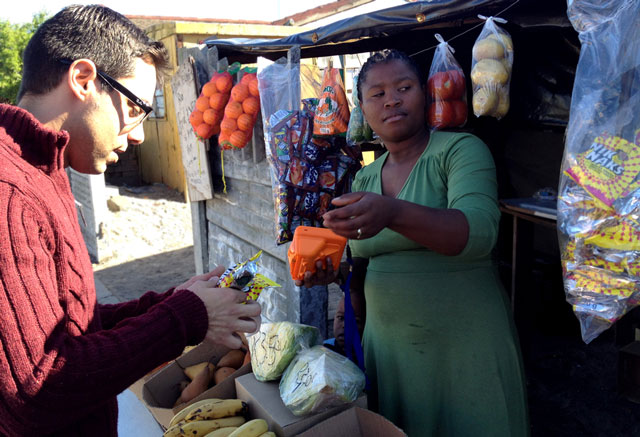
Nomanini, a Cape Town-based start-up, this week closed a lucrative round of funding and secured two international backers, all just 18 months after inception. The hardware and software company builds, distributes and maintains devices that allow informal retailers to sell prepaid vouchers.
Founder and CEO Vahid Monadjem, 30, started the company to, he says, “bring the power of the mobile revolution to the communities that have the most to gain from it”.
He says the company is not taking on JSE-listed Blue Label Telecoms, at least not directly. Blue Label, he says, has focused more on the “formal sector of the market”. Monadjem says there is space for players in the informal sector, particularly those that are focused on supporting vendors such as spaza shop owners and taxi drivers.
Nomanini means “anytime” in Zulu and Monadjem says the mobile GSM terminals it uses, the data for which is paid for by the company rather than vendors, make it possible to sell prepaid products in even the remotest parts of the country.
Last month, the company — which employs 12 people in its office in Cape Town’s Loop Street — raised US$600 000 in series-A funding from the Netherlands-based eVentures Africa (eVA) Fund and EDventure Holdings, the investment vehicle of independent venture capitalist Esther Dyson. Dyson sits on the boards of companies such as Evernote, 23andMe and Meetup.
Monadjem says this funding will be used to expand the company’s footprint in SA and into Mozambique and Zambia.
The company has 67 terminals active in SA and hopes to grow this number to 500 within six months. The battery-powered terminals are locally manufactured — from the PC board to the housing. The main manufacturer is Cape Town’s Tellumat.
Nomanini was founded in January 2011. Monadjem says that although he’d dipped his toes in the water with a proof of concept previously, it was only last year that he decided to quit his full-time job and make this his exclusive focus.
He previously worked for management consulting firm McKinsey & Co as international fellow for new product development for emerging markets. “It was a fascinating role, in that we got it completely wrong,” Monadjem says. “My mandate was to codify product development for best practice from cases in the US and take this to India and China. We learnt we should actually be doing it the other way around. The innovation coming from developing markets is beginning to outstrip that coming from developed ones. The knowledge I was codifying had long since passed its sell-by date.”
Prior to McKinsey, Monadjem worked in industrial design, on everything from car interiors and ATMs to mobile phones.
Early funding for Nomanini came from Monadjem’s network of friends and family. The first investor was his brother, and Nomanini cofounder, Ali. Support from “friends and mentors” followed.
“Because we’re doing hardware and a cloud-based back-end, Nomanini needed lots of capital to start. In just our seed round we raised about US$1m. We were also beneficiaries of an Industrial Development Corp grant.”
One of the anomalies about Nomanini is that, despite being a local start-up, local investors and venture capitalists have shied away from investing in the company.
“What we do is more appropriate for markets outside of SA,” says Monadjem. “There’s a strong informal market here and the business case will work here, but the product has real legs north of the border. There seems to be a lot more appetite to venture into the rest of Africa from investors in Europe than from those in SA.”
Monadjem says that doesn’t mean getting funding was easy, particularly because of the lack of awareness of prepaid solutions in developed markets and of the scale of the informal economy in Africa.
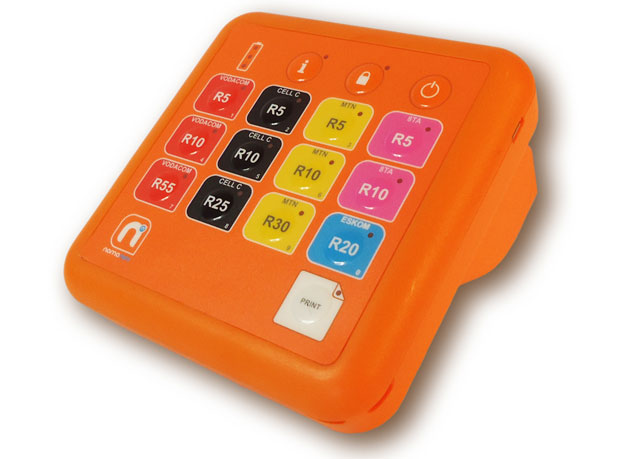
The method of distribution for prepaid vouchers had to be carefully considered, too, says Monadjem. The terminals include a thermal printer and a GSM modem to provide vouchers and print them.
“The winning mode of selling airtime in informal markets is scratch cards, so we had to replicate that,” he says. “Everyone talks about ‘transaction friction’ and saving consumers time at the high end of the market, but very few think about how time-poor people in the second economy are. People with the least money don’t have most time. For them, convenience is a necessity, not a luxury.”
Monadjem says that too often companies focus on the product and the consumer but don’t think about the vendor. He says Nomanini tries to address that by providing hardware that’s easy to use, lasts almost two days one charge of its battery, can dispense around 400 vouchers a day, and where vendors take home 80% of the mark-up on anything they sell.
The terminals have also been made deliberately hardy and Monadjem says recent versions have passed tests where they were dropped onto concrete from 1,8 metres.
The system supports all of SA’s mobile networks, with prepaid electricity tokens set to follow soon. The company is also looking into allowing users to top up funeral insurance or savings plans, or purchase other prepaid services like the recently launched bouquets from TopTV.
“We’re wary of proliferating too fast,” Monadjem says. “We don’t want to get too complex too quickly. We have to consolidate as we grow because we have only 12 buttons on the terminals and no LCD. You select a product, it prints, that’s about it.”
Terminals are Pin-code locked for user security and the GSM connectivity means stolen units can be locked down, cut off and tracked.
A terminal costs R1 795; thereafter there are no data or maintenance costs for vendors. While the company tries to provide support remotely wherever possible, where terminals need to be replaced or repaired, courier services are used.
In terms of Nomanini’s international ambitions, Monadjem says the company wants to stay in the Southern African Development Community countries for the foreseeable future. Zambia and Mozambique are next on the list because, through the eVA Fund, the company has relationships in those markets already.
Monadjem says that both countries offer additional benefits to Nomanini. “Mozambique is close to home but will teach us how to get through a language barrier, and Zambia is more reflective of the rest of Africa.” — (c) 2012 NewsCentral Media