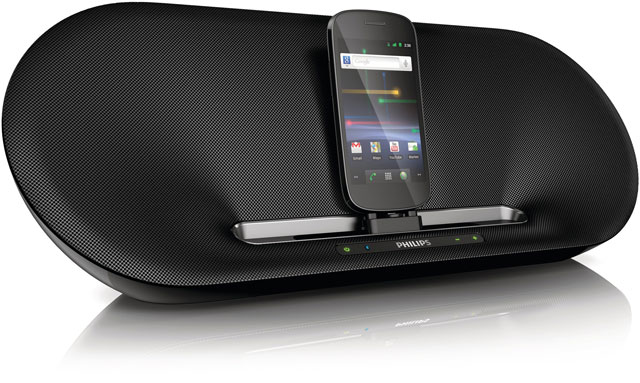
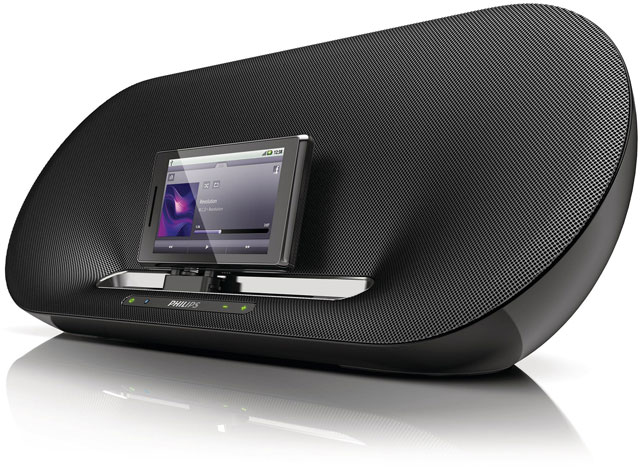
The Philips Fidelio dock for Android devices (otherwise known as the AS851) is one of the first docks designed specifically with Android users in mind. This is good news in a market awash with docks intended for Apple products, but the challenge of creating a micro USB connector that will fit every device, coupled with substandard audio, result in a product that underwhelms, despite a substantial price tag.
One of the advantages of the Android operating system is the range of devices that use it, meaning consumers are spoilt for choice at every price point. Unfortunately, this diversity is also an impediment to creating accessories that work equally well with every product. In the case of the Fidelio dock, it means a micro USB connector that slides left and right and rotates so as to accommodate every possible Android device.
In the case of handsets with the micro USB port located on the top or close to an edge, this presents all sorts of problems. The connector’s flexibility, along with the diminutive proportions of micro USB, mean operating a device while it’s docked is difficult without inadvertently disconnecting it. It also means handsets with the port on top or to a side may have to be operated at awkward angles because many music applications don’t support landscape or upside-down rotation.
Aside from the problem of actually keeping a device plugged into the micro USB connector – and sufficiently supported in the case of those with off-centre connections – the connector doesn’t allow one to stream audio to the device using it because there is, as yet, no standard for USB connectivity for Android devices. The connector is thus useful only for charging with audio being fed over a 3,5mm auxiliary cable or via Bluetooth.
Bluetooth pairing is effortless enough and allows for the use of non-Android, Bluetooth-enabled devices, but it also results in compromised audio quality. Highs are routinely clipped and there’s an incessant hiss that’s immediately evident in quiet portions of tracks or between them.
Curiously, the clipping isn’t solved by opting for an auxiliary cable, and it’s only possible to put the dock into auxiliary mode using either the supplied remote or the Fidelio application that users are encouraged to download. The app is the only way to fiddle the device’s equaliser and does a good job of making up for the lack of physical controls on the dock itself, but the same can’t be said of the remote.
With a connected device difficult to operate directly, the pebble-shaped remote control is crucial. Unfortunately, it’s poorly designed. The basic controls for power, volume, play/pause and auxiliary/Bluetooth input do what they’re supposed to, but the four-way controller only offers left and right buttons, with up reserved for Internet radio and down used to open Songbird, another application Philips suggests installing.
Rather than acting as a selection button, the centre button is used to control the clock function of the Fidelio app, rendering it largely superfluous and decidedly counterintuitive.
Lose the remote and you’re stuck using on-screen controls via the Fidelio application, something that’s challenging given the tentative nature of the connection at the best of times. We’d really have liked to see a wider range of physical buttons on the dock itself, even if hidden on the side or rear. Furthermore, we’d have liked to have seen a protocol other than Bluetooth, perhaps DNLA, supported for pushing audio to the device.
In addition to the obligatory 3,5mm auxiliary jack, the rear of the dock includes a connector for the mains power cable – the dock has no internal battery and thus has to be powered directly at all times — and a USB port for charging in case of devices that don’t have a micro USB port, won’t stay put on the connector or won’t charge using micro USB — this includes most Android-powered tablets.
Design flaws aside, the most disappointing aspect of the Fidelio dock is its poor audio performance. For a device that costs R2 199, the flat, tinny output and anaemic, muddy and distorted bass are an enormous letdown.
Given that it’s impossible to play audio using the micro USB connector and that pretty much every audio dock – even those designed with Apple products in mind – offers an auxiliary port, there’s no reason to recommend this dock over others in its price bracket. — (c) 2012 NewsCentral Media