Murdoch has friends in fight against Google, says M&G’s Ncube

This article was posted by on Dec 8th, 2009 and filed under In-depth, Top. You can follow any responses to this entry using RSS 2.0. Both comments and pings are currently closed.

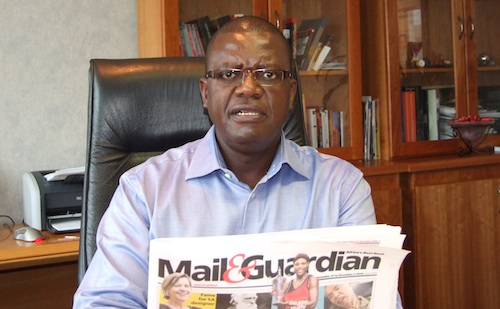
Trevor Ncube

Google is no friend of the newspaper industry. That’s the view of newspaper publisher Trevor Ncube, who agrees with News Corp chairman Rupert Murdoch that newspapers need to find ways of charging readers to access content on their websites.

Ncube, pictured, who recently attended the World Association of Newspapers conference in Hyderabad, India, says Murdoch is not fighting a lone crusade against Google and is not the only publisher that plans to erect pay walls around its websites and to block the search engine company from republishing copyrighted material.

Rather, Ncube, who is deputy chairman of Mail & Guardian owner M&G Media and publisher of Zimbabwe’s soon-to-be-launched independent daily, NewsDay, says almost the entire newspaper industry worldwide is behind Murdoch’s efforts to stave off the “threat” from Google and to get readers to pay for content online.

“We need to be clear that this is not just Murdoch vs Google,” he says. “Murdoch has been bold and outspoken, but, to a very large extent, the rest of the industry is behind what he is doing.”

Google thinks it can “dictate to us what the business model should be” because of its “dominance on the Internet”. “Now publishers are saying, ‘no thank you, it’s our content after all’.”

Ncube says Google has made it clear that it doesn’t want to deal with publishers as a united body. “They want to pick us off one by one,” Ncube says. “They want to attack us as individual publishers and not deal with us as a group. That smacks of negotiating in bad faith. Google should be dealing with the whole industry to find a solution.”

Ncube says he is “amazed” at how the media celebrates Google, despite the fact that it is a “monopoly”. Other “monopolies” are treated with disdain. “I rather use [Microsoft search engine] Bing. It’s kind of a one-man protest,” he says in jest.

“There’s this sense that Google is bullying us and that, because we don’t have the power to monetise our content, we should roll over and accept whatever Google comes up with. Publishers are saying ‘absolutely not’, that this is ruining our businesses and our livelihoods.”

Murdoch and other publishers have blamed Google for building its business — by selling advertising — on the back of other people’s content.

Google SA country manager Stephen Newton says in a prepared statement in response to a query from TechCentral that Web search and Google News — the latter aggregates the world’s online news sources — are “tremendous sources of promotion for news organisations”. Google News sends publishers about 100 000 clicks a minute, Newton says.

“Each of these visits offers offers a business opportunity for publishers to show ads, win loyal readers and sell subscriptions,” he says. “News publishers can charge for their content while at the same time ensuring that it’s discovered through Google — these two are not mutually exclusive.”

Of course, publishers themselves are also largely to blame for the situation they’re in, Ncube says. In developed markets, particularly in the US, readers are abandoning newspapers for free online content.

“Newspapers committed a cardinal sin — they gave away their content for free on the Internet,” Ncube says. “It’s easy to say this with the benefit of hindsight. None of us knew how the Internet was going to develop.”

What galls Ncube is that some journalists are writing the epitaph for their own industry. “We go around telling the whole world that our profession is dying and the world is starting to believe that.”

It’s true that newspaper publishers were too slow to react to technological change. Now, corrective action is needed, he says. “We have created an impression that content should be free. We have to disabuse people of that notion.”

But how? The answer, Ncube says, lies in charging for quality reporting and in-depth analysis and providing commodity news free of charge. “I have long maintained that the free content model is broken and is unsustainable. There is nothing in this world that is for free. Quality journalism costs money to produce, so how can we be expected to put that quality journalism for free on the Internet?”

Unfortunately, the advertising model that helps pay for journalism at newspapers doesn’t appear to be gaining traction on the Web, Ncube says.

But throwing up pay walls and asking readers to open their wallets could also prove challenging. Many consumers, especially youngsters accustomed to free content online, may baulk at the idea of having to pay for news articles.

Then there’s the small matter of figuring out how to facilitate payments, even if people are prepared to pay. A universally accepted micro-payments system doesn’t exist yet. People will be annoyed if they’re expected to haul out their credit cards every time they want to spend 50c on a news website.

Despite the challenges, Ncube says he remains optimistic about the future of journalism. “We have already been through the worst,” he says. “We have not yet found the right model, but it’s becoming clearer what we need to do.”

For now, the industry is going through a period of introspection. “We can’t continue with business as usual because this isn’t business as usual.”  — Duncan McLeod, TechCentral



  • http://www.key.co.za Andre

    I don’t think Trevor Ncube or Rupert Murdoch. I am not surprised that Murdoch does not get it, but I am surprised at Trevor. Google is not a newspaper. It gets content from websites, content that the newspapers put online, and now they are cross at Google.

    Google brings people to the websites at no cost to the newspapers. People who want to read articles of interest. As soon as they put up pay walls, people will go and look somewhere else for content. I will, for example, not go and search for news on a website that is blocking certain content. I want a free and open Internet. I will never pay for news content online, there are just too many other sources of news.

  • Caminsk

    I can’t wait for Murdoch to start charging us to read his biased information. At the long road he would be doing all of us a big favor. Also, newspaper were important because they monopolized on mass printing, the widespread of internet will put an end to mass publishing so anyone can really publish anything. Why would you need a journalist when you can reach the sources yourself?

    On the other hand , I agree that content could be costly and many people are willing to pay to read a newspaper online, but the only constant is change and as the flow of information turns into something so widespread why would anyone want to pay for information anyway? and to tell the general public that maintaining an online newspaper is as costly as maintaining a paper based newspaper is a big lie.

  • Greg

    I’m all for paid content, but everyone needs to decide on a way forward together. I’d love to pay say a reasonable fee of R100/month to never see another ad and be able to see all the content on the internet without restriction. I understand creating content is expensive, and that there have to be two sides to the internet – one for cheap/free crap created by amateur bloggers and suchlike, and one for quality content that needs funds to create, investigate and distill.

  • http://www.vincentmaher.co.za Vincent Maher

    ROFLMAO – robots.txt

  • um

    eTV is free. They manage to pay reporters and crew. The idea that nothing is free is stupid, somethings just have different business models and revenue streams.

  • http://www.brandscape.co.za Gordon Parkin

    Why, why, why? Surely Trevor and Rupert must realise that Advertisers buy space based on audience reach and segmentation. The more barriers to entry there are for the reader the less likely the uptake. Cost is a major factor in today’s economic climate, as is perceived value. Let’s put it this way; if I can search on Google for the latest news from all round the world, why would I want to subscribe to a single newspaper with one view of the news? Online news sites need to think ‘clever’ with potential advertisers to ADD VALUE and UTILITY to the site that makes viewing the content more rewarding. If profiling was used properly then these news sites could offer a more personalised news view and relevant advertising offers, rather than offer “Big promises”, tailor “Intimate Gratitude”.
    What News Corp is proposing amounts to pure unadulterated profiteering with no tangible value to the reader. It cost significantly less to run a syndicated web news site than it does to run a print press media so Mr. Murdoch can’t claim that his pay wall is because he can’t afford to run the site.
    But look, if News Corp and M&G want to become things of the past then let them go ahead with their ‘pay wall’. In the words of retired USA General Shinsenki: “If you don’t like change you’re going to like irrelevance even less.”

  • Peter

    I hear the sounds of people digging their own graves. So silly, so unnecessary, Lemmings rushing to build barriers to prevent viewers accessing pages on which advertisers would be / are willing to advertise. My, oh my, oh my!

    My opinion of the M&G just dropped, a LOT.

  • http://nevoda.wordpress.com nevo

    the issue at hand is changing media usage patterns more than “free”. If somebody using google went to a newspaper and clicked on a hundred stories and 10 ads, none of the publishers would be complaining. as they would be monetising the visit massively. unfortunately, they are not.. they find a story, maybe read another and then move on. compared to selling a newspaper full of ads that people may (or may not) read – thats not an attractive business model.

    M&G of all publishers is probably the safest as it actually has unique content. most newspaper publishers just rehash feeds.

  • http://simon.co.za Simon

    I have the utmost respect for Trevor Ncube – but I was surprised at his standpoint on Google. Frankly, I find it shortsighted.

    Online content has the ability to forge engagement with consumers and presents exciting new ways of creating revenue. The information economy operates in such a way that paid content is intrinsically limited. That isn’t to say that paid content doesn’t work – just that it gets ‘routed around’. Free content will win every time.

    Google is not the enemy and never has been. Quite the opposite – Google has done online publishers the biggest favour they have ever received. Which makes it infuriating that they don’t realise it.

    If anyone should be charging anyone else here it should be Google. Ncube and Rupert have the smarts to make this all work for them. But they’re approaching it from the arse-end.

  • http://www.skillsportal.co.za Alan Hammond

    I used to have a lot of respect for Trevor Ncube – until I read this article. What a lot of nonsense. If you don’t want to be in Google, take yourself out! If you don’t want to give away articles for free then charge people to read the M&G online! Stop whinging and run your business! And how can you say that Google is a monopoly and then in the next breath say that you use Bing? And there’s also Yahoo. The problem is that Google is better than the rest of them and it gives people what they want.
    This is going to be an interesting business proposal coming from newspapers. At every business school in the world they would tell you to give your consumers what they want. But newspaper publishers think that they can turn that on its head by giving people exactly what they don’t want! Good luck to you!

Advertisement

Recent Comments

  • Greg Mahlknecht: No, that’s fine, I’ll nip past my local hardware store and check it out.  In the xmas...
  • Theunis De Klerk:  Nope. The ellies 4w MR16 12v only have 3 led’s. My bathroom only has 2 in it. and they light...
  • T'saw Zizou Monareng: Wow!! Great work guys! 
  • Sandile: Good work Bequester this initiative will definitely open doors for up and coming businesses to access better...
  • Greg Mahlknecht: Are you sure you aren’t replacing 25W downlighters with those Ellies?  I got some to check...

Advertisement
Advertisement

TechCentral is proudly hosted by:


Log in / (c) 2009 - 2012 NewsCentral Media