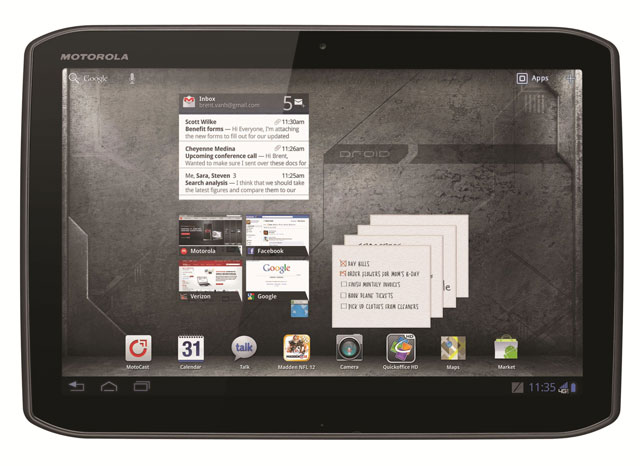
When the first Xoom was launched in SA, it was touted by some reviewers as the Android tablet we’d been waiting for. But it turned out to be too heavy and too late, arriving in the country six months after the US and Europe. With the Xoom 2, Motorola’s got the form factor down pat, but lateness to market remains a problem in an industry that moves this quickly.
When the Xoom 2 first became available on international shelves late last year, the third-generation iPad was still nothing more than a rumour and the Galaxy Tab 10.1 was the Android device to beat. But with the new iPad already in SA and Samsung’s next batch of tablets out soon, the Xoom 2 looks set to get much less attention than it probably deserves.
As its name suggests, the Xoom 2 is an incremental update to the original Xoom. The biggest difference is the size. The Xoom 2 is far slimmer than its predecessor — down to 8,8mm thick from 12,9mm before — and substantially lighter at 599g compared to the previous 730g.
It offers the same 1280×800-pixel resolution and 10,1-inch screen as before (though this time it’s an IPS rather than TFT display) and keeps the 1GB of RAM found in the first-generation model. Like its forerunner, it also offers micro-HDMI output and a 5-megapixel primary camera capable of 720p video at 30 frames a second.
The other thing that’s unchanged is the operating system out of the box. Annoyingly, the Xoom 2 runs Android 3.2 (Honeycomb). Though there is an upgrade to the latest version of Android (Ice Cream Sandwich) in the pipeline, its absence makes the Xoom 2 feel like an older Android tablet that’s been on a diet and had a makeover.
The power/unlock button and volume rocker are on the rear of the device because the sides are tapered and unsuited to buttons. Though you get used to it, it’s by no means intuitive and it can mean turning the tablet around to check you’re pressing the right key as there’s little to no tactile difference between them.
We had the same complaint about the first Xoom’s button placement and it’s a pity that this peculiar design decision has survived another outing.
What’s bizarre about the Xoom 2 is that it takes a number of steps back when compared to its predecessor. There’s no microSD card slot this time around, a strange decision when it could have been used to differentiate the device from the iPad.
It seems an even stranger decision when there’s only 16GB or 32GB of onboard storage space, really the minimum one expects from a high-end tablet. While the first Xoom came in 32GB and 64GB versions, the Xoom 2 is only available in 16GB and 32GB versions, making the exclusion of an SD card expansion option even more baffling.
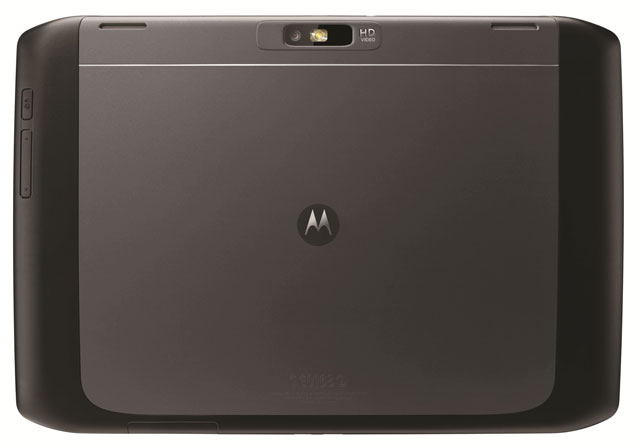
With the second Xoom, Motorola has decided to downgrade the secondary camera from two megapixels to 1,3 megapixels. Though the front camera isn’t likely to get that much use, it’s unusual and a little worrying to see a hardware feature regress between models.
Despite these decisions, there’s a great deal to like about the Xoom 2, just as there was with the original Xoom. It feels great in hand and sturdy, its stereo speakers offer surprisingly good sound for a tablet, and it’s responsive and stable in operation.
Motorola has opted to do the bare minimum of fiddling with the operating system or preinstalled applications and the company deserves a round of applause for this. The interface is simple, uncluttered and you needn’t spend the first half hour uninstalling superfluous apps or removing widgets.
Battery life is right up there with the competition. The Xoom 2 makes it through an entire day with heavy use and survived almost an entire weekend of light use.
There’s an optional stylus available for the Xoom 2, but we didn’t have one to test. There’s also an infrared emitter on top of the tablet, which allows it to interact with TVs and other devices. It’s novel, if not a little gimmicky, but you can’t blame Motorola for doing whatever it can to make its offering stand out in the already-crowded Android tablet market.
Though the 1,2GHz dual-core processor — really only a minor upgrade from the 1GHz dual-core model found on the first Xoom — results in great performance, with one quad-core tablet already in the market, and a slew of new quad-core offerings due in coming months, the overwhelming feeling is that the Xoom 2 is, once again, too late out of the gate.
Six months is a long time in the tablet market, and it’s far too long for a device to make its way from international markets to SA and still expect to be relevant, particularly if it isn’t running the latest and greatest software.
Aside from the strange omissions and downgrades, the Xoom 2 is a worthy successor to the Xoom and can hold its ground against the bulk of the current Android tablets. But the worry is that it’s not likely to stay abreast of new offerings, particularly when it comes to processing power and screen resolution.
It remains to be seen what impact Google’s acquiring Motorola Mobility will have on future products. Perhaps it’ll be a case of third time lucky with the Xoom? — (c) 2012 NewsCentral Media
- The Motorola Xoom 2 is available on Telkom’s 8ta network on the “Contract Basic S” package for R199/month over 24 months. Neither 8ta nor Motorola were able to provide standalone pricing at the time of publication.