Ahead of what promises to be a fiery two-day symposium in Midrand on Thursday and Friday, director-general in the department of communications, Mamodupi Mohlala, is seeking to play down industry concerns that SA plans summarily to ditch the standard it has adopted for digital terrestrial television.
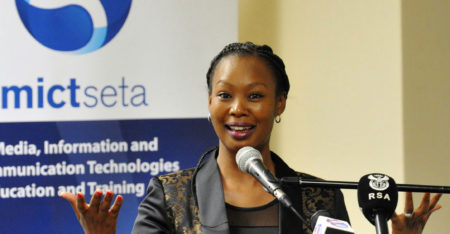
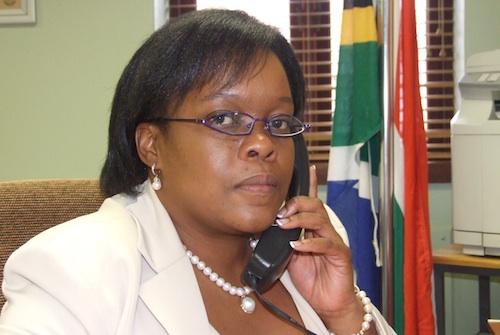
In an interview with TechCentral in Pretoria on Wednesday, Mohlala (pictured) insisted no deal has been done with Brazil to adopt Japan’s integrated services digital broadcasting terrestrial (ISDB-T) standard. SA adopted the rival European digital video broadcast terrestrial (DVB-T) standard in 2006 and has run extensive trials using the technology.
Industry leaders have been taken aback by government’s announcement last week that it will consider other digital standards for terrestrial broadcasting, saying the move could set back the migration to digital television by years. The migration to digital is expected to free up scarce radio frequency spectrum that can then be used to introduce new channels, offer high-definition television and provide wireless broadband services.
Sources told TechCentral earlier this week that the Brazilian government, which is one of only a handful outside Japan to adopt ISDB-T, is putting pressure on SA to switch away from its commitment to DVB-T.
Gerhard Petrick, a representative at the Southern African Digital Broadcasting Association, an industry body, says government’s call for a standards debate is “clearly biased against the adopted DVB-T standard and signals that the department of communications has bought into the sales talk of the Japanese and Brazilian lobbyists”.
But Mohlala has poured cold water on suggestions that government has already decided to ditch DVB-T in favour of ISDB-T. She says no decisions have been made and this week’s symposium has been called to debate the merits of the different technology standards. She also says there have been no agreements with Brazil related to digital television, despite a recent delegation to that country, led by Mohlala.
“I need to put the industry’s concerns at ease. There is no secret agreement and there is no decision to abandon the DVB-T standard,” Mohlala says.
She says technology has moved on since 2006 when SA adopted DVB-T, and a review of the different options is needed before the country commits itself to a commercial roll-out of digital terrestrial services. DVB-T, she says, has been “found to be somewhat problematic and this is why Europe is now moving to DVB-T2”.
DVB-T2 is an extension of the DVB-T standard.
“What we’re saying is, it is time for us to have a discussion about the challenges with the DVB-T standard, the challenges with the DVB-T2 standard, and to consider what ISDB-T provides, and then come up with what is most beneficial for SA from a developmental point of view,” Mohlala says.
She says government is keen to adopt the technology that best allows it to provide e-government services, especially to the rural poor.
“There is nothing that prevents DVB-T providers from coming to us and making proposals in line with government’s priorities,” Mohlala says.
“If there are manufacturers that are willing to bring forward proposals that meet our developmental needs, which include job creation, the issue of transferring skills, and the adaptability of the standard, it is incumbent on us as government to listen,” she says. “We mustn’t choose technology just for the sake of technology. We need to ensure it meets our developmental agenda and that’s why we are saying, let’s hear which technology best aligns itself to this agenda.”
Mohlala admits that if the country were to adopt a different standard, it would require buy-in from all the countries in the Southern African Development Community (SADC). The SADC countries have to agree on technologies and standards to ensure frequency harmonisation so that there isn’t cross-border interference in the airwaves.
Mohlala says she has already engaged personally with her peers in other SADC countries. “I spoke to them personally, and they welcomed the reopening of the discussions,” she says. SADC representatives will also be present and involved at this week’s symposium, as will representatives from Japan, China and South Korea, all of whom are interested in punting their respective digital terrestrial television standards.
If the country were to switch to a different standard — say, DVB-T2 or ISDB-T — the cost implications would be minimal, Mohlala says. She says Sentech, the government-owned signal broadcast distributor, has assured her that the investment it has already made in DVB-T technology will not have to be turfed, and that all that will be required is for the digital transmitters to be “reconfigured”. — Duncan McLeod, TechCentral
- See also: Row looming of digital TV standards
- Subscribe to our free daily newsletter
- Follow us on Twitter or on Facebook