Close Menu
TechCentralTechCentral

    Subscribe to the newsletter

    Get the best South African technology news and analysis delivered to your e-mail inbox every morning.

    Facebook X (Twitter) YouTube LinkedIn
    WhatsApp Facebook X (Twitter) LinkedIn YouTube
    TechCentralTechCentral
    • News

      Dis-Chem gets serious about e-commerce – again

      8 September 2026
      Shoprite's CTO is thinking of a future where new recruits arrive with their own AI agents - Chris Shortt

      Shoprite’s CTO is thinking of a future where new recruits arrive with their own AI agents

      8 September 2026
      Rubicon's EV charging network is profitable - and growing fast - Watts & Wheels

      Rubicon’s EV charging network is profitable – and growing fast

      8 September 2026
      Vodacom recruits former JSE chief as chair succession begins - Leila Fourie

      Vodacom recruits former JSE chief as chair succession begins

      8 September 2026
      The world map is messing with your head

      The world map is messing with your head

      8 September 2026
    • World
      'This is not circular': Jensen Huang defends $3.5-billion MediaTek deal

      ‘This is not circular’: Jensen Huang defends $3.5-billion MediaTek deal

      2 September 2026
      AI-generated music banned from Australian charts

      AI-generated music banned from Australian charts

      26 August 2026
      Traders brace for a R4.5-trillion swing in Nvidia's value

      Traders brace for a R4.5-trillion swing in Nvidia’s value

      25 August 2026
      Russia building its own Starlink - and faster than expected - Vadym Skibitskyi

      Russia building its own Starlink – and faster than expected

      11 August 2026
      Meta AI will now tell parents if their teen is in crisis

      Meta AI will now tell parents if their teen is in crisis

      17 July 2026
    • In-depth
      Google DeepMind CEO Demis Hassabis. Image: John Sears

      The plan to stop AI from breaking the world

      16 July 2026
      The internet has a Strait of Hormuz problem

      The internet has a Strait of Hormuz problem

      15 July 2026
      AI boom sparks rally, frenzy and fear

      AI boom sparks rally, frenzy and fear

      11 June 2026
      Every plug-in hybrid on sale in South Africa, ranked by price - Lamborghini Temerario

      Every plug-in hybrid on sale in South Africa, ranked by price

      7 June 2026
      What Wi-Fi 8 will mean for wireless networks

      What Wi-Fi 8 will mean for wireless networks

      1 June 2026
    • TCS
      Winstone Jordaan on building a national EV charging network

      Winstone Jordaan on building a national EV charging network

      2 September 2026
      Watts & Wheels S1E8: 'Tesla lands in Africa, just not here'

      Watts & Wheels S1E8: ‘Tesla lands in Africa, just not here’

      24 August 2026
      TCS | Herotel CEO Van Zyl Botha on beating Starlink to South Africa

      TCS | Herotel CEO Van Zyl Botha on beating Starlink to South Africa

      14 August 2026
      Meet the CIO | Discovery's Derek Wilcocks on AI, guardrails and growth

      Meet the CIO | Derek Wilcocks on how AI personalised Vitality

      13 August 2026
      TCS | Money just became native to the internet - Steven Boykey Sidley

      TCS | Money just became native to the internet – Steven Boykey Sidley

      12 August 2026
    • Opinion
      The fragile joint in the Capitec machine - Pambos Soteriades

      The R197-billion market the banks can’t reach

      25 August 2026
      South African tech's compounding debt problem - Jannie van Zyl

      Management consulting as we know it is over

      21 August 2026
      South African tech's compounding debt problem - Jannie van Zyl

      The most dangerous customer is the quiet one

      10 August 2026
      South African tech's compounding debt problem - Jannie van Zyl

      South African tech’s compounding debt problem

      29 July 2026
      The fragile joint in the Capitec machine - Pambos Soteriades

      Best network, worst vibes: the puzzle of SA telecoms

      20 July 2026
    • Company Hubs
      • 1Stream
      • Africa Data Centres
      • AfriGIS
      • Altron Digital Business
      • Altron Document Solutions
      • Altron Group
      • Arctic Wolf
      • Ascent Technology
      • AvertITD
      • BBD
      • Braintree
      • CallMiner
      • CambriLearn
      • CM.com
      • Contactable
      • CYBER1 Solutions
      • Digicloud Africa
      • Digimune
      • Domains.co.za
      • ESET
      • Euphoria Telecom
      • HOSTAFRICA
      • Incredible Business
      • iONLINE
      • IQbusiness
      • Iris Network Systems
      • Kaspersky
      • LSD Open
      • Mitel
      • NEC XON
      • Netstar
      • Network Platforms
      • Next DLP
      • Ovations
      • Paracon
      • Paratus
      • Q-KON
      • SevenC
      • SkyWire
      • Solid8 Technologies
      • Telit Cinterion
      • Telviva
      • Tenable
      • Vertiv
      • Videri Digital
      • Vodacom Business
      • Vox
      • Wipro
      • Workday
      • XLink
    • Sections
      • AI and machine learning
      • Banking
      • Broadcasting and Media
      • Cloud services
      • Contact centres and CX
      • Cryptocurrencies
      • Education and skills
      • Electronics and hardware
      • Energy and sustainability
      • Enterprise software
      • Financial services
      • HealthTech
      • Information security
      • Internet and connectivity
      • Internet of Things
      • Investment
      • IT services
      • Lifestyle
      • Policy and regulation
      • Public sector
      • Retail and e-commerce
      • Satellite communications
      • Science
      • SMEs and start-ups
      • Social media
      • Talent and leadership
      • Telecoms
      • Watts & Wheels
    • Events
    • Advertise
    TechCentralTechCentral
    Home » In-depth » Low-cost computers to teach SA kids

    Low-cost computers to teach SA kids

    By Regardt van der Berg25 June 2014
    Twitter LinkedIn Facebook WhatsApp Email Telegram Copy Link
    Get breaking news on WhatsApp

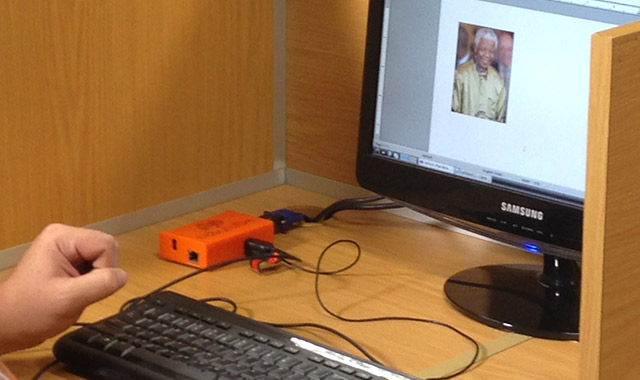
    EduCube-640

    The developers of a new, small-form-factor computer aimed at South African schools hope their invention will have an impact on the quality of the country’s education.

    The EduCube, developed in South Africa, is aimed at pupils all the way from grade one to matric and offers a range of educational software, past exam papers and an offline version of Wikipedia for scholars.

    The machine is the brainchild of Johan Roos, 37, the founder and MD of Enterprise Intelligence, a company that specialises in small-form-factor computing aimed at industrial and enterprise-scale users.

    The company sells the Ei Cube, which is similar in design to the EduCube, to industries where traditional computers do not work well due to power requirements or harsh operating conditions. It has also implemented the Ei Cube as a low-cost Asterisk communications server that is used in call centres.

    The idea for the EduCube was formed two years ago and was put into reality with the help of Luyanda Vappie, EduCube co-owner and director for strategy and innovation. “In the two years since we put the idea into reality, we have been working on getting the right content for EduCube,” says Roos. “This included getting Wikipedia onto the device and sourcing past exam papers, open-source handbooks and other materials.”

    Small-form-factor computers such as the Raspberry Pi and Arduino have become popular where traditional computers won’t work or are simply too large or expensive to implement.

    Roos says his company could not use the Raspberry Pi as the base device on which to build the EduCube because it has a number of shortcomings. “It only uses SD cards for storage, and we need something more reliable.” Also, the Raspberry Pi requires consistent power otherwise its circuit board “burns”. Power can’t be guaranteed in rural communities where the EduCube will be rolled out.

    “The USB ports on the Raspberry Pi also supply limited power and we needed more power to run a range of peripherals,” Roos says, adding that the fact that there’s no VGA port meant that an additional adapter is needed, adding to the cost.

    Enterprise Intelligence instead conceptualised its own computer that conformed to the specifications they felt were needed.

    The EduCube features a dual-core, 1GHz ARM processor and has 1GB of RAM. It also features 16GB of built-in Nand memory and storage can be expanded using a serial ATA connector. It also has a VGA port.

    The company is working on an eight-core version, which will also have a physical hard drive to allow the company to store large video files or even host data in basic server-like environments.

    Johan Roos
    Johan Roos

    The EduCube runs a custom version of Linux and is based on Ubuntu. It uses the optional Alex DE (Development Environment) to create the same look and feel as Windows. This, Roos says, was to keep the learning curve to a minimum and cut the training time needed.

    The EduCube has been piloted in five primary schools in Centurion, Midrand and Johannesburg, with 20 machines deployed per school.

    Roos says the solution caters to all scholars, from grade one to matric, with all the content, including 440 000 Wikipedia entries, stored on the device — meaning no Internet connection is needed. Pupils can search past exam papers for specific questions, while younger students can explore the educational games that come bundled with the EduCube.

    Part of the initiative is to also get funding for the translation of the Wikipedia content loaded onto the EduCube, into the top five national languages.

    The EduCube also contains a number of other educational software tools, including a Delphi-compatible cross-platform programming language called Lazarus.

    The EduCube retails for R2 000, although volume discounts are available.  The price excludes keyboard and mouse, but a small, notebook-like keyboard will be bundled in future.

    Roos says the next step is to put pre-recorded classroom lessons on the device. “These classes can be stored on the device where no Internet connection is available, or pulled from the cloud should the school have access to broadband.” This will also help to improve teacher skills, says Roos.

    Under a maintenance agreement, EduCube devices are updated with fresh content every two or three years, ensuring the latest national curriculum is covered. Schools with Internet access will soon also be able to download updates from a central server, but this feature is still in development.  — © 2014 NewsCentral Media

    Add TechCentral as a preferred source on GoogleFollow TechCentral on Google NewsGet breaking news on WhatsApp


    Arduino EduCube Ei Cube Enterprise Inteligence Johan Roos Luyanda Vappie Raspberry Pi Wikipedia
    WhatsApp YouTube
    Share. Facebook Twitter LinkedIn WhatsApp Telegram Email Copy Link
    Previous ArticleComedy Central cans Cliff: report
    Next Article Mxit by the numbers

    Related Posts

    Anthropic moves AI agents out of software and into the lab

    Anthropic moves AI agents out of software and into the lab

    28 August 2026
    AI demand sparks 'chipflation' warning

    AI is eating the world’s memory – and we’re all going to pay the price

    22 January 2026
    Wikipedia moves to monetise AI giants' reliance on its content

    Wikipedia moves to monetise AI giants’ reliance on its content

    15 January 2026
    Company News
    How dual-source technology is changing laser engraving

    How dual-source technology is changing laser engraving

    8 September 2026
    Why SA homes need better Wi-Fi, not faster internet - Vox Telecom

    Why SA homes need better Wi-Fi, not faster internet

    8 September 2026
    Most enterprises don't have an identity strategy - they have a patchwork - Contactable

    Most enterprises don’t have an identity strategy – they have a patchwork

    7 September 2026
    Opinion
    The fragile joint in the Capitec machine - Pambos Soteriades

    The R197-billion market the banks can’t reach

    25 August 2026
    South African tech's compounding debt problem - Jannie van Zyl

    Management consulting as we know it is over

    21 August 2026
    South African tech's compounding debt problem - Jannie van Zyl

    The most dangerous customer is the quiet one

    10 August 2026

    Subscribe to Updates

    Get the best South African technology news and analysis delivered to your e-mail inbox every morning.

    Latest Posts

    Dis-Chem gets serious about e-commerce – again

    8 September 2026
    Shoprite's CTO is thinking of a future where new recruits arrive with their own AI agents - Chris Shortt

    Shoprite’s CTO is thinking of a future where new recruits arrive with their own AI agents

    8 September 2026
    Rubicon's EV charging network is profitable - and growing fast - Watts & Wheels

    Rubicon’s EV charging network is profitable – and growing fast

    8 September 2026
    Vodacom recruits former JSE chief as chair succession begins - Leila Fourie

    Vodacom recruits former JSE chief as chair succession begins

    8 September 2026
    © 2009 - 2026 NewsCentral Media
    Built and maintained by Chronon
    • Cookie policy (ZA)
    • TechCentral – privacy and Popia

    Type above and press Enter to search. Press Esc to cancel.

    Manage consent

    TechCentral uses cookies to enhance its offerings. Consenting to these technologies allows us to serve you better. Not consenting or withdrawing consent may adversely affect certain features and functions of the website.

    Functional Always active
    The technical storage or access is strictly necessary for the legitimate purpose of enabling the use of a specific service explicitly requested by the subscriber or user, or for the sole purpose of carrying out the transmission of a communication over an electronic communications network.
    Preferences
    The technical storage or access is necessary for the legitimate purpose of storing preferences that are not requested by the subscriber or user.
    Statistics
    The technical storage or access that is used exclusively for statistical purposes. The technical storage or access that is used exclusively for anonymous statistical purposes. Without a subpoena, voluntary compliance on the part of your Internet Service Provider, or additional records from a third party, information stored or retrieved for this purpose alone cannot usually be used to identify you.
    Marketing
    The technical storage or access is required to create user profiles to send advertising, or to track the user on a website or across several websites for similar marketing purposes.
    • Manage options
    • Manage services
    • Manage {vendor_count} vendors
    • Read more about these purposes
    View preferences
    • {title}
    • {title}
    • {title}