Close Menu
TechCentralTechCentral

    Subscribe to the newsletter

    Get the best South African technology news and analysis delivered to your e-mail inbox every morning.

    Facebook X (Twitter) YouTube LinkedIn
    WhatsApp Facebook X (Twitter) LinkedIn YouTube
    TechCentralTechCentral
    • News
      Big win for South African innovation agency - Technology Innovation Agency CEO Titus Mathe

      R1.2-billion win for South African innovation agency

      9 June 2026
      Eskom Green to build 32GW of renewables by 2040 - Mteto Nyati - Mteto Nyati

      Eskom Green to build 32GW of renewables by 2040

      9 June 2026
      South Africa's EV sales nearly double - but the base is still tiny

      South Africa’s EV sales nearly double – but the base is still tiny

      9 June 2026
      MTN enlists Alipay owner to turn MoMo into a super app

      MTN enlists Alipay owner to turn MoMo into a super app

      9 June 2026
      The clock is ticking on South African banks' biggest advantage

      The clock is ticking on South African banks’ biggest advantage

      9 June 2026
    • World
      Meta declares war on Israeli spyware firm

      Meta declares war on Israeli spyware firm

      8 June 2026
      Meta takes on OpenAI and Anthropic in enterprise AI

      Meta takes on OpenAI and Anthropic in enterprise AI

      4 June 2026
      AI demand sparks 'chipflation' warning

      AI demand sparks ‘chipflation’ warning

      4 June 2026
      Astronomers discover exoplanets with magnetic fields

      Strange winds reveal magnetic fields on distant ‘hot Jupiters’

      2 June 2026
      AI giant Anthropic files for landmark US listing

      AI giant Anthropic files for landmark US listing

      1 June 2026
    • In-depth
      Every plug-in hybrid on sale in South Africa, ranked by price - Lamborghini Temerario

      Every plug-in hybrid on sale in South Africa, ranked by price

      7 June 2026
      What Wi-Fi 8 will mean for wireless networks

      What Wi-Fi 8 will mean for wireless networks

      1 June 2026
      Alfa's electric rebel - Alfa Romeo Junior Elettrica Veloce

      Alfa’s electric rebel

      29 April 2026
      Africa switches on as Europe dims the lights

      Africa switches on as Europe dims the lights

      9 April 2026
      The biggest untapped EV market on Earth is hiding in plain sight

      The biggest untapped EV market on Earth is hiding in plain sight

      1 April 2026
    • TCS
      Watts & Wheels S1E5: 'A Bentley of the bush and a car that swims'

      Watts & Wheels S1E5: ‘A Bentley of the bush and a car that swims’

      8 June 2026
      TCS | Charge's R1.8-billion bet on an off-grid EV future - Charge chairman Joubert Roux

      TCS | Charge’s R1.8-billion bet on an off-grid EV future

      18 May 2026
      TCS+ | The Up&Up Group on the hidden cost of AI - Jason Harrison

      TCS+ | The Up&Up Group on the hidden cost of AI

      13 May 2026
      Michael Rossouw

      TCS+ | The retirement decision most South Africans get wrong

      6 May 2026
      TCS | The Cape Town start-up listening for TB with AI - Braden van Breda

      TCS | The Cape Town start-up listening for TB with AI

      4 May 2026
    • Opinion

      Clashing judgments leave South Africa’s crypto law unsettled

      2 June 2026
      The author, Pambos Soteriades

      The trap inside South Africa’s banking MVNO boom

      1 June 2026
      The hidden cost of social media age bans is everyone's privacy - Petrus Potgieter

      The hidden cost of social media age bans is everyone’s privacy

      29 May 2026
      Treasury's crypto crackdown is a betrayal of Mandela's promise - Duncan McLeod

      Treasury’s crypto crackdown is a betrayal of Mandela’s promise

      22 May 2026
      South Africa is sleepwalking into another AI policy failure - Celeste Labuschagne

      South Africa is sleepwalking into another AI policy failure

      20 May 2026
    • Company Hubs
      • 1Stream
      • Africa Data Centres
      • AfriGIS
      • Altron Digital Business
      • Altron Document Solutions
      • Altron Group
      • Arctic Wolf
      • Ascent Technology
      • AvertITD
      • BBD
      • Braintree
      • CallMiner
      • CambriLearn
      • CM Telecom
      • Contactable
      • CYBER1 Solutions
      • Digicloud Africa
      • Digimune
      • Domains.co.za
      • ESET
      • Euphoria Telecom
      • HOSTAFRICA
      • Incredible Business
      • iONLINE
      • IQbusiness
      • Iris Network Systems
      • Kaspersky
      • LSD Open
      • Mitel
      • NEC XON
      • Netstar
      • Network Platforms
      • Next DLP
      • Ovations
      • Paracon
      • Paratus
      • Q-KON
      • SevenC
      • SkyWire
      • Solid8 Technologies
      • Telit Cinterion
      • Telviva
      • Tenable
      • Vertiv
      • Videri Digital
      • Vodacom Business
      • Wipro
      • Workday
      • XLink
    • Sections
      • AI and machine learning
      • Banking
      • Broadcasting and Media
      • Cloud services
      • Contact centres and CX
      • Cryptocurrencies
      • Education and skills
      • Electronics and hardware
      • Energy and sustainability
      • Enterprise software
      • Financial services
      • HealthTech
      • Information security
      • Internet and connectivity
      • Internet of Things
      • Investment
      • IT services
      • Lifestyle
      • Motoring
      • Policy and regulation
      • Public sector
      • Retail and e-commerce
      • Satellite communications
      • Science
      • SMEs and start-ups
      • Social media
      • Talent and leadership
      • Telecoms
    • Events
    • Advertise
    TechCentralTechCentral
    Home » Top » IBM in quantum computing breakthrough

    IBM in quantum computing breakthrough

    By Editor28 February 2012
    Twitter LinkedIn Facebook WhatsApp Email Telegram Copy Link
    News Alerts
    WhatsApp
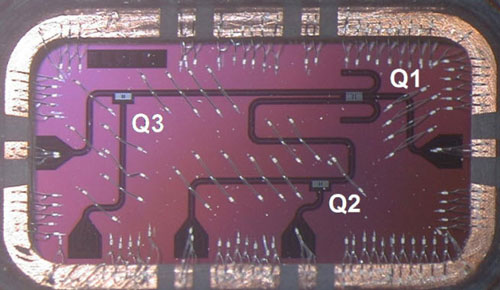
    The Silicon chip housing a total of three qubits. The chip is back-mounted on a PC board and connects to I/O coaxial lines via wire bonds (scale: 8mm x 4mm). A larger assembly of such qubits and resonators are expected to be used for a scalable architecture

    IBM is announcing on Tuesday that it has made major advances towards creating a practical, full-scale quantum computer, a fabled, theoretical machine that relies on the tiniest atomic properties to compute problems faster than any supercomputer that exists today.

    Scientists at IBM Research said that their quantum computing solution leverages the underlying quantum mechanics of matter and that a real quantum computer, which could work on millions of computations at once, could be built in the next decade. The hugely multitasking devices will have big implications for fields such as data encryption.

    Quantum computing has been a Holy Grail in research since Nobel Prize physicist Richard Feynman challenged scientists  in 1981 to build computers based on quantum mechanics, which predicts that matter can be in multiple states at once, in contrast to the on-off transistors that have been the foundation of computing since the 1940s. For decades, the work was all theoretical. But now IBM scientists believe they’re on the cusp of building systems that will redefine computing.

    “I do think this will happen within my lifetime,” said Matthias Steffen, manager of the Experimental Quantum Computing group, in an interview with VentureBeat. Steffen has been working on the technology for more than a decade. “Quantum computing could revolutionise information technology compared to what we know now.”

    Some of the advances in creating new quantum computers are astounding. Last week, Australian and American physicists at the University of New South Wales and Purdue University reported they had built a transistor from a single phosphorus atom embedded in a silicon crystal. That helped lay the groundwork for a quantum computer.

    The IBM scientists made their advances independently and will present them on Tuesday at the annual American Physical Society meeting in Boston. In contrast to last week’s news, the IBM “qubit,” or quantum bit technology, is built with relatively large dimensions. IBM showed it could put three qubits on one chip (picture at top). Individual 3D qubits are suspended in the centre of the cavity on a small sapphire chip, as shown in the smaller picture below.

    Steffen said that the new quantum computers should be able to do certain computations, such as factoring a prime number, much faster than traditional machines.

    “Quantum computing could factor numbers, or break them down into their prime numbers, in exponentially fewer steps than can be done with classical computers,” Steffen said. “That helps with decryption.”

    Right now, IBM can put about five qubit prototypes on a chip. But over time, it may want to put more than 1m qubits on a chip.

    The scientists have set three new records for reducing the error in elementary computations while retaining the integrity of quantum mechanical properties in quantum bits (or qubits), which are the basic units that carry information within quantum computing. Those qubits allow a quantum computer to work simultaneously on many problems while a desktop PC typically handles a limited number of computations at a time. A single 250-qubit state contains more bits of data than there are particles in the universe.

    IBM is creating superconducting qubits using established techniques for manufacturing silicon chips. That gives the qubit devices the potential to be mass-produced in the billions.

    Besides factoring very large numbers, the new devices could be used to search databases of unstructured information such as videos. They could also be used to do optimisation tasks and solve interesting new mathematical problems.

    Individual 3D qubits are suspended in the centre of the cavity on a small sapphire chip (click image to enlarge)

    “The quantum computing work we are doing shows it is no longer just a brute force physics experiment. It’s time to start creating systems based on this science that will take computing to a whole new level,” said Steffen.

    How it works
    In classical computers, the basic piece of information is a bit. A bit can have only one of two values: “1” or “0”. That forms the basis for the on-off nature of digital computers, like a light switch. It is either on or off. Qubits can hold a value of “1” or “0” as well as both values at the same time. This feature is known as “superposition” and it lets quantum computers do millions of calculations at once.

    The challenge of harnessing this power is controlling or removing quantum decoherence, or the creation of errors in calculations caused by interference from heat, electromagnetic radiation and materials defects in a chip. Scientists have experimented with ways to reduce the errors and lengthen the period in which qubits retain their quantum mechanical properties. If the time is long enough, error correction can make it possible to perform long and complex calculations.

    IBM says there’s a variety of ways to achieve the end goal of a functioning quantum computer. IBM’s group focused on using superconducting qubits — basically designer molecules — that allow easier mass production. It created a 3D superconducting qubit (3D qubit) that originated from research at Yale University. The 3D qubit is a sandwich of a superconducting electrode, an insulator and another superconducting electrode. Put together with a capacitor, the device captures the basic function of a qubit. The dimensions of the qubit are around 10 or 100 microns, large in terms of chip technology. If you add more and more qubits, you get something that can work on many different calculations as the same time.

    The team created a 3D qubit that allowed the devices to remain stable for up to 100 microseconds. After that, they collapse into a less useful ground state. When they collapse, they produce an error. But the 100-microsecond time is just past the minimum threshold needed to institute effective error correction. In other words, if you can correct an error quickly enough, the device can still be useful. Over the past decade, this technology has been improved about 10 000 times, Steffen said.

    “We are now good enough where we can put five or 10 of these on a chip and start doing quantum calculations,” Steffen said. “We have to solve a number of engineering questions. It’s exciting to be at this point.”

    The IBM team also did separate experiments, creating a 2D qubit device with two-qubit logic operations. The operation showed a 95% success rate and a coherence time of 10 microseconds. The numbers are just short of the time required for effective error correction. The net result of the advances is that a practical quantum computer could be created in the not so distant future.

    “The superconducting qubit research led by the IBM team has been progressing in a much focused way on the road to a reliable, scalable quantum computer,” said David DiVincenzo, professor at the Institute of Quantum Information at Research Center Juelich. “The device performance that they have now reported brings them nearly to the tipping point; we can now see the building blocks that will be used to prove that error correction can be effective and that reliable logical qubits can be realised.”

    While most of the work has focused on improving components within the devices, the research must now focus on building systems that integrate error correction, input-output and cost issues. IBM envisions a quantum computer connected to a classical computing system. Today, the smallest devices made may have circuits 22 nanometers apart, or less than 100 atoms.

    IBM started with five researchers and it now has 15 on the project.  — Dean Takahashi, VentureBeat

    • Images courtesy of IBM
    • Subscribe to our free daily newsletter
    • Follow us on Twitter or on Google+ or on Facebook
    • Visit our sister website, SportsCentral (still in beta)

    Follow TechCentral on Google News Add TechCentral as your preferred source on Google


    IBM
    WhatsApp YouTube
    Share. Facebook Twitter LinkedIn WhatsApp Telegram Email Copy Link
    Previous ArticleDell is ‘no longer a PC company’
    Next Article Copper theft rises with price increases

    Related Posts

    IBM doubles down on quantum computing with $10-billion bet

    IBM doubles down on quantum computing with $10-billion bet

    28 May 2026
    IBM commits $5-billion to secure open-source software

    IBM commits $5-billion to secure open-source software

    28 May 2026
    South Africa Inc must wake up to quantum threat - Phumzile Madonsela

    South Africa Inc must wake up to quantum threat

    7 April 2026
    Company News
    Huawei nova 15 Max now available in South Africa

    Huawei nova 15 Max now available in South Africa

    9 June 2026
    Avert IT Distribution, AnyDesk create growth opportunities for African IT partners

    Avert IT Distribution, AnyDesk create growth opportunities for African IT partners

    9 June 2026
    South Africa's cloud reckoning: have your say

    South Africa’s cloud reckoning: have your say

    9 June 2026
    Opinion

    Clashing judgments leave South Africa’s crypto law unsettled

    2 June 2026
    The author, Pambos Soteriades

    The trap inside South Africa’s banking MVNO boom

    1 June 2026
    The hidden cost of social media age bans is everyone's privacy - Petrus Potgieter

    The hidden cost of social media age bans is everyone’s privacy

    29 May 2026

    Subscribe to Updates

    Get the best South African technology news and analysis delivered to your e-mail inbox every morning.

    Latest Posts
    Huawei nova 15 Max now available in South Africa

    Huawei nova 15 Max now available in South Africa

    9 June 2026
    Big win for South African innovation agency - Technology Innovation Agency CEO Titus Mathe

    R1.2-billion win for South African innovation agency

    9 June 2026
    Eskom Green to build 32GW of renewables by 2040 - Mteto Nyati - Mteto Nyati

    Eskom Green to build 32GW of renewables by 2040

    9 June 2026
    Avert IT Distribution, AnyDesk create growth opportunities for African IT partners

    Avert IT Distribution, AnyDesk create growth opportunities for African IT partners

    9 June 2026
    © 2009 - 2026 NewsCentral Media
    • Cookie policy (ZA)
    • TechCentral – privacy and Popia

    Type above and press Enter to search. Press Esc to cancel.

    Manage consent

    TechCentral uses cookies to enhance its offerings. Consenting to these technologies allows us to serve you better. Not consenting or withdrawing consent may adversely affect certain features and functions of the website.

    Functional Always active
    The technical storage or access is strictly necessary for the legitimate purpose of enabling the use of a specific service explicitly requested by the subscriber or user, or for the sole purpose of carrying out the transmission of a communication over an electronic communications network.
    Preferences
    The technical storage or access is necessary for the legitimate purpose of storing preferences that are not requested by the subscriber or user.
    Statistics
    The technical storage or access that is used exclusively for statistical purposes. The technical storage or access that is used exclusively for anonymous statistical purposes. Without a subpoena, voluntary compliance on the part of your Internet Service Provider, or additional records from a third party, information stored or retrieved for this purpose alone cannot usually be used to identify you.
    Marketing
    The technical storage or access is required to create user profiles to send advertising, or to track the user on a website or across several websites for similar marketing purposes.
    • Manage options
    • Manage services
    • Manage {vendor_count} vendors
    • Read more about these purposes
    View preferences
    • {title}
    • {title}
    • {title}