
Close Menu
TechCentralTechCentral

    Subscribe to the newsletter

    Get the best South African technology news and analysis delivered to your e-mail inbox every morning.

    Facebook X (Twitter) YouTube LinkedIn
    WhatsApp Facebook X (Twitter) LinkedIn YouTube
    TechCentralTechCentral
    • News
      Political war erupts over BEE in the ICT sector - Solly Malatsi

      Political war erupts over BEE in the ICT sector

      13 December 2025
      Icasa told to align on BEE in move that will favour Starlink - Solly Malatsi

      Icasa told to align on BEE in move that will favour Starlink

      12 December 2025
      South African solar industry faces a reality check

      South African solar industry faces a reality check

      12 December 2025
      OpenAI launches GPT-5.2 after 'code red' push to counter Google. Shelby Tauber/Reuters

      OpenAI launches GPT-5.2 after ‘code red’ push to counter Google

      12 December 2025

      A leaner BCX positions itself as market consolidator

      11 December 2025
    • World
      Oracle’s AI ambitions face scrutiny on earnings miss

      Oracle’s AI ambitions face scrutiny on earnings miss

      11 December 2025
      China will get Nvidia H200 chips - but not without paying Washington first

      China will get Nvidia H200 chips – but not without paying Washington first

      9 December 2025
      IBM reportedly close to $11-billion deal to buy Confluent - Arvind Krishna

      IBM reportedly close to $11-billion deal to buy Confluent

      8 December 2025
      Amazon and Google launch multi-cloud service for faster connectivity

      Amazon and Google launch multi-cloud service for faster connectivity

      1 December 2025
      Google makes final court plea to stop US breakup

      Google makes final court plea to stop US breakup

      21 November 2025
    • In-depth
      Black Friday goes digital in South Africa as online spending surges to record high

      Black Friday goes digital in South Africa as online spending surges to record high

      4 December 2025
      Canal+ plays hardball - and DStv viewers feel the pain

      Canal+ plays hardball – and DStv viewers feel the pain

      3 December 2025
      Jensen Huang Nvidia

      So, will China really win the AI race?

      14 November 2025
      Valve's Linux console takes aim at Microsoft's gaming empire

      Valve’s Linux console takes aim at Microsoft’s gaming empire

      13 November 2025
      iOCO's extraordinary comeback plan - Rhys Summerton

      iOCO’s extraordinary comeback plan

      28 October 2025
    • TCS
      TCS+ | Africa's digital transformation - unlocking AI through cloud and culture - Cliff de Wit Accelera Digital Group

      TCS+ | Cloud without culture won’t deliver AI: Accelera’s Cliff de Wit

      12 December 2025
      TCS+ | How Cloud on Demand helps partners thrive in the AWS ecosystem - Odwa Ndyaluvane and Xenia Rhode

      TCS+ | How Cloud On Demand helps partners thrive in the AWS ecosystem

      4 December 2025
      TCS | MTN Group CEO Ralph Mupita on competition, AI and the future of mobile

      TCS | Ralph Mupita on competition, AI and the future of mobile

      28 November 2025
      TCS | Dominic Cull on fixing South Africa's ICT policy bottlenecks

      TCS | Dominic Cull on fixing South Africa’s ICT policy bottlenecks

      21 November 2025
      TCS | BMW CEO Peter van Binsbergen on the future of South Africa's automotive industry

      TCS | BMW CEO Peter van Binsbergen on the future of South Africa’s automotive industry

      6 November 2025
    • Opinion
      Netflix, Warner Bros deal raises fresh headaches for MultiChoice - Duncan McLeod

      Netflix, Warner Bros deal raises fresh headaches for MultiChoice

      5 December 2025
      BIN scans, DDoS and the next cybercrime wave hitting South Africa's banks - Entersekt Gerhard Oosthuizen

      BIN scans, DDoS and the next cybercrime wave hitting South Africa’s banks

      3 December 2025
      Your data, your hardware: the DIY AI revolution is coming - Duncan McLeod

      Your data, your hardware: the DIY AI revolution is coming

      20 November 2025
      Zero Carbon Charge founder Joubert Roux

      The energy revolution South Africa can’t afford to miss

      20 November 2025
      It's time for a new approach to government IT spend in South Africa - Richard Firth

      It’s time for a new approach to government IT spend in South Africa

      19 November 2025
    • Company Hubs
      • Africa Data Centres
      • AfriGIS
      • Altron Digital Business
      • Altron Document Solutions
      • Altron Group
      • Arctic Wolf
      • AvertITD
      • Braintree
      • CallMiner
      • CambriLearn
      • CYBER1 Solutions
      • Digicloud Africa
      • Digimune
      • Domains.co.za
      • ESET
      • Euphoria Telecom
      • Incredible Business
      • iONLINE
      • IQbusiness
      • Iris Network Systems
      • LSD Open
      • NEC XON
      • Netstar
      • Network Platforms
      • Next DLP
      • Ovations
      • Paracon
      • Paratus
      • Q-KON
      • SevenC
      • SkyWire
      • Solid8 Technologies
      • Telit Cinterion
      • Tenable
      • Vertiv
      • Videri Digital
      • Vodacom Business
      • Wipro
      • Workday
      • XLink
    • Sections
      • AI and machine learning
      • Banking
      • Broadcasting and Media
      • Cloud services
      • Contact centres and CX
      • Cryptocurrencies
      • Education and skills
      • Electronics and hardware
      • Energy and sustainability
      • Enterprise software
      • Financial services
      • Information security
      • Internet and connectivity
      • Internet of Things
      • Investment
      • IT services
      • Lifestyle
      • Motoring
      • Public sector
      • Retail and e-commerce
      • Satellite communications
      • Science
      • SMEs and start-ups
      • Social media
      • Talent and leadership
      • Telecoms
    • Events
    • Advertise
    TechCentralTechCentral
    Home » Opinion » Hilton Tarrant » How Vodacom is outsmarting MTN

    How Vodacom is outsmarting MTN

    By Hilton Tarrant2 June 2015
    Twitter LinkedIn Facebook WhatsApp Email Telegram Copy Link
    News Alerts
    WhatsApp

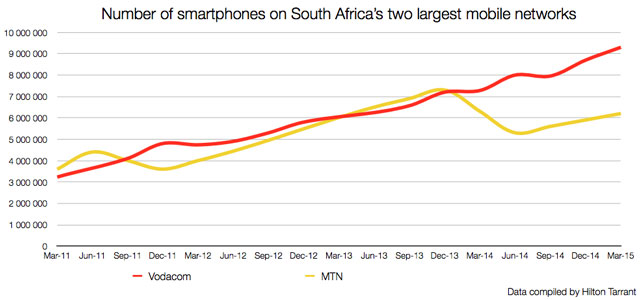
    hilton-tarrant-180In May, Vodacom announced that it had 9,3m smartphones on its network in South Africa (as at end March, the end of its financial year). That is massive, especially considering that a year ago, the number was 7,3m. Total smart devices on its network — which include tablets and dongles — number 11,6m.

    By comparison, MTN had 5,9m smartphones on its South African network as at 31 December 2014. That’s the most recently published number (it doesn’t disclose this data in its quarterly group subscriber updates). MTN is adding about 300 000 smart devices a quarter, so by 31 March, it likely had around 6,2m active.

    But, this still leaves Vodacom around 50% ahead!

    What makes this particularly interesting is that up until the end of 2013, both Vodacom and MTN were neck and neck in terms of number of active smartphones on their networks. In fact, MTN caught up to Vodacom and then surpassed its larger rival in the latter half of 2013.

    What happened last year is unprecedented: MTN announced in August that active smartphones as at 30 June totalled 5,3m, a 2m drop from six months prior. It cited a “change in definition” for this reduction. Attempts to get comment from MTN South Africa last week were unsuccessful (but then again, with tyres burning outside its 14th Avenue head office, call centres and stores shut, it surely has bigger problems).

    So what could’ve led to this massive restatement?

    The clue, I believe, is in the above-average growth evident in MTN’s 2012 and 2013 numbers. It’s no coincidence that the fourth quarter of 2013 marked “peak” BlackBerry in South Africa. Among the local operators, MTN was still aggressively adding BlackBerry subscribers very late in the game. Remember that, following the launch of BlackBerry 10 in 2013, legacy BlackBerry usage (the kind that became popular with all-you-can-eat Internet) cratered. From that point, there were precious few compelling devices that still offered BIS. Plus the market moved on. You simply didn’t need a BlackBerry anymore. Not with the cheap and undeniably better Android devices that began to hit stores.

    So, MTN’s mystery 2m “smartphones” were surely legacy BlackBerry (OS 7) devices. It’s the only plausible answer. Besides, in 2015 (and 2014), it would actually be hard to argue that a three-year-old Curve which was still chugging away on the network would be classed as a “smartphone”.

    Vodacom-Smart-Kicka--SIDE-640
    Vodacom Smart Kicka

    Vodacom’s definition of a smartphone, as per its annual report, is rather generic: “a mobile phone offering advanced capabilities, including access to e-mail and the Internet” (MTN doesn’t publish a definition in its annual report). This means those legacy phones are probably stuck somewhere inside Vodacom’s 9,3m figure, but, it has been far more aggressive in switching users away from those legacy BlackBerry devices. In fact, in late 2013, you could hardly find the promotion of one in its monthly deal sheets (compared to MTN where they’d have pride of place on page 3). I’d guesstimate that Vodacom probably has around a million of the old OS 7 BlackBerry devices left on its network, if that.

    Many of those old BlackBerry die-hards have ended up on Vodacom’s own low-cost Vodafone-branded devices, a strategy that’s becoming more successful over time. In the past year alone, Vodacom has sold “more than 3m low-cost smart devices”. This includes the Smart Kicka (R659 cash) and Smart Tab (R1 179), which sold over a million since launch in the operator’s financial third quarter (September to December 2014). That is an incredible number.

    Out of the 2m total smart devices Vodacom added between March 2014 and March 2015, 1,3m were in the last six months. This speaks to the success of its low-cost own-device strategy. (MTN, by contrast, has tried to emulate this with the “Steppa”, but continual stock-problems have meant that customers simply haven’t been able to get them.)

    It also illustrates something else. With most of the growth coming at the low end (effectively sub-R1 200), the rest of the market is already fairly saturated.

    Practically everyone who can afford a smartphone has one. Vodacom says 43% of the devices on its network are smart (with 15,4m non-smart). These numbers are important, because it’s not as simple as dividing the device total by the active “subscribers” total, given that active subscribers are total active Sim cards, not devices.

    But Vodacom’s detailed numbers back this up: 78% of post-paid users are on “integrated tariffs” (the Smart and Red price plans). You can be sure that smartphone penetration among the remaining 22% of users is high. So, nearly everyone who is on contract has a smartphone. In the (upper-) mid- to high-end of the prepaid market, the same is true.

    Winning here is now about driving the adoption of those sub-US$100 (R1 200) and even sub-$50 (R600) smartphones.

    Why all this focus on smartphones when there are 17m active data users each on Vodacom and MTN? After all, that’s around twice as many as there are smartphones?
    smartphones-mtn-vodacom-640

    Not only is the market ensuring that very soon you won’t be able to buy a feature phone (they simply will no longer exist), but smartphone users use a ton more data than non-smartphone users. To operators, this is gold.

    Already, Vodacom says the average amount of data used per month by its smartphone users is 342MB, growth of 38% from a year earlier.

    Vodafone’s group figures are revealing. Users with iOS and Android devices in its European markets (including the UK, Germany, Italy and Spain) are now using 755MB/month on average. This is 60% more than a year ago (473MB).

    That’s the gap. That’s the potential. From this point, we will double to catch up with average usage in Europe. At the upper end of the market, we already likely compare very favourably.

    Aside from driving smartphone adoption, data bundles (and pricing) are the other big lever that operators have to stimulate usage. In its May reporting, Vodacom’s given us some colour on how successful it’s been. In the past year, it sold 196m data bundles, an increase of 139% over 2014. By the beginning of this year, it was selling an average of 20m data bundles per month! Ninety percent of all usage is now in bundle.

    bundles-devices-640

    Most would argue that data pricing is not quite “there” yet. Still, Vodacom says the average price per megabyte has dropped by 24,1% over the past year, after a 24,8% reduction a year prior. That means the average price users are paying for data has halved since March 2013.

    Many people will balk at this statement, and that’s potentially the problem with averages. Prices have not necessarily halved at the top end. But it’s definitely become a lot cheaper and easier to buy a 60MB data bundle for R6 (or 100MB for R10) at the lower end. Anyone surprised?

    • Hilton Tarrant works at immedia, specialists in native mobile app and Web development
    • This article was first published on Moneyweb and is republished here with permission


    BlackBerry MTN MTN Steppa Smart Kicka Steppa Vodacom Vodacom Smart Kicka
    Subscribe to TechCentral Subscribe to TechCentral
    Share. Facebook Twitter LinkedIn WhatsApp Telegram Email Copy Link
    Previous ArticleCwele edges forward on ICT policy review
    Next Article SA’s online porn secrets revealed

    Related Posts

    Vodacom follows MTN with post-paid price hikes

    Vodacom follows MTN with post-paid price hikes

    11 December 2025
    Above-inflation price hikes to hit MTN customers

    Above-inflation price hikes to hit MTN customers

    10 December 2025
    Nkosana Makate sees off challenge to his 'please call me' payout

    Makate sees off challenge to his ‘please call me’ payout

    9 December 2025
    Company News
    When the physical world goes online: the new front line of cyber risk - Snode Technologies

    When the physical world goes online: the new front line of cyber risk

    12 December 2025
    Endless possibilities with Adapt IT Telecoms' unified VAS platform - Matthew Seabrook

    Endless possibilities with Adapt IT Telecoms’ unified VAS platform

    11 December 2025
    Securing IoT connectivity: how MSB Micro Systems keeps devices in check

    Securing IoT connectivity: how MSB Micro Systems keeps devices in check

    11 December 2025
    Opinion
    Netflix, Warner Bros deal raises fresh headaches for MultiChoice - Duncan McLeod

    Netflix, Warner Bros deal raises fresh headaches for MultiChoice

    5 December 2025
    BIN scans, DDoS and the next cybercrime wave hitting South Africa's banks - Entersekt Gerhard Oosthuizen

    BIN scans, DDoS and the next cybercrime wave hitting South Africa’s banks

    3 December 2025
    Your data, your hardware: the DIY AI revolution is coming - Duncan McLeod

    Your data, your hardware: the DIY AI revolution is coming

    20 November 2025

    Subscribe to Updates

    Get the best South African technology news and analysis delivered to your e-mail inbox every morning.

    Latest Posts
    Political war erupts over BEE in the ICT sector - Solly Malatsi

    Political war erupts over BEE in the ICT sector

    13 December 2025
    Icasa told to align on BEE in move that will favour Starlink - Solly Malatsi

    Icasa told to align on BEE in move that will favour Starlink

    12 December 2025
    South African solar industry faces a reality check

    South African solar industry faces a reality check

    12 December 2025
    TCS+ | Africa's digital transformation - unlocking AI through cloud and culture - Cliff de Wit Accelera Digital Group

    TCS+ | Cloud without culture won’t deliver AI: Accelera’s Cliff de Wit

    12 December 2025
    © 2009 - 2025 NewsCentral Media
    • Cookie policy (ZA)
    • TechCentral – privacy and Popia

    Type above and press Enter to search. Press Esc to cancel.

    Manage consent

    TechCentral uses cookies to enhance its offerings. Consenting to these technologies allows us to serve you better. Not consenting or withdrawing consent may adversely affect certain features and functions of the website.

    Functional Always active
    The technical storage or access is strictly necessary for the legitimate purpose of enabling the use of a specific service explicitly requested by the subscriber or user, or for the sole purpose of carrying out the transmission of a communication over an electronic communications network.
    Preferences
    The technical storage or access is necessary for the legitimate purpose of storing preferences that are not requested by the subscriber or user.
    Statistics
    The technical storage or access that is used exclusively for statistical purposes. The technical storage or access that is used exclusively for anonymous statistical purposes. Without a subpoena, voluntary compliance on the part of your Internet Service Provider, or additional records from a third party, information stored or retrieved for this purpose alone cannot usually be used to identify you.
    Marketing
    The technical storage or access is required to create user profiles to send advertising, or to track the user on a website or across several websites for similar marketing purposes.
    • Manage options
    • Manage services
    • Manage {vendor_count} vendors
    • Read more about these purposes
    View preferences
    • {title}
    • {title}
    • {title}