

How 3D printing will change the world

Johannesburg-based company DemaPlasTech says 3D printing is going mainstream and will change manufacturing forever. By Duncan McLeod.

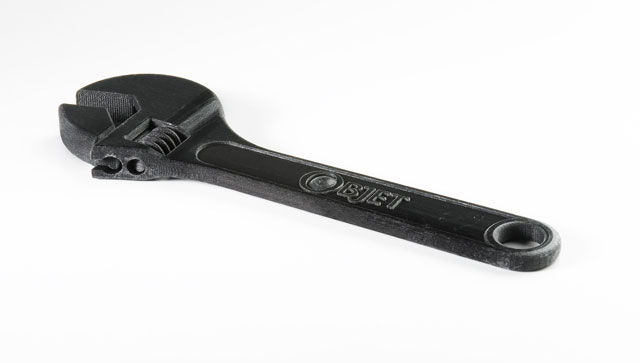
An adjustable spanner created on an Objet 3D printer

In a nondescript office park northwest of Fourways in Johannesburg, a printer was whirring away. But this was no ordinary printer. The Connex model from Israeli firm Objet Geometries is a 3D printer that jets a range of materials simultaneously to create 3D models.

When TechCentral visited local Objet distributor DemaPlasTech, the R2,2m printer was humming away industriously, building a fully functional fitting for a garden tap (see video below).

If the proponents of the technology are right, 3D printing could herald a revolution in the way the world makes things. And, in time, 3D printers could be as commonplace on people’s desks and inkjet and laser printers are today.

The Economist, in an April cover story, suggested that 3D printing, also sometimes referred to as additive manufacturing, would lead to the digitisation of manufacturing and bring about the third industrial revolution.

“The old way of making things involved taking lots of parts and screwing or welding them together,” the magazine wrote in a leader. “Now a product can be designed on a computer and ‘printed’ on a 3D printer, which creates a solid object by building up successive layers of material… In time, these amazing machines may be able to make almost anything, anywhere — from your garage to an African village.”

DemaPlasTech director Jacques Kleynhans says 3D printing technology has been around, in the form of rapid prototyping, for nearly 20 years but it’s only now starting to become mainstream as the technology improves and as prices fall. Basic 3D printers, which produce low-resolution 3D prints, are available for as little as R10 000. Higher-end devices, like Objet’s Connex range, which are meant for use by large companies, can fetch millions.

The Connex printer seen by TechCentral this week has eight print heads and can print from more than one cartridge, with more than 100 source materials available.

Kleynhans explains that the applications for 3D printing are almost limitless. “It’s applicable to any industry that wants to do fit, form and function testing,” he says. “If you take a computer-aided design, or whatever you’ve designed, be it toys, consumer goods, packaging or engineering goods, you can create prototypes and, in some rare instances, final product.”

In the past, he says, if a plastic bottle manufacturer wanted to create a new bottle design, it would typically cost tens of thousands or even hundreds of thousands of rand and months of labour to produce factory samples. With 3D printing technology, a prototype bottle can be printed within a matter of hours and changes made equally rapidly.

Although traditional manufacturing will still be used to produce the bottles in mass, creating prototypes in a printer ensures the product gets to market cheaper and quicker. Excluding the cost of the actual printer, producing a prototype bottle in a 3D printer costs only a few thousand rand.
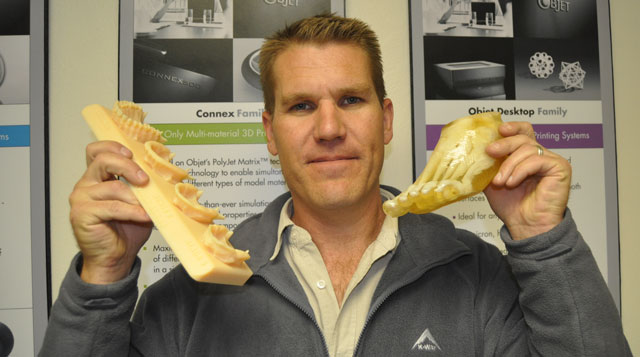
Jacques Kleynhans with objects printed in a 3D printer

Another application could be in car manufacturing, where companies could build prototype automotive parts and test these thoroughly before putting them into production. “Image a manifold for water – you can print it, check that the clips work and that the hoses fit. You can quickly verify the design before going into manufacturing.”

Kleynhans says German sports clothing manufacturer Adidas has 10 3D printers that it uses to test shoe designs. It uses the system like a “3D fax machine”. It creates designs in software, encrypts the files and e-mails them to its offices around the world. “The very next day, they all have a physical sample of the shoe,” he says.

“The product development cycle has come down substantially, which means you can get to market quicker and start selling quicker,” he adds.

The technology can also be used for testing consumer products. New toy designs, for example, can be printed and given to a room full of three-year-olds. The toys they take a keen interest in are the ones that are likely to succeed in the market.

Some industries are even using 3D printers to produce final product. Dental laboratories, for example, have started using it to do away with the need for silicone moulds and other casts. “Now, dentists can scan your mouth digitally using a pen-shaped scanner, send the file to the lab, where it prints a model with the tooth and without it. They design the whole tooth digitally and nothing is done by hand.”

Another application is in printing hearing aids. Because everyone’s ear is shaped differently, it makes sense to use 3D printing to create them, complete with the necessary holes for the electronics.

Hobbyist market
Most computer-aided design and manufacturing software is able to read and manipulate the files — typically Standard Tessellation Language (STL) files — to create 3D prints. STL files are loaded into printing software, which then works out the best orientation and “cuts” the print into slices and sends those slices to the 3D printer, which then builds the output by depositing materials in thin layers until a product is created.

Kleynhans says Objet used its first range of 3D printers, called Eden, to print all of the prototype parts for its subsequent 3D printers. “It used its own machines to build its own machines,” he says.

The next frontier, Kleynhans says, is the home and hobbyist market, where people may want the ability to build parts that are not readily available. Objet doesn’t play in this space, but a growing number of companies are focusing on it, typically with fused deposition modelling technology. “If you’re not worried about having the greatest finish or resolution, then the result isn’t bad.”

There’s already a keen hobbyist market developing, with thousands of free 3D models available to consumers via websites such as Trimble SketchUp, which was previously owned by Google. People can download STL files and literally print the products in their homes.  — (c) 2012 NewsCentral Media

Share this article

  • Lesego

    Wait until you get a ‘printed’ p*nis enlargement advertisement at the robot… won’t be as cool anymore.

  • http://twitter.com/TsipaA Gomi A. Thobejane

    cool stuff right there.

  • Xumlungu

    I saw one of the models DermaPlasTech had at an expo. The quality was amazing and even showed different materials. Man I wish I could have one of the these proper models at home

  • http://www.3d-printer.co.za Bernhard Vogt

    The hobbyist market is already booming in South Africa. 3D printers are already available for under R10 000. There are probably more than 2000 of these machines floating around in SA already. Recently the Fabbster 3D printer was launched which is aimed more at the consumer market – or the less technically challenged – and print quality rivals that of machines costing as much as R200 000.

  • http://www.cartridgemonkey.com David

    Places like shapeways.com allow you to upload your CAD design and then they will print it off for you and deliver it.

  • Greg Mahlknecht

    @Bernard – I see you guys are the local resellers for that Fabster – is that currently the best “affordable” 3D printer? How does it compare to the Thing-O-Matic and Makerbot Replicator? Do you have prices on the printers and consumables?

  • http://shyentrepreneur.com TJ Mollahan

    These are the future. As you say 3d printing fits so well into the build to order market place. I am looking forward as to how the small business and entrepreneur will be able to take advantage of the technologies. Will additive manufacturing ever fully replace subtractive manufacturing? I don’t think so but only the future will tell.

  • http://www.facebook.com/mgamanya Mark Gamanya

    Now is the time to study law. Intellectual Property Lawyers are going to make a killing with this technology. Patented stuff and designs being reproduced for sale in your own garage. Just wait and see.

  • http://twitter.com/FriedmanUnit Friedman Unit

    It’s a cool micro-manufacturing device. It is not a printer — “a machine for printing text or pictures onto paper, esp. one linked to a computer.”

    Again, it’s very cool, and will have lots of applications and impacts. It’s just misleading to call it a printer, journalists should not play into this marketing hype. ‘Additive manufacturing’ is the technical name.

    What material(s) does this one use to create the 3-dimensional objects? Wikipedia has a good article on this:
    Different machines use different base materials:
    Additive technologies
    Base materials

    Selective laser sintering (SLS)
    Thermoplastics, metals powders, ceramic powders

    Direct metal laser sintering (DMLS)
    Almost any alloy metal

    Fused deposition modeling (FDM)
    Thermoplastics, eutectic metals

    Stereolithography (SLA)
    photopolymer

    Laminated object manufacturing (LOM)
    Paper, foil, plastic film

    Electron beam melting (EBM)
    Titanium alloys

    Powder bed and inkjet head 3d printing

    Plaster-based 3D printing (PP)
    Plaster, Colored Plaster

  • http://www.facebook.com/jacques.a.kleynhans Jacques Arno Kleynhans

    Of all the technologies you describe below OBJET do not fit into any. It is true OBJET is additive manufacturing as opposed to subtractive but it truly resembles a printing process. Just like a printer jets ink onto paper we jet liquid plastic onto a plate and by introducing the Z axis we can move that plate away from the head in incremental steps thereby building layer by layer. The heads are in fact high end Inkjet printing heads. So yes it is printing but in 3d – no hype. Check out the process on http://www.objet.com or contact us at Demaplastech.

  • Franc

    The image at the top shows an adjustable spanner created on an Objet 3D printer. Surely this is only for show as it will not be able to handle the stresses required by a real spanner? It may look identical, but cannot do the job?

  • Xumlungu

    Wow. That stopped the party – congrats

  • Xumlungu

    Nope – I don’t think this prints real spanners – but I like your line of thinking

  • Schalk

    Yes but 3D printers are generally used for rapid prototyping and in this case if the 3D printed shifting spanner prototype is successful it can be given to the manufacturer with the necessary CAD files to go straight into manufacturing whereas previously the manufacturer had to cast or machine a lot of prototypes until they’ve finally reached a product which is suitable for market. Imagine how time consuming and expensive it must be each time to prototype a product on a manufacturing machine like a massive CNC machine.

  • KapCarl

    If printed in Objet’s ABS-like material, the wrench will function as a real wrench. The material is made to simulate the stength and toughness of ABS-grade engineering plastics. You can see how it is 3d printed and how the wrench functions in this video: http://ow.ly/bW8lf Disclaimer – I work for Objet.

Why TechCentral?

We know that as a prospective advertiser, you are spoilt for choice. Our job is to demonstrate why TechCentral delivers the best return for your advertising spend.

TechCentral is South Africa’s online technology news leader. We don’t say that lightly. We believe we produce the country’s best and most insightful online tech news aimed at industry professionals and those interested in the fast-changing world of technology.

We provide news, reviews and comment, without fear or favour, that is of direct relevance to our fast-expanding audience. Proportionately, we provide the largest local audience of all technology-focused online publishers.

We do not constantly regurgitate press releases to draw in search engine traffic — we believe websites that do so are doing their readers and advertisers a disservice. Nor do we sell “editorial features”, offer advertising “press offices” or rely on online bulletin-board forums of questionable value to advertisers to bolster our traffic.

TechCentral, which is edited and written by award-winning South African journalists, cares about delivering top-quality content to draw in the business and consumer readers that are of most interest to technology advertisers.

We’d like the opportunity to demonstrate the value of directing a portion of your advertising budget to TechCentral, whether your company is in the technology field or not. Numerous opportunities exist for companies interested in reaching our audience of key decision-makers in South Africa’s dynamic information and communications technology sector. We offer packages that will deliver among the best returns on investment available in the online technology news space.

For more information about advertising opportunities, and how your organisation can benefit by publicising itself on TechCentral, please call us on 011-792-0449 during office hours. Or send us an e-mail and ask for our latest rate card and brochure.