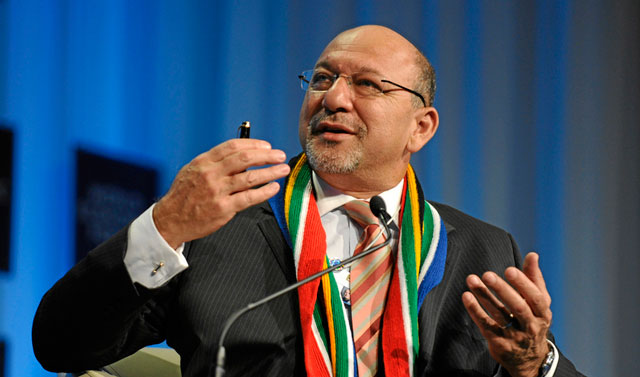
The National Planning Commission’s revised National Development Plan, handed over to President Jacob Zuma by planning minister Trevor Manuel on Wednesday, has raised the idea of separating Telkom structurally into two businesses, one focused on backhaul operations and the other on retail.
The National Development Plan states that to achieve the country’s information and communications technology (ICT) goals it must have a coordinated ICT strategy and plan, a key aspect of which would be the establishment of a common carrier network.
This could “possibly” be achieved by “structurally separating Telkom’s backbone operations from its retail services [or] at least applying open-access policies to encourage sharing of certain elements of the backbone fibre network without discouraging private long-term investment”.
The revised development plan has made significant changes to its proposals for the ICT industry, tightening up the wording and making it clear that the commission is in favour of free-market competition, coupled with effective regulation, to deliver broadband and other telecommunications services affordably to consumers.
The revised plan concedes that the performance of “most state interventions in the ICT sector has been disappointing”.
It says, too, that it is necessary to address the “inherent conflict of interest” between government’s role as a competitive player in the market through Sentech, Broadband Infraco and its majority shareholding in Telkom, and its role as policy maker. Similar tensions exist at local government level, the report says.
“SA has lost its status as continental leader in Internet and broadband connectivity. The price of services and equipment remains a significant barrier to expanding mobile-phone and fixed-line use, with limited network competition further increasing costs.”
The document laments what it describes as the “ineffectual” regulation of Telkom’s dominance in SA telecoms, which it says has resulted in an increase in the cost of services and products and inhibited investment in business process outsourcing and offshore IT-enabled services.
“Telkom’s monopoly has seen deterioration in fixed-line connections that will further undermine SA’s future competitiveness unless it is addressed.”
Abandoning fixed lines for mobile broadband alternatives is also no solution, the plan argues. “This may lock South Africans out of global networks in the longer term as applications in other countries are increasingly based on ultra high-speed ‘fibre-to-the-premises’ networks.”
Constraining factors have included little evidence of an effective strategy to ensure that connectivity in SA keeps up with connectivity in peer countries; policy constraints, weaknesses in institutional arrangements, conflicting policies, regulatory failure and limited competition; and the ability of the Independent Communications Authority of SA to facilitate a more open market.
“In the very short term, and well in advance of 2030, the state will need to re-establish the shape and nature of its participation in the sector,” the plan reads. “A new policy framework will be needed to realise the vision of a fully connected society. A key issue will be to decide on the role of state infrastructure interventions, [which] will have to balance the priority goal of achieving affordable and truly universal access to communications services while recognising the general efficiencies that may be derived from the application of private capital in economic activity.
“In future, the state’s primary role in the ICT sector will be to facilitate competition and private investment, to ensure effective regulation where market failure is apparent, and to intervene directly to meet specific social goals,” it says. “Direct involvement will be limited to interventions to ensure universal access and to help marginalised communities develop the capacity to use ICTs effectively.”
The report adds that experience elsewhere in the world “demonstrates that private-sector participation and competition, coupled with effective regulation, have the potential to deliver lower prices and improved quality and speed of service. SA needs to commit to intensifying competition in the ICT sector.”
It also needs to streamline spectrum allocation and ensure that spectrum that will be freed up through the migration from analogue to digital terrestrial television is made available to telecoms operators as quickly as possible. As in the previous version of the plan, it calls for spectrum to be made fully tradeable.
Spectrum policy should favour competition but incumbent operators should not be excluded from gaining access to bands needed for expansion or to apply new technologies.
Apart from raising the idea of a possible structural separation of Telkom, the report says that for the country to achieve its goals in ICT, a national “e-strategy” is needed that cuts across government departments and industry sectors.
A review of the market structure is also needed to analyse the benefits and costs of duplicating versus sharing infrastructure given that radio frequency spectrum is limited. — (c) 2012 NewsCentral Media
- Image: World Economic Forum