
Close Menu
TechCentralTechCentral

    Subscribe to the newsletter

    Get the best South African technology news and analysis delivered to your e-mail inbox every morning.

    Facebook X (Twitter) YouTube LinkedIn
    WhatsApp Facebook X (Twitter) LinkedIn YouTube
    TechCentralTechCentral
    • News
      The real reason Absa wrote off R2.4-billion in software - Johnson Idesoh

      The real reason Absa wrote off R2.4-billion in software

      27 March 2026
      MTN Group shakes up board with five new directors

      MTN Group shakes up board with five new directors

      27 March 2026
      Anoosh Rooplal

      TCS | Anoosh Rooplal on the Post Office’s last stand

      27 March 2026
      Global crackdown on children's screen time gathers pace

      Global crackdown on children’s screen time gathers pace

      27 March 2026
      Big Tech's Big Tobacco moment has arrived

      Big Tech’s Big Tobacco moment has arrived

      27 March 2026
    • World

      Apple plans to open Siri to rival AI services

      27 March 2026
      It's official: ads are coming to ChatGPT

      It’s official: ads are coming to ChatGPT

      23 March 2026
      Mystery Chinese AI model revealed to be Xiaomi's

      Mystery Chinese AI model revealed to be Xiaomi’s

      19 March 2026
      A mystery AI model has developers buzzing

      A mystery AI model has developers buzzing

      18 March 2026
      Samsung's trifold gamble ends in retreat

      Samsung’s trifold gamble ends in retreat

      17 March 2026
    • In-depth
      The last generation of coders

      The last generation of coders

      18 February 2026
      Sentech is in dire straits

      Sentech is in dire straits

      10 February 2026
      How liberalisation is rewiring South Africa's power sector

      How liberalisation is rewiring South Africa’s power sector

      21 January 2026
      The top-performing South African tech shares of 2025

      The top-performing South African tech shares of 2025

      12 January 2026
      Digital authoritarianism grows as African states normalise internet blackouts

      Digital authoritarianism grows as African states normalise internet blackouts

      19 December 2025
    • TCS
      Meet the CIO | HealthBridge CTO Anton Fatti on the future of digital health

      Meet the CIO | Healthbridge CTO Anton Fatti on the future of digital health

      23 March 2026
      TCS+ | Arctic Wolf unpacks the evolving threat landscape for SA businesses - Clare Loveridge and Jason Oehley

      TCS+ | Arctic Wolf unpacks the evolving threat landscape for SA businesses

      19 March 2026
      TCS+ | Vox Kiwi: a wireless solution promising a fibre-like experience - Theo van Zyl

      TCS+ | Vox Kiwi: a wireless solution promising a fibre-like experience

      13 March 2026
      TCS+ | Flipping the narrative on AI in the Global South - Josefin Rosén

      TCS+ | Flipping the narrative on AI in the Global South

      13 March 2026
      TCS | Sink or swim? Antony Makins on how AI is rewriting the rules of work

      TCS | Sink or swim? Antony Makins on how AI is rewriting the rules of work

      5 March 2026
    • Opinion
      South Africa's energy future hinges on getting wheeling right - Aishah Gire

      South Africa’s energy future hinges on getting wheeling right

      10 March 2026
      Hold the doom: the case for a South African comeback - Duncan McLeod

      Apple just dropped a bomb on the Windows world

      5 March 2026
      VC's centre of gravity is shifting - and South Africa is in the frame - Alison Collier

      VC’s centre of gravity is shifting – and South Africa is in the frame

      3 March 2026
      Hold the doom: the case for a South African comeback - Duncan McLeod

      Hold the doom: the case for a South African comeback

      26 February 2026
      The AI fraud crisis your bank is not ready for - Andries Maritz

      The AI fraud crisis your bank is not ready for

      18 February 2026
    • Company Hubs
      • 1Stream
      • Africa Data Centres
      • AfriGIS
      • Altron Digital Business
      • Altron Document Solutions
      • Altron Group
      • Arctic Wolf
      • Ascent Technology
      • AvertITD
      • Braintree
      • CallMiner
      • CambriLearn
      • CYBER1 Solutions
      • Digicloud Africa
      • Digimune
      • Domains.co.za
      • ESET
      • Euphoria Telecom
      • HOSTAFRICA
      • Incredible Business
      • iONLINE
      • IQbusiness
      • Iris Network Systems
      • LSD Open
      • Mitel
      • NEC XON
      • Netstar
      • Network Platforms
      • Next DLP
      • Ovations
      • Paracon
      • Paratus
      • Q-KON
      • SevenC
      • SkyWire
      • Solid8 Technologies
      • Telit Cinterion
      • Telviva
      • Tenable
      • Vertiv
      • Videri Digital
      • Vodacom Business
      • Wipro
      • Workday
      • XLink
    • Sections
      • AI and machine learning
      • Banking
      • Broadcasting and Media
      • Cloud services
      • Contact centres and CX
      • Cryptocurrencies
      • Education and skills
      • Electronics and hardware
      • Energy and sustainability
      • Enterprise software
      • Financial services
      • HealthTech
      • Information security
      • Internet and connectivity
      • Internet of Things
      • Investment
      • IT services
      • Lifestyle
      • Motoring
      • Policy and regulation
      • Public sector
      • Retail and e-commerce
      • Satellite communications
      • Science
      • SMEs and start-ups
      • Social media
      • Talent and leadership
      • Telecoms
    • Events
    • Advertise
    TechCentralTechCentral
    Home » In-depth » Balloons: Google’s plan to connect the world

    Balloons: Google’s plan to connect the world

    By Craig Wilson15 June 2013
    Twitter LinkedIn Facebook WhatsApp Email Telegram Copy Link
    News Alerts
    WhatsApp
    Project-Loon-640
    Inflating a Project Loon balloon shortly before launch

    First it was self-driving cars, then Google Glass, and now with Project Loon, Google is turning its attention to … balloons. The company has begun a pilot project in New Zealand using high-pressure balloons in the stratosphere to provide Internet connectivity “at 3G speeds” and, if it goes well, Google wants to encircle the planet with them, with South Africa high on the list of planned countries that will run pilots.

    Though the project may sound like something out of a science-fiction film, or like the ramblings of a madman — one of the motivations for its amusing name — Google is convinced the project is feasible.

    Project Loon balloons will float about 19km above the earth’s surface, twice the altitude at which commercial aircraft fly and above unpredictable atmospheric weather systems. Each pumpkin-shaped balloon is the size of a light aircraft and is roughly 15m in diameter.

    The superpressure balloons are designed to remain aloft for more than 100 days and travel around the earth on stratospheric wind currents. The direction and speed of the balloons will be controlled by raising or lowering them to different altitudes that correspond with different winds.

    Users connect to the balloon network using an antenna attached their building. The balloons relay connectivity from terrestrial Internet networks and can share connectivity between them. Consistent connectivity is provided by ensuring that as a balloon moves out of range, another takes it place.

    Because the balloons can share and distribute connectivity between them — acting as an airborne mesh network — it will also be possible to share connectivity from other regions if the terrestrial network in the coverage area is interrupted. This makes them ideally suited to providing connectivity in times of crisis.

    In theory, this also means Google could provide connectivity across an entire degree of latitude with a sufficiently large number of balloons. The company says the project depends on support from existing terrestrial service providers and isn’t intended to replace them.

    Each balloon is capable of serving an area with a 20km radius and a couple of hundred simultaneous users.

    Mike Cassidy, a project leader for Loon and director of product management at Google[x] — the part of the company that’s home to its self-driving cars and to Project Glass — says the idea is inspired by the fact that two-thirds of the world’s population don’t yet have access to the Internet.

    In addition to the terrestrial challenges presented by difficult terrain or inadequate network infrastructure, Cassidy says in many countries, particularly those in the southern hemisphere, a reliable Internet connection costs more than an average monthly income.

    The Project Loon balloons communicate with one another and with the ground using unlicensed radio spectrum in the 2,4GHz and 5,8GHz bands.

    Because the balloons are deployed at an altitude far lower than satellites — which are around 200km above the ground and higher — Cassidy says the connectivity they provide isn’t subject to the sort of high latency (the amount of time it takes a packet of data to make a round trip) that dogs satellite connectivity.

    Although Google isn’t willing to disclose how much it’s spending on Project Loon or how much each balloon costs, Cassidy says the balloons are “relatively inexpensive” and a fraction of the cost of satellites or high-altitude platforms like tethered blimps.

    Cassidy says one of key breakthroughs in conceptualising Project Loon was deciding that the balloons needn’t be tethered and would be allowed to move. Keeping them in fixed positions would have required fuel to power propellers or other solutions that would limit how much time they could spend aloft and would affect the cost.

    Each balloon is, however, equipped with a small propeller to add air to the balloons to adjust their altitude. “There’s a propeller that allows us to add air to make the balloons drop,” he says. This may sound counterintuitive, but that adding air makes the balloon descend due to the “rules of buoyancy”.

    Conversely, a valve allows air to be released if the balloon needs to be elevated. The balloons are made of polyethylene plastic roughly 0,08mm thick, and include solar panels to power them. The antennae, onboard computer and other electronic components are positioned beneath the solar panels.

    While each balloon includes a parachute in case of emergency, Cassidy says they can be brought back to earth with precision by forcing them to perform a controlled descent.

    The reason for using superpressure balloons is that even at night when temperatures drop, the pressure within them doesn’t fall sufficiently to alter their altitude. Cassidy explains that the balloons are only 5% full at launch but that the gas inside them expands as they get higher.
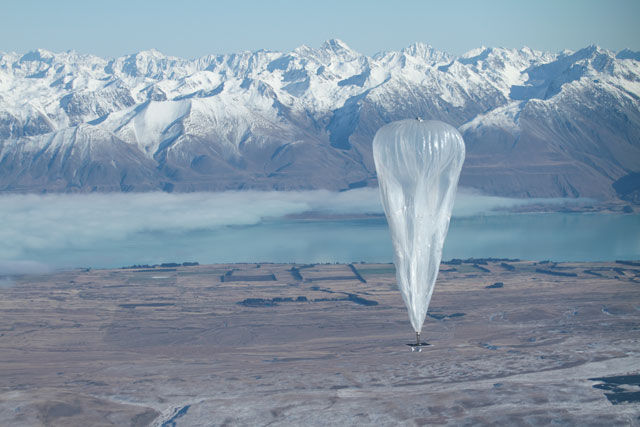
    Project-Loon-NZ-640
    A Project Loon balloon takes flight in New Zealand’s Canterbury region near Christchurch

    Google uses wind data from the US National Oceanic and Atmospheric Administration to calculate potential flight paths for the balloons and uses its vast computing power to control the balloons in groups in order to provide consistent connectivity.

    As part of the trial, which will service 50 locations in and around Christchurch in New Zealand, Google launched a total of 30 balloons last week. Fibre backhaul from the ground station is being supplied by Research and Education Advanced Network New Zealand (Reanzz), which operates a high-speed broadband network for the New Zealand education, research and innovation communities.

    Cassidy says New Zealand provides an excellent testing ground because outside of the cities, connectivity is often poor, a common problem in developing markets. “Over time we’d like to set up pilots in countries at the same latitude as New Zealand,” he says. “We’re looking at a band around 40 degrees and would naturally work north from there.”

    Does this mean South Africa could see a Project Loon trial? “We do want to reach South Africa in our trials,” Cassidy says. “We hope to include South Africa, Uruguay and other South American countries in our trial as soon we expand it.”

    Directing the balloons requires enormous computational power, something in which Google is well versed, and although the bulk of the balloons’ processes are automated, there remains an element of human control, especially during the testing phase.

    It’s not hard to imagine the potential uses for the sort of network Google is proposing when it comes to mobile devices. “We imagine someday you’ll be able to use your cellphone with your existing service provider to connect to the balloons and get connectivity where there is none today,” Cassidy says.  — (c) 2013 NewsCentral Media

    Follow TechCentral on Google News Add TechCentral as your preferred source on Google


    Google Mike Cassidy Project Loon
    WhatsApp YouTube
    Share. Facebook Twitter LinkedIn WhatsApp Telegram Email Copy Link
    Previous ArticleBackspace: ‘Functional separation’
    Next Article ZATS: Ep 262 – ‘An Apple a day’

    Related Posts

    Big Tech's Big Tobacco moment has arrived

    Big Tech’s Big Tobacco moment has arrived

    27 March 2026

    Apple plans to open Siri to rival AI services

    27 March 2026
    Major security alert for iPhone users

    Major security alert for iPhone users

    18 March 2026
    Company News
    Durban's finance leaders are done with AI theatre - Sage Intacct

    Durban’s finance leaders are done with AI theatre

    26 March 2026
    Defend your cloud with Altron Digital Business

    Defend your cloud with Altron Digital Business

    26 March 2026
    Why most Cisco partners leave money on the table at renewal time - Westcon-Comstor

    Why most Cisco partners leave money on the table at renewal time

    25 March 2026
    Opinion
    South Africa's energy future hinges on getting wheeling right - Aishah Gire

    South Africa’s energy future hinges on getting wheeling right

    10 March 2026
    Hold the doom: the case for a South African comeback - Duncan McLeod

    Apple just dropped a bomb on the Windows world

    5 March 2026
    VC's centre of gravity is shifting - and South Africa is in the frame - Alison Collier

    VC’s centre of gravity is shifting – and South Africa is in the frame

    3 March 2026

    Subscribe to Updates

    Get the best South African technology news and analysis delivered to your e-mail inbox every morning.

    Latest Posts
    The real reason Absa wrote off R2.4-billion in software - Johnson Idesoh

    The real reason Absa wrote off R2.4-billion in software

    27 March 2026
    MTN Group shakes up board with five new directors

    MTN Group shakes up board with five new directors

    27 March 2026
    Anoosh Rooplal

    TCS | Anoosh Rooplal on the Post Office’s last stand

    27 March 2026
    Global crackdown on children's screen time gathers pace

    Global crackdown on children’s screen time gathers pace

    27 March 2026
    © 2009 - 2026 NewsCentral Media
    • Cookie policy (ZA)
    • TechCentral – privacy and Popia

    Type above and press Enter to search. Press Esc to cancel.

    Manage consent

    TechCentral uses cookies to enhance its offerings. Consenting to these technologies allows us to serve you better. Not consenting or withdrawing consent may adversely affect certain features and functions of the website.

    Functional Always active
    The technical storage or access is strictly necessary for the legitimate purpose of enabling the use of a specific service explicitly requested by the subscriber or user, or for the sole purpose of carrying out the transmission of a communication over an electronic communications network.
    Preferences
    The technical storage or access is necessary for the legitimate purpose of storing preferences that are not requested by the subscriber or user.
    Statistics
    The technical storage or access that is used exclusively for statistical purposes. The technical storage or access that is used exclusively for anonymous statistical purposes. Without a subpoena, voluntary compliance on the part of your Internet Service Provider, or additional records from a third party, information stored or retrieved for this purpose alone cannot usually be used to identify you.
    Marketing
    The technical storage or access is required to create user profiles to send advertising, or to track the user on a website or across several websites for similar marketing purposes.
    • Manage options
    • Manage services
    • Manage {vendor_count} vendors
    • Read more about these purposes
    View preferences
    • {title}
    • {title}
    • {title}